




On GE13, Daim predicts less and opines more
COMMENT Because he was uncannily accurate on the results of the March 2008 general election, former finance minister Daim Zainuddin enjoys a reputation as a prognosticator of sorts.
His visage in the last week or so has been all over the Chinese press which, understandably, had sought him out on how GE13 would go.
In the immediate prelude to GE12, it was the Chinese press that first carried Daim's prescient predictions - that Penang, Selangor and Kedah would fall to the opposition - before the other language streams picked them up for their readerships.
No surprise, then, the Chinese press, in the final lap to GE13, has again interviewed Daim for his take...
COMMENT Because he was uncannily accurate on the results of the March 2008 general election, former finance minister Daim Zainuddin enjoys a reputation as a prognosticator of sorts.
His visage in the last week or so has been all over the Chinese press which, understandably, had sought him out on how GE13 would go.
In the immediate prelude to GE12, it was the Chinese press that first carried Daim's prescient predictions - that Penang, Selangor and Kedah would fall to the opposition - before the other language streams picked them up for their readerships.
No surprise, then, the Chinese press, in the final lap to GE13, has again interviewed Daim for his take.
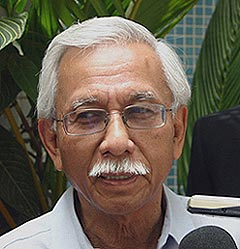 Having accurately called one throw of the general election dice, they think he would be useful at reading the tea leaves on the next.
Daim ( right ) loves this sort of thing. Long an inhabitant of the shadowy corners where politics intersects with business, he guards his privacy from which he departs from time to time to emerge, gnome-like, into the limelight with premonitions on matters that turn out to have tidal impact.
One such prediction, in 1994, shook the stock market following his "sell" prognosis. Another, in 2008, resulted in a shakedown of Umno-BN.
Clearly, to many in the media, the man has what in the industry is called star quality: the ability to generate the illusion that the enterprise in which he appears is better than it actually is.
But it appears that Daim, in his pre-GE13 interview phase, was not as keen on polls predictions as he was on party and personality assessments, and a rebuttal of charges that he had been the chief cause of Anwar Ibrahim's tribulations of 1998 which saw him expelled from government and Umno.
In the latter regard, it seemed that Daim was more interested in tendering what looked like a preemptive defence against the accusations that he was the "chief conspirator" behind Anwar's travails at that time.
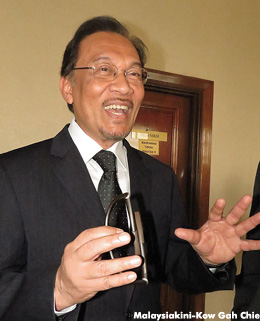 The non-Mandarin reading public cannot help but gain this impression from the substance of the two-part interview Daim gave to the
New Straits Times
which appeared in last Sunday's edition of the paper and in yesterday's daily version.
The non-Mandarin reading public cannot help but gain this impression from the substance of the two-part interview Daim gave to the
New Straits Times
which appeared in last Sunday's edition of the paper and in yesterday's daily version.
There Daim displays his scant regard for the training he has had as a lawyer by opining that "I want Najib to win because I don't think that Anwar is the right candidate to be prime minister because he will mess up the country..."
It is as if Daim's immersion in his zealously guarded privacy has insulated him from the more recent revelations - one set concerning the second sodomy case against Anwar, and another set having to do with statutory declarations made in respect of the Altantuya murder case - that pertain to the PM and, because the latter has not denied them, affect his worthiness to hold office.
It must take a bold man indeed - and that too one from a legal background - to hold forth magisterially on a pair of individuals' worthiness to hold high office and prefer for the role of PM the one who is seen in grave danger of being a felon to the other who has had all manner of accusations hurled against him that have yet to be proven and from a few of which has been exonerated.
It is a piece with the vast devastation of values that has occurred in this country that a former finance minister can presently engage in this travesty with a straight face.
Downfall of Salleh Abas
But this former economic czar, who came loaded with wealth to high ministerial office in 1984 and left after two stints in 2000 even richer than when he arrived, is not only saddled with the accusation that he was "chief conspirator" behind Anwar's fall in 1998, it is also bruited about that he was behind the impeachment of then Lord President Salleh Abas in 1988.
If there was a pivotal cause behind the moral turpitude in which the country is presently immersed, it was that impeachment event of 1988.
Word has it that Salleh came back from a judicial seminar he attended earlier that year in New Delhi and spoke to fellow judge, the late Hashim Yeop Sani, of being impressed with the way seminar participants had spoken of the need for jurists to be imbued with the "rights" of supplicants when deciding cases.
Hashim, a government-favouring flunkey, hurried to inform Daim of the chief justice's newfangled interest in a jurisprudence of "rights."
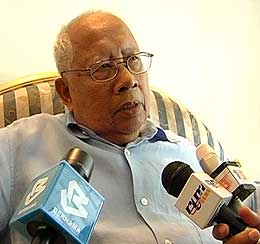 When Salleh (
left
) convened the full nine-member bench of the Supreme Court to hear the appeal of the case in which High Court judge, the late Harun Hashim, had ruled Umno an illegal body for having 13 deregistered branches participate in their presidential election of April 1987, Daim carried his misgivings about Salleh's "rights" inclinations to then-prime minister Dr Mahathir Mohamad who proceeded to advise the king on the Lord President's liability to impeachment.
When Salleh (
left
) convened the full nine-member bench of the Supreme Court to hear the appeal of the case in which High Court judge, the late Harun Hashim, had ruled Umno an illegal body for having 13 deregistered branches participate in their presidential election of April 1987, Daim carried his misgivings about Salleh's "rights" inclinations to then-prime minister Dr Mahathir Mohamad who proceeded to advise the king on the Lord President's liability to impeachment.
Salleh was duly impeached by an international tribunal of judges and with that development, the debasement of our judiciary began with assorted other deteriorations to the civic values of the country following in its train.
Salleh was not the only judge impeached. In the ensuing conflagration that engulfed the judiciary and shocked the nation, other senior and respected judges were impugned and sacked for their "misdeeds."
Mahathir was in the imperial phase of his long premiership, with dire consequences to anyone who made bold to step into his crosshairs, Anwar included.
Daim, with his skill at gliding in and out of the dark corners of Malaysian politics, likes to think that he can evade the zone of culpability for the misdeeds of the Mahathir era, just like the period's author.
The trend of recent developments and their likely electoral impact are running counter to that expectation.
His views on the parties and central personalities involved in GE13 are deeply coloured by the resultant anxiety.
TERENCE NETTO has been a journalist for four decades. He likes the occupation because it puts him in contact with the eminent without being under the necessity to admire them.


Are you sure you want to delete this comment?
This action cannot be undone.