




Pakatan's political tweaks for rural votes
COMMENT Pakatan Rakyat will have to push for internal reforms, move out of its comfort zone, and look beyond ethnicity and religion in order to win the rural vote.
The coalition has convinced urban dwellers that it can offer an alternative national government - by claiming 51 percent of the nation’s popular vote - and must now do the same for rural voters.
Pakatan must decide to invest in the party machinery in rural Peninsular Malaysia, Sarawak and Sabah, as well as address the impoverished living conditions of the rural populations.
Rural voters have limited access to information and education. Consequently, most have a virtually feudalistic understanding of the political process. They cannot be converted into enthusiasts of liberal democracy overnight, and history will take its course.
COMMENT Pakatan Rakyat will have to push for internal reforms, move out of its comfort zone, and look beyond ethnicity and religion in order to win the rural vote.
The coalition has convinced urban dwellers that it can offer an alternative national government - by claiming 51 percent of the nation’s popular vote - and must now do the same for rural voters.
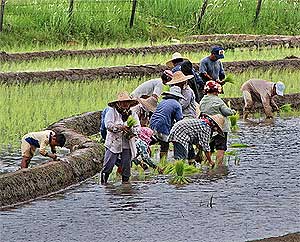 Pakatan must decide to invest in the party machinery in rural Peninsular Malaysia, Sarawak and Sabah, as well as address the impoverished living conditions of the rural populations.
Rural voters have limited access to information and education. Consequently, most have a virtually feudalistic understanding of the political process. They cannot be converted into enthusiasts of liberal democracy overnight, and history will take its course.
Pakatan controls the two wealthiest states, Selangor and Penang, but will never be able to compete with the BN’s financial clout.
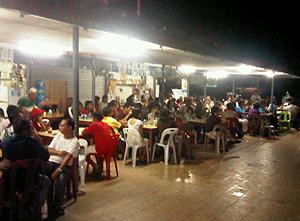
Thanks to BN’s largesse during elections, rural campaigns are welcomed with a festive air and are celebrated with ‘angpow’ windfalls and free food. Doling out cash certainly does not hurt BN’s chances, but only partly explains its enduring success.
BN’s BR1M handouts may have given a modest boost to its GE13 support in rural seats, since many families there live off the land or the sea, and earn little cash.
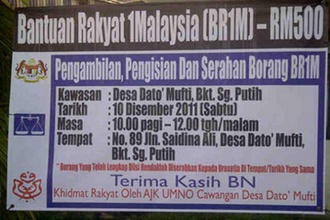 On the other hand, BR1M may not have reached many rural Sarawakian and Sabahan communities, because they were unaware of BR1M, or could not travel to collect the forms and cash.
During the GE13 campaign, Sarawak BN chief Abdul Taib Mahmud also promised community leaders a hike of between RM400 and RM650 in their monthly allowance. This election gimmick may have convinced some village chiefs to bolster BN support in their longhouses, but it was unlikely to have been decisive.
Instead, the greatest incentives to support BN are the fear of the government depriving rural people of basic services and financial aid if BN candidates lose in isolated constituencies, and the psychological dependency on BN as ‘perintah’ (or absolute ruler).
These sentiments have been ingrained into many rural communities, via RTM and TV3 , newspapers, and the civil service. Fear is a powerful motivation.
 According to PSM’s Sungai Siput MP Dr Michael Jeyakumar Devaraj
(left)
, “there is still a deep-seated fear among a significant portion of the the Malay population that they will ‘lose control’… they fear that they will be neglected by a (Pakatan) government that places too much emphasis on meritocracy”.
According to PSM’s Sungai Siput MP Dr Michael Jeyakumar Devaraj
(left)
, “there is still a deep-seated fear among a significant portion of the the Malay population that they will ‘lose control’… they fear that they will be neglected by a (Pakatan) government that places too much emphasis on meritocracy”.
Jeyakumar emphasised that Pakatan has to be “sensitive to the anxieties of the Malay community who still make up the majority of Malaysian families earning less than RM3,000 per month. And all of us have to share the responsibility of reassuring them that there will be an enhancement of the aid they currently receive when (Pakatan) takes over. That political task cannot be ‘sub-contracted’ to PAS!”
Quell fear, expand services
These arguments hold true for Sarawak and Sabah’s rural populations too. DAP and PKR have to quell fear in all states, by reaching out to rural communities.
DAP and PKR must expand service centres in small towns, offer voluntary legal and social services, provide scholarships to bright students - in short, do more of the ground work that PAS has been doing.
This accumulation of social capital allowed the eventual political ascendancy of the Muslim Brotherhood in Egypt, Solidarity in Poland and Hamas in Gaza, under tougher conditions than our own.
Pakatan cannot - and if it is to offer a true alternative, must not - win power by buying votes.
 In a cautionary tale, Parti Bansa Dayak Sarawak (PBDS) nearly unseated Taib
(left)
in a pivotal state assembly election in 1987. PBDS showered tycoons’ money around Dayak constituencies, and promised that “Dayakism” could deliver political dominance over Malays and Chinese.
In a cautionary tale, Parti Bansa Dayak Sarawak (PBDS) nearly unseated Taib
(left)
in a pivotal state assembly election in 1987. PBDS showered tycoons’ money around Dayak constituencies, and promised that “Dayakism” could deliver political dominance over Malays and Chinese.
PBDS’s racial rhetoric cost the party non-Dayak votes, while its backers’ pockets were not as deep as Taib’s. PBDS leaders lost narrowly, and finally returned to Taib’s BN in 1993.
Taib dismembered PBDS, and a generation later, former PBDS firebrand leaders, such as James Masing, have become Taib’s apologists, and enforcers of native customary rights land takeovers.
Pakatan would do well to continue to strengthen and emphasise its multicultural and ‘welfare state’ policies - despite Pakatan’s obvious ‘big business’ leanings and internal contradictions - instead of trying to win an impossible duel with BN on the ethnic politics or vote-buying battleground.
Criticism and candidates crucial
Pakatan can invest in winning hearts and minds by listening to these rural communities. This is a fine skill that the clumsy BN could never cultivate, trapped within its ethno-capitalist, and corruption-riddled, top-down development model.
 Why did rural communities vote for PKR in two rural state assembly seats, Ba’kelalan and Krian, in 2011, but not in the corresponding parliamentary contests in 2013?
Why was the DAP’s mobilisation of its machinery sluggish in rural seats, even in those contested by the DAP itself, such as Serian and Lawas? Why did PAS win only 12-21 percent of the ballot in the five seats it contested?
The only way to answer these difficult questions is to sit down with these communities, as well as unsuccessful candidates, and to gather feedback and constructive criticism.
All three Pakatan parties are unwilling to contemplate a merger, although that must be an eventual aim. They must at least conduct a vigorous post-mortem debate in rural seats, particularly in Sabah and Sarawak.
The lukewarm support for the State Reform Party (Star) and the Sabah Progressive Party in Sabah, as well as for Star and the ‘BN-friendly’ debutante Sarawak Workers’ Party in Sarawak, must provide Pakatan momentum to establish a more united front in the next polls.
In GE13, Sarawak and Sabah were not troubled by three-cornered Pakatan contests (with the exception of Labuan), a respite from the mad scramble in previous elections. Pakatan must build on this, and begin immediate negotiations on seat allocations for 2016 and 2018, well in advance.
 ‘Parachute’ candidates are best avoided, despite the scintillating success of the DAP’s Lim Kit Siang
(right)
and Liew Chin Tong in Johor. Candidates must be vetted thoroughly for financial solvency and party loyalty, and must start groundwork in their rural constituencies from now.
‘Parachute’ candidates are best avoided, despite the scintillating success of the DAP’s Lim Kit Siang
(right)
and Liew Chin Tong in Johor. Candidates must be vetted thoroughly for financial solvency and party loyalty, and must start groundwork in their rural constituencies from now.
This does not preclude emulating DAP’s tactical breakthrough in Johor. Some Pakatan leaders enjoy popularity among all ethnic groups, and would make convincing rural candidates, if they begin grassroots work there now.
In Sarawak, these include state assembly representatives such as the DAP’s Chong Chien Jen in Kota Sentosa and PKR’s See Chee How in Batu Lintang, both in Kuching, and the DAP’s Chiew Chin Sing in Kidurong, Bintulu.
 Pakatan might consider bringing in new candidates for these relatively safe, mainly urban seats, thereby freeing these charismatic and industrious leaders to build the party infrastructure in rural seats around Kuching or Bintulu.
The intriguing suggestion of moving urban voters’ addresses to rural constituencies is unlikely to make a formidable impact.
Civil society and Pakatan must also embrace the tasks of registering rural voters, getting Mykad issued to marginalised groups such as the Penan, and training polling and counting agents.
The Malaysian Election Observers’ Network has already done sterling work in small towns and villages in Sarawak. Peninsular Malaysian civil society must support this social bridging work energetically.
There is no time like the present.
Related stories
Why the 'urban tsunami' stopped at the coast
'BN=perintah' formula wins Sarawak rural seats
Next: Pakatan’s socio-economic tweaks for rural votes
KERUAH USIT is a human rights activist - ‘anak Sarawak, bangsa Malaysia’ - and can be contacted at keruah_usit@yahoo.com


Are you sure you want to delete this comment?
This action cannot be undone.