




Wan Ahmad not fit to talk about 'fair' redelineation
MP SPEAKS It was reported in The Star on May 26, 2013, that Election Commission (EC) deputy chairperson Wan Ahmad Wan Omar had reassured the public of “utmost transparency” in the upcoming redelineation exercise.
MP SPEAKS It was reported in The Star on May 26, 2013, that Election Commission (EC) deputy chairperson Wan Ahmad Wan Omar had reassured the public of “utmost transparency” in the upcoming redelineation exercise.
He also tried to defend the EC against allegations of gerrymandering constituencies in favor of the BN by saying that “many people are unaware of how the review is conducted and merely believe some political parties which accuse us of not doing our job in accordance with the law”.
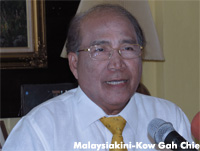 The fact of the matter is that the EC did not do their job in accordance with the law, but was in fact heavily biased towards the BN during the 2003 redelineation exercise when Wan Ahmad (
left
) was also the EC deputy chairperson then.
The fact of the matter is that the EC did not do their job in accordance with the law, but was in fact heavily biased towards the BN during the 2003 redelineation exercise when Wan Ahmad (
left
) was also the EC deputy chairperson then.
This was most obvious in the state of Kedah where no parliamentary and state seats were added (because the BN lost their two-thirds’ control of the state assembly after losing the 2000 Lunas by-election), but boundaries were redrawn with the sole intention of helping Umno win back some of the parliamentary seats which it had lost in the 1999 general election.
The EC has tried to defend the disparity in the number of voters per seat by referring to the ‘rural weightage’ principle where rural areas - with poorer transportation networks and a larger area of coverage - should have a smaller number of voters compared to urban areas, which are more compact and are more accessible.
However, during the 2003 redelineation exercise in Kedah, this principle was clearly violated. Non-Malay voters were moved out from the then safe seats of Alor Setar into the PAS-held seats of Kuala Kedah and Pokok Sena. In addition, non-Malay voters were moved out from the then safe seat of Merbok into the PAS held seat of Jerai. Meanwhile, pro-Umno/BN majority areas in the then safe seat of Padang Serai were moved to the PAS held seat of Baling.
This blatant gerrymandering on the part of the EC was obvious when we compared the number of voters in and the area of coverage of these seats in 2003.
'Disparity still seen in GE13 figures'
For example, P9 Alor Setar, despite being the most urbanised seat with the smallest area (sq km) among all parliament seats in Kedah, actually had fewer voters (56,007) compared to the adjoining larger and less urban seats of P8 Pokok Sena (64,912 voters) and P10 Kuala Kedah (73,942 voters). This disparity can still be seen in the 2013 general election figures. Alor Setar now has 69,189 voters compared to 80,916 for Pokok Sena and 95,534 for Kuala Kedah.
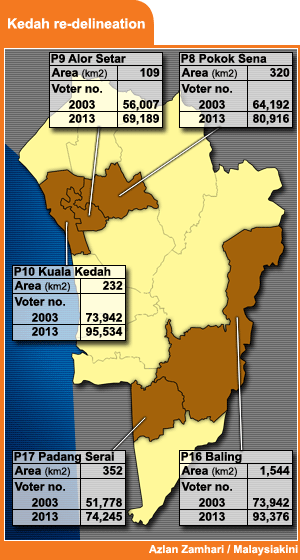 An even more obvious case is that of P16 Baling, a largely rural seat in Kedah. The 2003 delimitation exercise increased the area of coverage for Baling from 1,107 sq km to 1,544 sq km, which makes the size of the Baling seat slightly smaller than the entire state of Malacca. This was because one of the strong Umno state seats in the adjoining Padang Serai parliamentary constituency - Kuala Ketil - was moved to Baling.
The result was that Padang Serai, a much more urban seat, ended up with fewer voters (51,778) compared to the much larger Baling (with 73,942 voters). This disparity can still be seen from the GE13 figures. Baling now has 93,376 voters (second largest in Kedah) compared to only 74,425 voters for the more urbanised seat of Padang Serai.
The ‘rural weightage’ principle was clearly not followed by the EC during the 2003 redelineation exercise in the state of Kedah. In an ironic twist of fate, this blatant gerrymandering ended up hurting the BN in 2008 because the non-Malay voters, who were considered hardcore BN supporters who would never vote for PAS, switched their votes to the opposition in the 2008 general election.
As someone who has studied the redelineation exercise in detail, I can safely say that I am not one of the people ‘who are not aware of how the review is conducted’. Which is why I can also safely say that the EC was anything but impartial in the 2003 redelineation exercise.
Among its members, Wan Ahmad is the only one who was part of the EC during the biased 2003 redelineation exercise. As such, he is the least qualified member of the EC to defend its record in ensuring a fair redelineation exercise that will start at the end of the year.
As long as Wan Ahmad is one of the EC members who will oversee the upcoming redelineation exercise, I have no confidence whatsoever that it will be done transparently, fairly and in accordance to the ‘one-man, one-vote’ principle.
ONG KIAN MING is MP for Serdang and DAP election strategist.


Are you sure you want to delete this comment?
This action cannot be undone.