




Politicians interfered in action against illegals, RCI told
SABAH RCI Former Sabah Immigration Department deputy director Ismail Ahmad today said that politicians had attempted to interfere in the agency’s enforcement work against illegal immigrants.
SABAH RCI Former Sabah Immigration Department deputy director Ismail Ahmad today said that politicians had attempted to interfere in the agency’s enforcement work against illegal immigrants.
Testifying before the royal commission on inquiry (RCI) on immigrants in Sabah, Ismail said that some state assemblypersons had asked the Immigration Department not to act against people deemed to be aligned to them.
“Yes, it happens. There has been such cases (of political interference).
“The YBs said, these are our people, don’t disturb them,” he testified at the Kota Kinabalu court complex this morning.
However, Ismail did not name names or provide specific examples.
Due to such incidences, Ismail, who led a lab in 2010 on how to resolve the flood of foreigners in Sabah, had proposed that a letter be issued to all state assemblypersons warning them against interfering in the enforcement activites of the relevant authorities.
Furthermore, a proposal was also made to order all local authorities to assist and cooperate with the Immigration Department in enforcement operations against illegal immigrants.
“These proposals have been agreed upon, the Sabah Chief Minister (Musa Aman) had also consented to it,” said Ismail, who is now Sabah National Registration Department (NRD) director.
Acknowledging the immigrant problem in Sabah, Ismail estimated there was over 800,000 foreigners in the state, making that one foreigner for every Sabahan.
Ismail said the government was working on a number of measures to resolve this problem including a proposal to make 30 percent local workforce compulsory for companies by 2015.
'Onus of citizenship on NRD'
Also testifying today was Sabah Election Commission director Mohd Idrus Ismail who said the onus of determining the validity of a voter's citizenship lies with the NRD.
"For the electoral roll, we depend on (blue) identity cards but in terms of the validity of citizenship we are not the authoritative body to decide that.
"We only follow the documents that is issued by the NRD," he said, adding that this was done through the Agency Linked-Up System (Alis) which hooks up NRD and EC as well as other agencies.
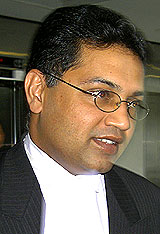 However, conducting officer Manoj Kurup (
left
) pointed out that there had been widespread incidences where foreigners had illegally obtained valid blue identity card and thus were able to also get into the electoral roll.
However, conducting officer Manoj Kurup (
left
) pointed out that there had been widespread incidences where foreigners had illegally obtained valid blue identity card and thus were able to also get into the electoral roll.
At this, Mohd Idrus said it was up to the RCI to decide how to rectify the problem and added that the humanitarian factor also has to be considered as such recipients now have families in Sabah after living here for decades.
Mohd Idrus also viewed calls for automatic registration of voters positively, but went a step further to suggest a complete re-registration of the over 13 million voters on the electoral roll.
"It would be better to first re-register everyone but this will depend on the commitment of the RCI and the government," he said.
Mohd Idrus explained that the electoral roll had been used since independence and some information may not be up to date.
"For example, we only remove death voters from the electoral roll after we get acknowledgement from the NRD.
"But in the interiors, they may just bury their dead under their house and not inform NRD because it is inconvenient, then the name of that person will remain on the electoral roll," he said.
A total of seven witnesses took the stand during he fourth day of the sixth RCI hearing session today.
To date, 168 witnesses have testified since the RCI hearings first started in January this year.


Are you sure you want to delete this comment?
This action cannot be undone.