




Chinese business to support GST if income tax is cut
The Associated Chinese Chambers of Commerce and Industry of Malaysia (ACCCIM) will support the implementation of the goods and services tax (GST) provided the income tax is simultaneously reduced.
Such a move is important to ensure a fair policy that will balance the people's burdens, ACCCIM president Lim Kok Cheong told a press conference today.
The Associated Chinese Chambers of Commerce and Industry of Malaysia (ACCCIM) will support the implementation of the goods and services tax (GST) provided the income tax is simultaneously reduced.
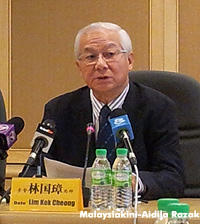 Such a move is important to ensure a fair policy that will balance the people's burdens, ACCCIM president Lim Kok Cheong (right) told a press conference today.
It is possible for the government, Lim added, to announce the implementation of the GST when the Budget 2014 is tabled in Parliament on Oct 25.
With this, Lim urged the government to confirm the exact implementation date so that all quarters would be ready for it.
He added that ACCCIM wanted the GST tax rate not to exceed four percent.
Among all 10 Asean countries, Lim said, only Malaysia, Brunei and Myanmar do not charge GST, while the tax rates in seven other countries range between seven and 12 percent.
He opined that basic necessities of people’s daily life like sugar, flour, cooking oil and rice should be exempted from GST.
“It’s logical if GST is only implemented on luxury items,” said Lim.
‘Foreign labour enjoying more benefits’
Meanwhile, ACCCIM secretary-general Low Kian Chuan, who was also at the press conference, said foreign workers in Malaysia were enjoying more benefits than the local people.
In a circular issued by the Human Resource Ministry in July, Low said, foreign workers were no longer entitled to go through a work probation period.
This, he said, has raised dissatisfaction among the local workers, who had to go through the probation period before being confirmed as employees of a company.
According to the Minimum Wage Order 2012, Low said, both local and foreign workers would have to pass a six-month working probation with a minimum monthly salary of RM630 during the period.
“However, after a meeting between the Human Resources Ministry and the Cabinet Committee on Foreign Workers, a circular was issued in July to cancel the probation period for foreign labour,” he said.
Low then questioned why the government was providing benefits for foreign labour and ignoring the locals’ welfare.
He added that the minimum wage order was a burden for many employers, especially local manufacturers, who experienced a 64 percent cost increase, but the workers’ productivity was still at the same level.
Survey report launched
In other development, according to ACCCIM’s launched a survey report on small-medium enterprise, 69 percent of the respondents said that the minimum wage led to a drastic cost increase, with 20 percent having their operational costs increased by 25 percent or more.
The four most affected industries are manufacturers, restaurants, hotels and agriculture, timber, fishery, farming and gardening.
The information, communications and technology (ICT) sector is the industry least affected, with 57 percent of them not facing any increase in operational costs.
Meanwhile, more than two-third of the respondents (78 percent) had implemented the minimum wage policy, with construction and contractors (72 percent) as the biggest sector, followed by professionals (71 percent) and ICT (71 percent).
In addition, out of 772 respondents, 15 percent of them had applied for deferment on the implementation, with only one-third of the applications approved.


Are you sure you want to delete this comment?
This action cannot be undone.