




'Grandmothers' in politics - stating facts can be sexist
COMMENT A few days ago Penang Chief Minister Lim Guan Eng called Penang state opposition leader Jahara Hamid a “typical grandmother” and an “unreasonable and racist grandmother”.
He was reacting to something Jahara had said in the Penang state legislative assembly.
COMMENT A few days ago Penang Chief Minister Lim Guan Eng called Penang state opposition leader Jahara Hamid a “typical grandmother” and an “unreasonable and racist grandmother”.
He was reacting to something Jahara had said in the Penang state legislative assembly.
Criticised promptly by Jahara and women’s groups, Lim apologised. Subsequently, some of his women colleagues called him out as well.
This apology is commendable. Yet, at least by reading through comments to the news reports of this episode, many seem to think that Lim had nothing to apologise for, that calling someone a "grandmother" is just stating a fact, not being sexist. I get the feeling many others feel this way, too.
But Lim's apology was warranted. Referring to a woman opposition leader as a grandmother for comments she made that have nothing to do with her gender, is sexist.
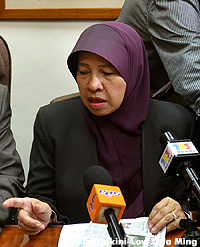 Let’s get one thing out of way – calling out Lim for referring to Jahara (right) as a grandmother does not mean supporting what Jahara said in the state legislative assembly.
There were several separate parts to Lim’s response to what Jahara said.
One part of the responses was that she was being racist and unreasonable, which was at least a rebuttal to the statement Jahara made. Criticising Lim for saying this could, though not necessarily, mean defending what Jahara said.
Another part of his response was that Jahara is a grandmother, which was not a rebuttal to her statement but a characterisation of Jahara as a person. Lim calling her a grandmother, or criticising Lim for saying so, has little to do with what Jahara said.
Birds can fly
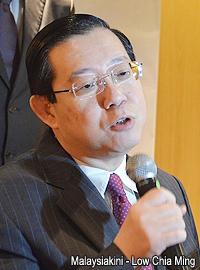 One might say that Lim (left) was simply stating a fact, and therefore what he said was not sexist. While it may be a fact that Jahara is a grandmother (I actually don't know if Jahara is in fact a grandmother, but that's beside the point), it does not immediately follow that the statement was not sexist. Depending on the context in which a fact is said, certain connotations can follow, including sexist connotations.
Let's say for example Lim and a friend were looking at a picture of Jahara's family, and they see young children in the picture. Lim's friend says, "Oh, Jahara is a grandmother?" Lim responds "Yes, she is a grandmother."
In this example, it makes sense that Lim was just stating a fact, without connotations, because the fact that Jahara is a grandmother directly addresses the friend’s question.
But in the context of responding to the statement Jahara made as a state opposition leader, it doesn’t make sense that he was just stating a fact without connotations, because that fact alone is not relevant to the context. If he had said an equally irrelevant fact like "birds can fly" before calling Jahara unreasonable and racist, we would certainly not say that he was just stating a fact – we would be asking why he said such a thing.
So it is unlikely that Lim was just stating a fact; rather, there was probably a reason why he called Jahara a grandmother. What could that reason be? What did he, whether intentionally or unintentionally, mean?
Perhaps he meant that grandmothers are supposed to be loving and gentle. Or, perhaps that grandmothers are frivolous and shouldn't be taken seriously. Whatever the reason, referring to Jahara as a grandmother ascribes certain stereotypical characteristics to her, based on her gender (and age).
In 2011, US Congressman Allen West chided his Congressional colleague, Congresswoman Debbie Wasserman Schultz, for not being a “lady” after she criticised him in Congress. Insinuating, like West did, that women are expected to act like a “lady” is perhaps a clearer and more common example of gender stereotyping. But similarly, should a woman of a certain age be expected to act a certain way?
It is unfair for Jahara to be defined on the basis of her gender, when she is many other things, not least the state opposition leader.
What about grandfathers?
Say we agree that calling Jahara a grandmother was sexist. Why does it matter? If a man was called a “grandfather”, would there be such a fuss?
Do men face sexism? Of course. But sexism is a form of discrimination that is primarily directed against women, more so in politics where women are almost always in the minority. In the World Economic Forum’s Global Gender Gap Report 2013, all 132 countries compared had more men in Parliament (or equivalent body) than it had women.
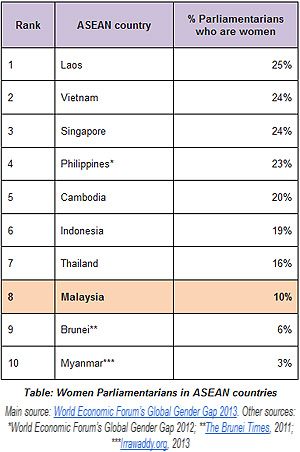 The situation is particularly dismal in Malaysia, which has one of the lowest percentages of women parliamentarians in the world, ranking 110th lowest out of the 132 countries in the Global Gender Gap Report. In ASEAN, Malaysia ranks 8th lowest out of the 10 countries.
Of the 222 members of parliament elected during the 13th general election, only 23 (10 percent), are women, according to an analysis by non-governmental organisation Empower. Malaysia does not fare much better at the state level. Out of 505 state assemblypersons nationwide, only 57 (11 percent) are women, according to Empower’s analysis.
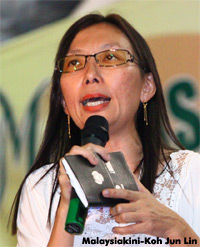 Sexism and discrimination against women in politics are real. Elizabeth Wong, a state assemblyperson in Selangor, described the political arena as a “boys’ club” in a recent article in The Star. Earlier this week, Ridhuan Tee, a lecturer with the National Defence University Malaysia, called Member of Parliament Teresa Kok (right) a “spinster” after she criticised him in Parliament. And who can forget the infamous “bocor” (leak) remark Member of Parliament Bung Mokhtar Radin made in 2007 towards a woman opposition member of parliament.
Calling Jahara a grandmother has nothing to do with her statement in the state assembly, whether what she said was racist or not. And it was not just stating a fact; it had connotations that were sexist and gender specific.
There has been some progress in curbing sexism in politics. Last year, sexist statements were banned from Parliament. We should encourage further positive law and policy changes. We should also support more representation of women in political leadership positions, which a 2009 study by the Massachusetts Institute of Technology’s Poverty Action Lab suggests can reduce biases towards women political leaders.
And when political leaders make sexist statements, we must call them out; not necessarily to criticise individual leaders, but to make it clear that sexist statements are not acceptable.
YU REN CHUNG is a human and women's rights activist.


Are you sure you want to delete this comment?
This action cannot be undone.