




'Fuel subsidy cuts may rewind inequality to 1970'
Cuts in fuel subsidy could see rural-urban inequality regress four decades to the 1970 level, a Universiti Malaya study finds.
Cuts in fuel subsidy could see rural-urban inequality regress four decades to the 1970 level, a Universiti Malaya study has found.
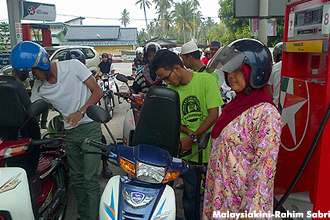 UM Centre for Poverty and Development Studies professor Fatimah Kari said the worst hit by the subsidy cuts are the poor Malay-bumiputera households that are in "deep pockets" of poverty, both in rural and urban areas.
Economic modelling showed that the cuts also led to higher poverty among urban and rural Chinese and Indians, but to a relatively lesser extent, she said.
Across the board, the Gini index, which measures income inequality, between rural and urban residents of the same ethnic group rose by an average two percent.
She said that the fuel subsidy cuts had a deep impact on households as it effects transportation and food costs.
The result is interpreted according to race because the centre is restricted by the Economic Planning Unit data which collate data by ethnicity, she said.
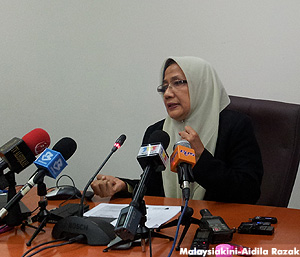
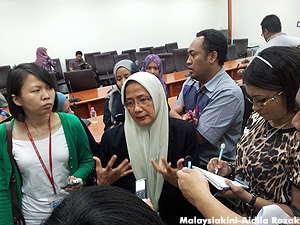 Presenting the findings today to the media, Fatimah (
centre in photo)
said the regression could go back to the 1970 level in the "short- to medium-term" if widening income gaps are not addressed through policy.
Presenting the findings today to the media, Fatimah (
centre in photo)
said the regression could go back to the 1970 level in the "short- to medium-term" if widening income gaps are not addressed through policy.
"We are very concerned about this. In 1970, the income ratio between the rural and urban populations was 1:2, that is for RM1 earned by a rural person, an urban person earns RM2.
"The latest figure in 2012 is 1:1.7... Because of subsidy rationalisation, there is a tendency that it could go back to what it was in 1970. We feel that there is probability that it will go back to the 1970 level."
This is a striking situation, Fatimah said, as this means that 40 years of affirmative action have come to naught.
While the probability is evident from the centre's study, she said, the model it used is not meant for forecasting.
The study found that the subsidy cuts raise real investments by 1.7 percent and growth by 0.6 percent, but this does not mean that the growth will be shared by all.
"It is quite a problematic scenario. It is something the government should take a serious look at," she said.
No response from Pemandu
Even on the private sector side, the centre found that only petroleum products, cement imports, trade works and imports in the transportation sector benefitted from the subsidy cuts.
Fatimah also told reporters that there is an urgent need to curtail rapid urbanisation by spurring development in rural and semi-rural areas.
"We see it as normal that people have to go to the cities to work but this shows that rural economies have failed," she said.
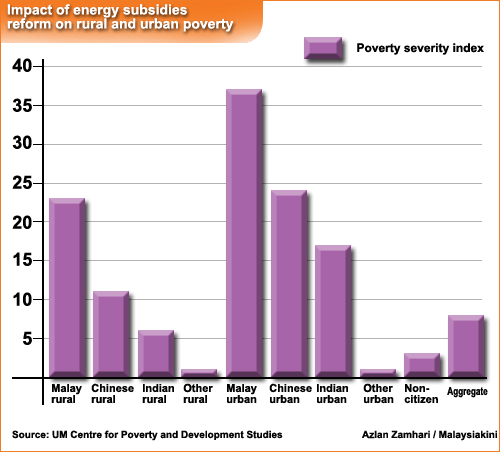
 On the impact of fuel subsidy on households, she said the poverty severity index shows that an additional 37.5 percent of urban bumiputera households and 23.3 rural bumiputera households will be categorised as groups at risk of severe poverty because of the subsidy cut.
These are groups who are considered "vulnerable" and could fall into poverty "in an instant" due to turn of events like natural disasters or death of a breadwinner.
Fatimah said that to cushion the impact of subsidy cuts, the government needs to look at supply-side stimulus, especially in the agriculture and food sectors, to ensure prices do not go up.
"The government is in a fairly comfortable position (to do this), assuming that policy is implemented in a judicious way with no waste and leakages," she said.
Fatimah added that the study had been provided to the Performance and Management Delivery Unit (Pemandu) to assist the government in policy making, but the centre has not heard from Pemandu as yet.
"So we called this press conference to show that there are local researchers who have conducted these studies which they can use. We want to say, 'Hello, we are here'," she said.
Pemandu, which has run laboratories on subsidy rationalisation, has been criticised for hiring expensive consulting firms to assist in policy making.


Are you sure you want to delete this comment?
This action cannot be undone.