




Judiciary to issue yearly report card on own performance
In a bid to enhance the judiciary's transparency and public confidence, Chief Justice of the Federal Court Ahmad Fairuz Sheikh Abdul Halim today unveiled the institution's first 'report card' for public perusal.
In a bid to enhance the judiciary's transparency and public confidence, Chief Justice of the Federal Court Ahmad Fairuz Sheikh Abdul Halim today unveiled the institution's first 'report card' for public perusal.
Ahmad Fairuz said the report, entitled 'Palace of Justice: Inaugural report of the superior and subordinate courts in Malaysia', was also aimed at improving the judiciary's performance in disposing cases.
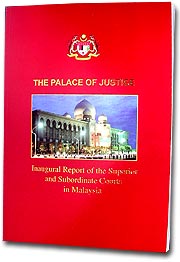 "The primary aim of this report is to act as a report card for the judiciary for the preceding year and thus enhance transparency within the institution both in form and substance," he said in a press conference held in his chambers at the Palace of Justice in Putrajaya.
"Being a report card, it is for all to see whether we have attained good grades for the past year and it can also indicate our weaknesses."
He said the report would be compiled and published annually and would help keep judges and other judicial staff on their toes besides showing " ... us who is working and who is not".
Ahmad Fairuz said statistics on civil cases available in the report would also negate comments by some 'armchair critics' that public confidence in the judiciary had been seriously eroded.
"The truth is that public confidence in the judiciary has been increasing steadily as the statistics in this report show," he maintained.
Criminal cases backlog
The Chief Justice pointed out that the focal point of the report was the workings of the Palace of Justice which reflected the Federal Court judges' commitment to justice and respect for rule of law.
 "And the fact that it is standing on its own, quite apart from the executive and legislative branches can only mean one thing - that the Malaysian judiciary and its judges are independent and free from fear, favour or influence from any quarter when dispensing justice according to law and will remain to be so."
In a question-answer session, Ahmad Fairuz said that while traffic of cases has improved with the disposal of pre-2000 cases, he is bent on ensuring that all criminal cases registered before 2002 be disposed of by this year.
He said that his bid to dispose of the criminal backlog should not be seen as 'hurrying justice' as the courts would careful to adhere to all basic principles of justice.
"If anyone feels that their case had been unfairly rushed, they can write to me personally and we will investigate the complaint, if any, carefully."
Shortage of judges
Ahamd Fairuz admitted that one nagging problem faced by the judiciary in clearing trial backlogs was the shortage of judges with currently only 73 judges to serve a total population of 23.5 million.
"The ratio here is one judge to 322,225 Malaysians. In Singapore the ratio is one to 310,922 while Hong Kong is one to 190,420," he revealed, adding that he would continue to discuss with the government to increase the quota for judges.
"Although the Federal Constitution limits the number of judges, the number can be increased by the order of the King. But we have to talk to the government as we also have to take into account financial constraints."
Although he declined to divulge an ideal judge-population ratio for Malaysia he said: "I am sure that all my judges would be very happy if the ratio is like that of Hong Kong."


