




Anwar: Judgment only a small sign of change
Malaysians will only see further reforms being brought about if the judiciary undergoes a clean-up, said ex-deputy prime minister Anwar Ibrahim, who was freed of a sodomy charge last Thursday.
Malaysians will only see further reforms being brought about if the judiciary undergoes a clean-up, said ex-deputy prime minister Anwar Ibrahim, who was freed of a sodomy charge last Thursday.
He said the Federal Court's decision in allowing his appeal was only a small sign of reform.
"It (the judgment) did provide a sign of change, but (a) very small (one) indeed. If people think that from now on there will be change, I don't think that's true," he said.
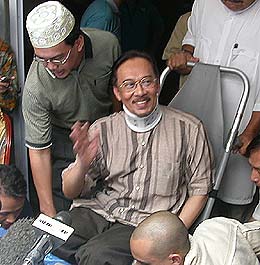 "That can only happen after several process in the judiciary. We have to appoint credible judges, we have to take action against judges who misuse their position or are corrupt. We must ensure that the judges are free to decide independently, to correct wrongs (done) and shame (brought) upon others."
He said that these steps are necessary because many others have also been denied fair judicial conduct.
"This (injustice) has not happened only to me, but hundreds of others who were politically prosecuted," he told malaysiakini at his home in Damansara Heights, Kuala Lumpur. On Saturday night, he left for endoscopic surgery in Munich, Germany.
He also said Prime Minister Abdullah Ahmad Badawi must substantiate his concept of Islam Hadhari by improving laws, eliminating corrupt practice and all forms of repression.
"To me, it doesn't matter if you call it ummah (community building), you call it hadhari (progressive) or madani (civil society), you have to substantiate and rationalise the position. Articulate your views," he said.
".... but you can't have hadhari and condone corruption, then have hadhari and condone repression and then have hadhari and condone detaining people without trial. It's very difficult to rationalise. You cant have hadhari and have muzzled the media. It makes no sense."
Re-inventing PKR
Anwar also quashed rumours that he was planning to rejoin Umno, saying he was committed to the reformasi agenda and that he hoped to help strengthen the opposition front.
He also conceded that Parti Keadilan Rakyat (PKR), headed by his wife Dr Wan Azizah Wan Ismail, needs re-invention following negative publicity on the party's internal squabbles.
"The media in Malaysia, with the exception of malaysiakini, are controlled by the ruling coalition and the media focus is to highlight the internal squabbles of the opposition parties...up to a point, these are somewhat true but (have been) grossly exaggerated," he said.
He said he was optimistic about the future of PKR because, like most opposition parties, it has the silent support of those at the grassroots.
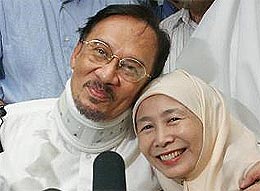 Anwar dismissed the notion that Wan Azizah's political role would gradually be minimised now that he is a free man. (He completed a six-year jail sentence for corrupt practice and had started serving his nine-year sentence for sodomy when the conviction was quashed.)
"She chaired the political bureau meeting (last Thursday). I wasn't consulted when they decided who was going to be the new (PKR) secretary-general or who was to handle the co-ordination of programmes related to my release. I was only told of the decision after the meeting," he said.
"Of course, I am not saying that I am irrelevant, but it shows that she can handle it."
He was also asked to comment on the statement made by former prime minister Dr Mahathir Mohamad who defended his action to sack him for sexual misconduct.
 "He (Mahathir,
photo
)), from his own statements, has shown an iron-fisted attitude. He doesn't care about investigations, he doesn't care about doctor's examinations, he doesn't care about the judiciary. All he cares about is himself and his decision. He is the investigator, prosecutor and judge, and therefore thinks he is not answerable to anyone."
"He (Mahathir,
photo
)), from his own statements, has shown an iron-fisted attitude. He doesn't care about investigations, he doesn't care about doctor's examinations, he doesn't care about the judiciary. All he cares about is himself and his decision. He is the investigator, prosecutor and judge, and therefore thinks he is not answerable to anyone."
Lost years
Anwar, asked about his worst moments while being imprisoned, listed the assault by former Inspector-General of Police Abdul Rahim Mohd Noor as well as being informed that several close family members had died.
 He recalled the difficulties he experienced before obtaining permission to visit his sick mother, brothers and close friend and former PAS president Fadzil Noor (
photo
) before they died.
He recalled the difficulties he experienced before obtaining permission to visit his sick mother, brothers and close friend and former PAS president Fadzil Noor (
photo
) before they died.
"My mother was critically ill, yet they (the authorities) sought doctor's letters to affirm that she was really sick. I obtained permission (to visit her) but by the time I got there she was gone. My eldest brother was dying of cancer... it took months of appeal but (there was) no response. I was only able to get to the graveyard just before he was buried. And my close friend ustaz Fadzil Noor...
 "There are things that I have lost that will never come back....like last seeing your daughter in kindergarten and she is now sitting her UPSR (Year Six) examination. You leave a young girl and suddenly she's someone's wife," he said referring to his youngest and eldest daughters, Nurul Hana and Nurul Izzah (
photo
), respectively.
"There are things that I have lost that will never come back....like last seeing your daughter in kindergarten and she is now sitting her UPSR (Year Six) examination. You leave a young girl and suddenly she's someone's wife," he said referring to his youngest and eldest daughters, Nurul Hana and Nurul Izzah (
photo
), respectively.
Anwar's aides said he has been giving a series of interviews since 11am last Friday to the British Broadcasting Corporation, Al-Jazeera, Australian Broadcasting Corporation and The Asian Wall Street Journal among other media.
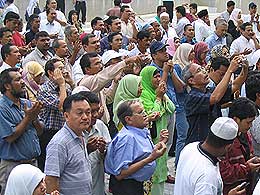 When mobbed by a group of local journalists, Anwar laughed and said: "I'm afraid that I may become
obsolete
like Dr Mahathir, after having to answer everything within two days."
When mobbed by a group of local journalists, Anwar laughed and said: "I'm afraid that I may become
obsolete
like Dr Mahathir, after having to answer everything within two days."
He has also disregarded advice from family members against receiving so many visitors.
"He said he does not want to disappoint people. They have missed him as much as he did," said Nurul Izzah.
Anwar was given a grand welcome by thousands of supporters who flocked his home soon after they heard news that the Federal Court had quashed his conviction for sodomy.


Are you sure you want to delete this comment?
This action cannot be undone.