




Q&A: Anwar looks to strong and cohesive opposition
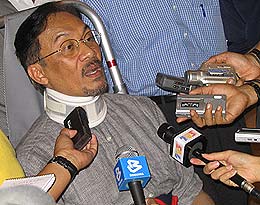
Ex-deputy prime minister Anwar Ibrahim spared 10 minutes for an interview at his home in Bukit Damansara, Kuala Lumpur, following his release from jail last Thursday when the Federal Court quashed his conviction and sentence for sodomy.
Ex-deputy prime minister Anwar Ibrahim spared 10 minutes for an interview at his home in Bukit Damansara, Kuala Lumpur, following his release from jail last Thursday when the Federal Court quashed his conviction and sentence for sodomy.
Malaysiakini: Parti Keadilan Rakyat managed to win only one seat in your absence, during the last general election. How do you plan to strengthen the party now that you are free?
 Anwar:
I have yet to get the opportunity to discuss this with party leaders. You have to give me some time to do this. I think there are going to be changes and we have to re-think, re-invent ourselves before we can forge a cohesive and strong opposition. To my mind, it is not feasible or tenable to offer alternative programmes without building a cohesive front first.
Anwar:
I have yet to get the opportunity to discuss this with party leaders. You have to give me some time to do this. I think there are going to be changes and we have to re-think, re-invent ourselves before we can forge a cohesive and strong opposition. To my mind, it is not feasible or tenable to offer alternative programmes without building a cohesive front first.
You said re-inventing the party. In what way?
The media in Malaysia, with the exception of malaysiakini (grins), are controlled by the ruling coalition and the media focus is to highlight the internal squabbles of the opposition parties... up to a point these are somewhat true but (have been) grossly exaggerated. So the perception is that the party is beset with too many internal problems - over the merger (with Parti Rakyat Malaysia) and resignation (of office-bearers). What they fail to consider is that the key leaders are committed to the struggle. They are supported - unlike the ruling coalition - by people and the general public who don't declare their affiliation. I am optimistic.
Former prime minister Dr Mahathir Mohamad told the media, among other things, that he still believes you are guilty and that he was right to sack you.
 Dr Mahathir (
photo
) is after all an old man (grins). His views are also becoming out of date. People are not really concerned with him...not only among the rakyat but even within Barisan Nasional (BN). So why should we react to what he says?
Dr Mahathir (
photo
) is after all an old man (grins). His views are also becoming out of date. People are not really concerned with him...not only among the rakyat but even within Barisan Nasional (BN). So why should we react to what he says?
He, from his own statements, has shown his iron-fisted attitude. He doesn't care about investigations, he doesn't care about doctor's examinations, he doesn't care about the judiciary. All he cares about is himself and his decision. He is the investigator, prosecutor and judge, and therefore thinks he is not answerable to anyone.
So if you were to see him in person, what would say to him? Would you just ignore him?
No, I would not ignore him. I would be civilised. I have no malice towards him and I say this frankly, I am not making it up. I mean there are people with small minds, big minds. So we should not be bothered with such things.
Your wife, Dr Wan Azizah Wan Ismail, has been leading the party while you were in jail. Now that you're out, what do you want her to do?
 Well, she's taking care of me now (smiles as he looks aat Azizah, sitting next to him). But she has responsibilities to the party. I, of course, respect that. Yesterday (Thursday), she presided over the political bureau meeting and I was completely ignored for a few hours. I also accept that as a reality and am perfectly all right with that.
Can we expect her political duties to decrease over the coming months?
Maybe that is your perception. When she chaired the political bureau meeting, I wasn't consulted when they decided who was going to be the new secretary-general of the merged party, or who was to handle the co-ordination of programmes related to my release. I was only told of the decision after the meeting. I am not saying that I am irrelevant (laughs), but it shows that she can handle it.
Do you think the Federal Court judgment in allowing your appeal is a small sign of reform?
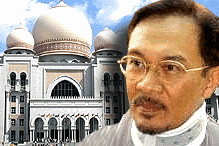 The word small is an apt description. It did provided a sign of change but (a) very small (one) indeed. If people think that from now on there will be change, I don't think that's true. That can only happen after several processes in the judiciary. We have to appoint credible judges, we have to take action against judges who misuse their position or who are corrupt. We must ensure that the judges are free to decide independently, to correct the wrongs (done) and shame (brought) upon others. This has not happened only to me, but to hundreds of others who have been politically prosecuted.
There are rumours that you will soon be joining Umno.
I have never rejected any request for discussions with anyone. This includes Umno, BN and opposition parties. This has always been my policy. But I stress that we have tied ourselves to the agenda for change, for reformasi. We also want to strengthen the opposition front. This is our commitment. We don't need to delineate our struggle in opposition with readiness to discuss.
 If the prime minister (Abdullah Ahmad Badawi) says he wants to do something and ask for consensus from the opposition in relation to the repel of the Internal Security Act, I would support him. If he wants to take steps to improve the judiciary, I would agree. To agree with them on such matters does not mean that we have to join BN. The tradition to annihilate the competition is an outdated mindset. We have to change or the injustices will continue.
In your book 'The Asian Renaissance' you talked about progressive Muslims. What do you think of Islam Hadhari promoted by Abdullah?
For me, it doesn't matter if you call it ummah (community building), you call it hadhari (progressive) or madani (modern), you have to substantiate and rationalise the position.
.
You know the term hadhari was popularised by Abdul Rahman Ibn Khaldun in the (book) 'Mukadimmah'. This was opposed to the Islam Badawi of the nomadic civilisation, then to modern, city-based hadhari civilisation. He (Ibn Khaldun) talks about civilisation from the nomadic culture to modern civilisation.
Conceptually, to my mind, it is flawed. But, notwithstanding that, if Abdullah is persistent and serious wanting to have it, then okay... by all means, do it. But you can't have hadhari and condone corruption, then have hadhari and condone repression and then have hadhari and condone detaining people without trial. It's very difficult to rationalise. You can't have hadhari and have a muzzled media.
Your loved ones - your mother, brothers, close friend (ex-PAS president) Fadzil Noor - passed away while you were in jail. How did you feel about not being able to be with them during their last moments?
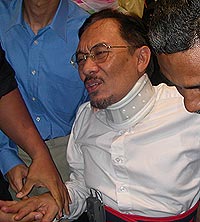 If there is one issue - other than the one personal predicament of the assault (by former police chief Abdul Rahim Mohd Noor) on Sept 2, 1998 - that really disturbs me, that gave me so much sorrow was to hear of the demise of my loved ones. My mother was critically ill, yet they (the authorities) sought doctor's letters to affirm that she was really sick. I obtained permission (to visit her) but by the time I got there she was gone.
My eldest brother was dying of cancer... it took months of appeal but (there was) no response. I was only able to get to the graveyard just before he was buried. And my close friend ustaz Fadzil Noor.
(There were many other) things that you have lost that will never come back....like last seeing your daughter (Nurul Hana) in kindergarten and she is now sitting her UPSR (Year Six) examination. You leave a young girl (Nurul Izzah) and suddenly she's someone's wife.
How did you overcome such difficult moments?
There are times when you feel very sad and lonely, you seek solace in the Quran and read. I also sang a lot in the bathroom (laughs).


Are you sure you want to delete this comment?
This action cannot be undone.