




Mixed reviews for Pak Lah's first year in power
Prime Minister Abdulah Ahmad Badawi marks his first year in office this Sunday with a mixture of positive reviews and criticism that he has not lived up to his promises.
Prime Minister Abdulah Ahmad Badawi marks his first year in office this Sunday with a mixture of positive reviews and criticism that he has not lived up to his promises.
"He deserves full marks for his first year. He has been a really pleasant surprise," said Robert Broadfoot of the Hong Kong-based Political and Economic Consultancy.
 But parliamentary opposition leader Lim Kit Siang said: "Abdullah raised sky-high public hopes of reforms but after one year people are still waiting for the rhetoric of a clean, efficient and incorruptible government to be translated into deeds."
Lim, however, acknowledged that Abdullah had notched up some notable successes, particularly in foreign policy where he has mended fences with Singapore and Australia after relations were strained under his predecessor Mahathir Mohamad.
Out from Mahathir's shadow
Abdullah, 64, took over when Mahathir retired on Oct 31 last year after 22 years in power during which his acid tongue and aggressive style ruffled feathers in governments from Washington to Canberra.
At the same time Mahathir was widely admired at home for dragging Malaysia from the economic backwaters into the mainstream of Asian development, and many were sceptical of the mild-mannered Abdullah's ability to step into his shoes.
"I think he came out from Mahathir's shadow much more quickly and decisively than observers thought he would," said Broadfoot.
"Abdullah was very quick to set his own mark in identifying the problems like in the police force, corruption, and that struck a chord with the population."
Broadfoot noted that Abdullah had also steered the ruling United Malays National Organisation (Umno) to a landslide victory in March elections in which he rolled back a growing challenge from Muslim fundamentalists in the opposition Islamic Party (PAS).
Both Broadfoot and the Democratic Action Party's Lim noted however that Abdullah still faced opposition to his anti-corruption drive from within Umno, which has led the ruling Barisan Nasional coalition since independence from Britain in 1957.
Resistant towards change
In party elections last month, claims of vote buying emerged after unexpected results for three Umno vice president posts and the defeat of some ministers in the supreme council, the top policy-making body.
"Some in the establishment within Umno are still resistant towards changes. There were factions that were able to defend their own interests against what he wanted to do," Broadfoot said.
"However well-intended Abdullah may be, the question is whether he can fully stamp his personality and priority on the system or whether he will be a captive of the system," said Lim.
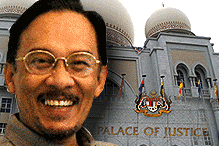 Both men said the release last month of former deputy premier Anwar Ibrahim after six years in jail was a positive development and had removed a long-standing complaint against Malaysia by foreign governments and human rights groups who saw him as a political prisoner.
Anwar himself has said he believes Abdullah had made some good policy moves but that much more needed to be done to reform a system of government which he says is corrupt.
Lim agreed. "I don't think he has fully come out of Mahathir's shadow yet. We need to see major systemic changes, a free press, a truly independent judiciary, an anti-corruption agency, a First World parliament. There is still a long way to go.
"One year may not be enough. We should give him more time. The next 12 months will be crucial as people will expect no more rhetoric, but deeds."


Are you sure you want to delete this comment?
This action cannot be undone.