




On preserving Malaysia’s judicial independence
COMMENT Mark Trowell’s latest book, ‘The Prosecution of Anwar Ibrahim - the Final Play’ is the echo of a growing concern expressed by the international community on the state of judicial independence in Malaysia.
As the world gets smaller by the day, and news about Malaysia can be accessed from anywhere in the world at the click of the button, Malaysia cannot pretend that it can continue to run its own affairs without being watched by the rest of the world.
COMMENT Mark Trowell’s latest book, ‘The Prosecution of Anwar Ibrahim - the Final Play’ is the echo of a growing concern expressed by the international community on the state of judicial independence in Malaysia.
As the world gets smaller by the day, and news about Malaysia can be accessed from anywhere in the world at the click of the button, Malaysia cannot pretend that it can continue to run its own affairs without being watched by the rest of the world.
There is a difference between the need to uphold the sovereignty of the nation, and the demand to maintain the separation of powers in all three branches of the government - the executive, the legislature and the judiciary, so that the country will not be perceived as a rogue nation.
There is an aphorism, ‘Not only must justice be done; it must also be seen to be done’. And precisely, this is what I believe the international community has been trying to remind the people in the corridors of power.
Perception matters
How we perceive Myanmar’s respect for human rights, for example, is how the international community looks at Malaysia.
One may argue that this is a matter of perception based on the circumstances revolving around Aung San Suu Kyi (Myanmar) and Anwar Ibrahim (Malaysia), but the conclusion on people’s minds depends largely on the way we conduct ourselves based on the rule of law.
This is why Singapore has always been on world map in many aspects, while Malaysia’s reputation has taken a beating within the past two years, since news of the 1MDB scandal and Anwar’s jailing hit the streets, coupled with the way we handled the missing MH370 aircraft.
Of course, some would argue that we have been on the international watch list for nearly three decades, which I would not dispute as well, but I think the last two years have been the most trying times for our nation as we are being put on the spotlight.
We have also been lagging far behind Singapore on a number of international scoreboards. The blame is on the actors, rather than the reviewers.
Reports are written by observers such as Trowell and presented to various international bodies that they represent, including the International Commission of Jurists (ICJ).
Such reports or at least parts of the contents, are made public and Trowell’s book is an excellent example. It is a simplified version of what he would have written to the bodies which he represented during the trial - dubbed Sodomy I and II - of former opposition leader Anwar Ibrahim.
Like it or not, reports of this nature is a form of check-and-balance on our executive branch of government and judiciary, and its main objective, rather than to damage the reputation of the latter, is to protect it from executive interference.
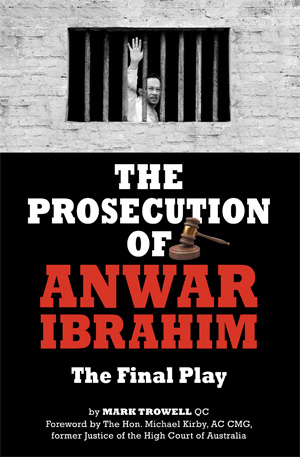 We can whip up counter-arguments - from the conspiracy theory to interference from foreign political powers, and we send some henchmen to demonstrate in front of the Australian High Commission to protest against Trowell’s book - but these are international observers representing international bodies, which are managed by distinguished people within the fraternity.
Trowell himself is a Queen’s Counsel and a senior criminal lawyer. We may dispute Trowell’s observations, but their reports are trusted by the governments around the world. At the end of the day, it is how the international community perceives of Malaysia, which is supposed to be a modern and democratic nation.
This is why, in order to manage international perception, where necessary, at least a counter argument should be provided to further enlighten the public.
We are being watched
These days when we hear the idiom, ‘No Man is an Island’, we immediately think of Lee Kuan Yew’s book, although the original line came from an English poet, John Donne.
The late prime minister of Singapore realised that in order for him to lead Singapore to achieve greatness, the island republic could not afford to insulate itself as an island; therefore, running its own affairs as though the world community no longer matters, was his biggest fear. Lee realised that Singapore could not afford to be snubbed by the rest of the world.
This is a wake-up call for Prime Minister Najib Abdul Razak. Unless of course he wants to be another Saddam Hussein, who was hated by his fellow countrymen especially the Kurds in northern Iraq, Najib cannot ignore what the world is saying about the current state of the country as well as the executive interference of the judiciary.
It is easy to pick up the book by Trowell, scan through it briefly and say, “This is utter rubbish!” but it will not solve the way how the world perceives of us.
Under the federal constitution, the legislative, executive and judicial branches of the government are supposed to be kept entirely separate and distinct, but since the dismissal of former Lord President Salleh Abas and several judges during the judicial crisis in 1988, the international community has been closely watching the judicial system in Malaysia.
This is why, at a press conference immediately after Anwar’s appeal in 2004, Trowell ( photo ) told journalists: “The international community has a clear perception that the original trial was patently unfair and contained many errors of law.”
He stressed that “perception can only be overcome by the court acting objectively and dealing with the appeal on its merits without regard to any extraneous factors. Malaysia’s reputation as a modern and democratic nation governed by the rule of law will be assessed by how the judges deal with this appeal.”
Trowell himself had made this observation, which he wrote: “There is no doubt Anwar’s struggle for justice exposed fundamental issues confronting the Malaysian justice system, including judicial independence, police brutality and corruption and the use of the draconian Internal Security Act (ISA) in prosecuting alleged offenders.”
Trowell’s comments are based on his own observations as a legal professional himself. For example, when Anwar’s second prosecution in Sodomy II led to his acquittal by the Kuala Lumpur High Court, commentators were suggesting various scenarios such as Anwar in prison would be able ‘to portray himself to be a political martyr’.
Trowell, however, said it is “almost impossible to say because the verdict of acquittal was the correct decision in the face of the insufficiency of the evidence at the trial.”
Easy reading
Reading it intermittently, I have finished nearly half the book. It is written in plain English that at certain points, Trowell’s narratives appear like a chapter lifted up from a modern-day novel.
Besides presenting the facts of the Anwar’s court case, I like the way Trowell also provides the context in which the drama unfolds. He also gives his reader a brief profile of the actors and actresses involved and the background and the context in which the drama unfolds.
To me, Trowell has brilliantly put together all the pieces of the jigsaw puzzle to give his reader a big picture.
For example, assuming that the reader does not know how the Reformasi movement came about, and how it gave rise to the party that became known as Keadilan or PKR, Trowell wrote an accompanying story on the Reformasi movement.
He also provides the various sections of the law that were quoted in Anwar’s case, for the convenience of the non-legal person who reads his book.
This book will be officially launched on Sept 21 (today) at the Royal Selangor Club at 8PM. For reservation, please contact Nuha (mobile: 012-2477397) or Saifullah (mobile: 013-3005461).
Trowell will be there personally to sign autograph for his book. Other speakers include Professor Mohammad Redzuan Othman (deputy chairperson of Institut Darul Ehsan), Ambiga Sreeneevasan and Bar Council president Steven Thiru.
STEPHEN NG is an ordinary citizen with an avid interest in following political developments in the country since 2008.
More news
Researchers should look for the subtle signs, too
MP: Deloitte must lodge report against 1MDB if misled
On preserving Malaysia’s judicial independence
'Cabinet should ask Suhakam on red shirt rally'


Are you sure you want to delete this comment?
This action cannot be undone.