




Malaysia's 'Mr Clean' former prime minister
COMMENT In Malaysia, is being a Muslim a prerequisite to being an ethical leader?
The iconic former spiritual leader of PAS, the late Tok Guru Nik Aziz Nik Mat, stated that only a Muslim could be the prime minister of Malaysia. His popular argument was crouched in terms of majoritarian politics but a deeper introspection suggests that the Tok Guru had a vision for a Malaysian state that was ruled by Islamic scholars.
An analysis of Malaysia’s fifth prime minister, Abdullah Ahmad Badawi, who ruled from 2003 to 2009 and is considered the most qualified “Islamic” leader among Malaysia’s six Muslim prime ministers, raises more questions than it resolves...
COMMENT In Malaysia, is being a Muslim a prerequisite to being an ethical leader?
The iconic former spiritual leader of PAS, the late Tok Guru Nik Aziz Nik Mat , stated that only a Muslim could be the prime minister of Malaysia. His popular argument was crouched in terms of majoritarian politics but a deeper introspection suggests that the Tok Guru had a vision for a Malaysian state that was ruled by Islamic scholars.
An analysis of Malaysia’s fifth prime minister, Abdullah Ahmad Badawi, who ruled from 2003 to 2009 and is considered the most qualified “Islamic” leader among Malaysia’s six Muslim prime ministers, raises more questions than it resolves.
To-date, the most comprehensive analysis of Abdullah’s years as prime minister is Awakening: The Abdullah Badawi Years in Malaysia , a book edited by Bridget Welsh and James UH Chin and published in 2013.
While extensive it does not provide any definitive answer (the editors acknowledge the difficulty in attempting to do so). The book certainly provides an interesting analysis.
It also most certainly provides several interesting facts and raises several interesting issues in relation to whether being a Muslim is either a necessary or sufficient condition to providing ethical leadership in Malaysia.
Abdullah – popularly known as Malaysia’s Mr Clean – would fit the Tok Guru’s conceptualisation of a “good leader” and certainly an “ethical leader.”
Abdullah comes from a line of prestigious religious leaders. His paternal grandfather, Syeikh Abdullah Badawi Fahim, was Penang’s first mufti after independence. His stature was such, that it is widely reported that it was he – Sheikh Abdullah – who advised Tunku Abdul Rahman (Malaysia’s first prime minister) that Aug 31 would be good date to declare Malaya’s independence.
Syeikh Abdullah also helped establish Hizbul Muslimin, a party that promoted Islamic tenants. Members of Hizbul Muslimin were also often members of Umno.
Abdullah Badawi’s father, Ahmad Badawi, also became a mufti. He also joined Umno and was a member of the Penang legislative assembly from 1959 until his death in 1978.
Interestingly, both Abdullah’s father and grandfather were among the founders of PAS. There is no doubt that Abdullah understood the role of leader from an Islamic perspective and the role of Islam in promoting good governance.
Abdullah did not become a mufti but graduated with a degree in Islamic Studies from the University of Malaya (although he was offered a scholarship to study economics). This would have solidified his lived experience of Islam in leadership and governance.
He joined the Malaysian civil service after graduation. In 1978, he resigned from the civil service and stood for election in the Kepala Batas constituency, which was held by his father since 1959.
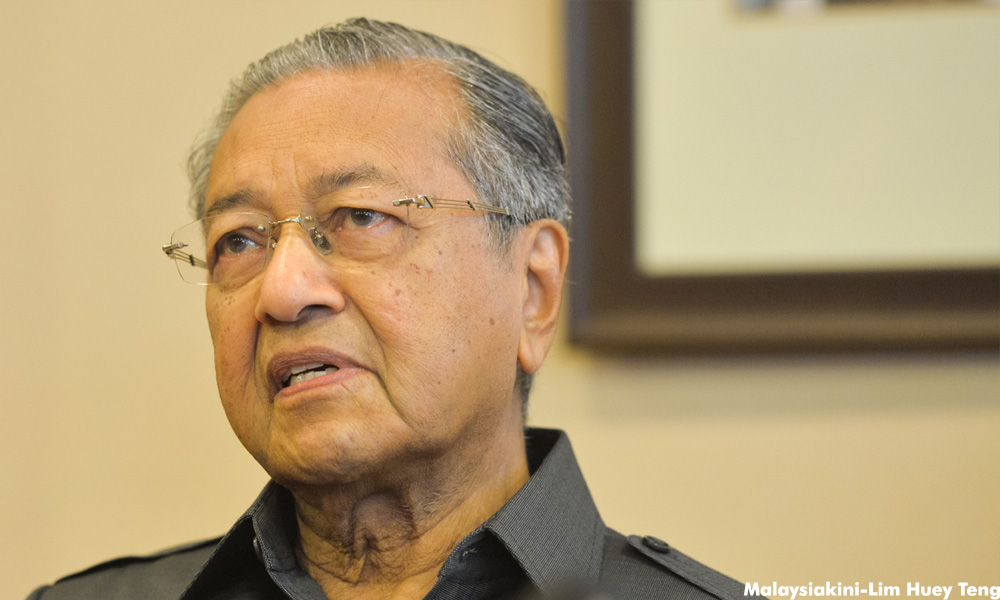 Although Umno had begun to use Islam as a political strategy in earnest since the time of Malaysia’s fourth prime minister Dr Mahathir Mohamad (
photo
), it was Abdullah who was the first prime minister to formally introduce Islam into mainstream Malaysian public policy making.
Although Umno had begun to use Islam as a political strategy in earnest since the time of Malaysia’s fourth prime minister Dr Mahathir Mohamad (
photo
), it was Abdullah who was the first prime minister to formally introduce Islam into mainstream Malaysian public policy making.
Abdullah did this through the introduction of Islam Hadhari . While Islam has always had an elevated position in Malaysia Abdullah Badawi made it the hallmark of his administration. These efforts further strengthened the already formidable powers (both formal and informal) of “Islam” in Malaysia.
But was Abdullah an ethical leader and did all these Islamic overtures improve governance in Malaysia?
Here are some fascinating insights extracted from the book by Welsh and Chin.
Abdullah Badawi’s son
 Kamaluddin Abdullah (
photo
) was a businessman with moderate holdings before Abdullah became prime minister. After his father became deputy prime minister and prime minister, Kamaluddin’s holding company, Scomi Group, was perceived to have grown into one of the largest companies in Malaysia and Kamaluddin became one of Malaysia’s richest men.
Kamaluddin Abdullah (
photo
) was a businessman with moderate holdings before Abdullah became prime minister. After his father became deputy prime minister and prime minister, Kamaluddin’s holding company, Scomi Group, was perceived to have grown into one of the largest companies in Malaysia and Kamaluddin became one of Malaysia’s richest men.
In 2004, Kamaluddin was ranked by leading business magazine Malaysian Business as the 32nd richest man in Malaysia, with a net worth in the region of US$100 million .
Abdullah Badawi’s son-in-law
Khairy Jamaluddin, the current Minister for Youth and Sports, married Abduallh’s daughter in 2001. When Abdullah became prime minister, Khairy Jamaluddin, then a political novice with no experience in government was accused of running his father-in-law’s government through his control of the ‘Fourth Floor Boys’ – a group of young professionals who manned the policy-making unit of the PM’s office.
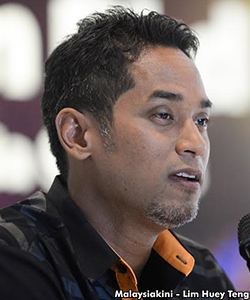 Khairy (
photo
) himself held the posts of ‘special officer’ and Deputy Principal Private Secretary (2003-2004) in the Prime Minister’s Office. After resigning from the prime minister’s office, Khairy Jamaluddin joined a merchant bank, ECM Libra.
Khairy (
photo
) himself held the posts of ‘special officer’ and Deputy Principal Private Secretary (2003-2004) in the Prime Minister’s Office. After resigning from the prime minister’s office, Khairy Jamaluddin joined a merchant bank, ECM Libra.
In 2005, one year after Abdullah became prime minister, Khairy Jamaluddin helped in the merger between ECM Libra Capital Bhd and the Malaysian government-owned Avenue Capital Resources Bhd.
A year later in 2006, the three founding members of ECM Libra – Lim Kian Onn, Kalimullah Masheerul Hassan and David Chua – announced that they were each selling one percent of their shares in the company to Khairy Jamaluddin. The deal was transacted at 71 cents per share for a total of approximately US$2.6 million. Khairy Jamaluddin was able to finance it through a soft loan from the founders.
Abdullah Badawi’s brother, Ibrahim Badawi, the chairperson of LSG Sky Chefs-Brahim’s Sdn Bhd, was criticised for being given a long-term catering contract by state-owned Malaysian Airlines. The terms were deemed so favourable that even the minor caterers complained.
Another close business associate of Abdullah, Patrick Lim was able to buy a prime piece of land belonging to the Penang Turf Club. Using his company, Abad Naluri Sdn Bhd (a private limited company), Patrick Lim proposed to build a multi-million development project called Penang Global City Centre and managed to secure federal approval for the project.
Abdullah’s name also appeared twice in The Independent Inquiry Committee into the United Oil-for-Food Programme chaired by Paul A Volker. The Oil-for-Food Programme was established by the United Nations to allow Iraq to sell oil in exchange for food, medicine and other vital supplies. However, the Iraqi government abused the programme by demanding kickbacks from these contracts.
Mastek Sdn Bhd was at that time owned by three persons: Noor Aishah Mahmood (Abdullah Badawi’s sister-in-law), Faek Ahmad Sharef (Noor Aishah’s ex-husband) and Jaya Sudhir (a businessman).
The report stated that Iraqi officials gave Mastek a large allocation because of Faek Ahmad’s relationship to Abdullah. Iraqi officials referred to Faek Ahmad as ‘Mr Faek Ahmad Shareef/for the benefit of Abdullah’.
Support for Prime Minister Najib Razak
Most surprisingly, in the recent scandal involving Prime Minister Najib Razak, Abdullah instead of supporting calls for the prime minister to resign, has come out instead, in support of the prime minister.
While the book provides extensive coverage of Abdullah’s administration and of Abdullah himself, the question if being a Muslim is either a necessary or sufficient condition to providing ethical leadership remains unanswered.
Yet, Tengku Razaleigh Hamzah, Malaysia’s longest-serving parliamentarian, in the forward of Welsh and Chin’s book, may have provided some resolution to this burning question:
“So the best way to conclude Tun Abdullah Ahmad Badawi’s stewardship of the country is to say that he has failed to live up to the legitimate expectations of the people. People say that he failed miserably to translate the aspiration of the people in wanting real reforms for the country. Perhaps it could be said, he fell into the same trap as many Third World leaders as he too succumbed to corrupting tendencies of power.”
GREG LOPEZ is research fellow at Murdoch University Executive Education Centre, Murdoch University and visiting fellow, Department of Political and Social Change, Australian National University.


Are you sure you want to delete this comment?
This action cannot be undone.