




Thaksin agrees to share information on southern Thailand
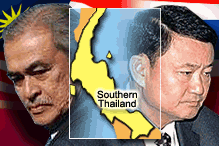
Thailand, Malaysia and Indonesia have agreed to boost cooperation on security amid fears that Muslim unrest in the southern Thai provinces could explode into a regional threat, officials said today.
Thailand, Malaysia and Indonesia have agreed to boost cooperation on security amid fears that Muslim unrest in the southern Thai provinces could explode into a regional threat, officials said today.
Thai Prime Minister Thaksin Shinawatra met the leaders of the two Muslim nations late yesterday to soothe tensions after he threatened to walk out of the Asean summit here if leaders raised the unrest.
The issue was however not raised in a leaders' meeting that opened the two-day Association of Southeast Asian Nations (Asean) summit that started in Laos today, officials said.
Share intelligence
Thaksin, Malaysian Prime Minister Abdullah Ahmad Badawi and Indonesian President Susilo Bambang Yudhoyono agreed to intensify cooperation on law enforcement and share intelligence to curb radical groups, said Thai foreign ministry spokesman Sihasak Phuangketkeow.
"The causes of the situation (are) domestic. It's not part of any international terrorist network but of course we are concerned about the introduction of extremist ideologies among the youths," he told AFP .
"We are concerned about the possibility of extremist groups in the region connecting together and this could become a serious problem.
"We are concerned about the possibility of links among extremist movements in the region, that's why it's important for us to share intelligence."
The unrest in Buddhist Thailand's south has left some 550 people dead this year. International concern about the violence peaked last month when 87 Muslim protestors died, most of them from suffocation while packed on to army trucks.
Thaksin has said Asean's policy of not interfering in the domestic affairs of its members meant the unrest should not be raised by leaders at the annual summit.
Some Asean members had wanted the issue to be addressed because of fears the unrest could spill over Thailand's borders, particularly into its southern neighbour Malaysia.
Non-interference?
Thaksin's spokesman Jakapop Penkhal told AFP the Malaysian and Indonesian leaders "expressed their full understanding and agreement to the principle of non-interference".
"In fact, the Malaysian leader at the summit this morning mentioned the fact that the principle of not interfering in each other's affairs remains one of the most important tenets that holds Asean together," he said.
 Abdullah had however stressed that Malaysia "reserves the right to ask questions", Jakapop said.
Thaksin was on Sunday "very clear in saying that they had no problem sharing information but they have a problem sharing it in the Asean forum because they don't wish to multilateralise the problem", Indonesian foreign ministry spokesman Marty Natalegawa said.
Abdullah told the Malaysian media here today that he welcomed Thailand's move to set up an independent body to investigate the October killing of nearly 90 protesters as "their efforts would help restore confidence of residents in the south."
The two countries this year beefed up security cooperation at their border, notably to check the movement of citizens holding dual nationalities who can move across the border freely.


Are you sure you want to delete this comment?
This action cannot be undone.