




Good education is what raises dignity
COMMENT Between a Chinese and a Malay teacher, I picked the Malay lady to give my daughter violin lessons.
The reason is simple - she appeared to me as someone who is more enthusiastic about teaching children.
COMMENT Between a Chinese and a Malay teacher, I picked the Malay lady to give my daughter violin lessons.
The reason is simple - she appeared to me as someone who is more enthusiastic about teaching children.
I had observed how both teachers were teaching the violin to primary school children, but after careful consideration, I decided Teacher Reen would be the one to teach my daughter and I hope it will work out well for both of them.
Soon after contacting Teacher Reen, I learnt to my delight that she was able to communicate in three languages - English, Bahasa Malaysia and Mandarin!
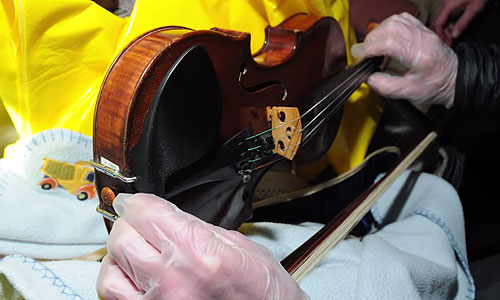 My intention was, of course, partly to expose my daughter to Bahasa Malaysia while learning violin, but now, there is the added advantage since Teacher Reen also speaks Mandarin.
We have agreed that Teacher Reen can use partly Mandarin and Bahasa to teach, but accordingly to her, the vital parts of the violin lessons would still have to be taught in English.
Like most other ‘bananas’ (English-speaking Asians), English is my daughter’s first language but we want her to learn more than one language, and at least the three major dialects - Hokkien, Hakka and Cantonese!
The reason why I picked this story to write an article on is because I was on WhatsApp with the chief of a parents’ lobby group, who has worked hard on ensuring that ‘pupils are to be educated in accordance with the wishes of their parents’, as stated in the Education Act 1996.
Both this lady (let’s just call her Khadijah, as I do not have her permission to mention her name here) and I agree that learning an additional language would be a great advantage for the children, given that we are a multi-lingual society and the world is increasingly becoming a borderless village. With an additional language, one can have a head start in a career whether locally or overseas.
She is Malay, and I am Chinese, but both of us can see the importance of being bilingual.
In our society, however, it is sadly the politicians who, in the past and in the falsehood of nationalism and patriotism, have politicised the learning of language; this is what has made our younger generation become less competitive when they do not have a good command of the English language.
Fair enough, our children can speak Bahasa Malaysia fluently, but when they are on business overseas, unless they can speak good English they will not be taken seriously, compared to someone who speaks the language fluently.
For this reason, we agreed that not only Bahasa should be taught in school, but both English and the mother tongue should be given enough emphasis in schools. This is for the sake of the future generation of Malaysians. At least one generation of Malaysians have lost out on the command of English language, no thanks to the bigots in our political arena.
At the same time, other European and Asian languages, besides Chinese and Tamil, should also be taught in schools to those children who want to pick up an additional language.
Education
In the midst of our conversation, I suggested that she read a book that I had written for a client, whose mother was a primary school teacher.
Khadijah gave her thumbs-up on WhatsApp after I sent her a soft copy of the book, and for her to read it would open a new dimension, especially on why the Chinese have done well in this area of education.
Although we have not even met in person, I could feel her pulse about the importance of a good education. Education, of course, is Khadijah’s own passion as well, judging from her reason for quitting her job to focus on tutoring her own children.
Today, the success of the children of the late Madam Lau Phek Tin can only be attributed to the mother’s singlemindedness about giving her children the best education can offer.
In the midst of the short conversation, I could draw similarities within my own family. My grandfather used to tutor my uncles, aunts and cousins when they were young after dinner every night. This, he did for his children and grandchildren for many years all the way to ‘O’ Levels.
Grandfather himself was a scholar from an extremely poor family, but he completed Form Five with the help of some scholarship raised by his form teacher in the early part of last century.
Although he passed away at the age of 50, he had left behind a legacy that no one can dispute - he was someone who believed in education. Most of his sons and daughters are university graduates.
Extending to what I had to say about both Lau and my grandfather’s examples, which are worth emulating, I told Khadijah that for the Malays to raise their dignity, it is not about emulating people like National Silat Federation (Pesaka) chairperson Ali Rustam or Sungai Dua Umno division chief Jamal Mohd Yunos. Or, Perkasa’s Ibrahim Ali.
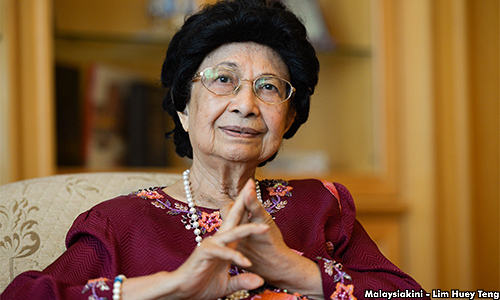 Instead, it is having people like Dr Siti Hasmah Mohamad Ali (
photo
) who was one of the first Malay ladies to qualify as a medical doctor, and she plays violin even in her old age. It is Dr Wan Azizah Wan Ismail, whose qualification as a medical doctor places her one level over those allegedly ‘thug-like’ politicians are currently the faces of Umno.
Instead, it is having people like Dr Siti Hasmah Mohamad Ali (
photo
) who was one of the first Malay ladies to qualify as a medical doctor, and she plays violin even in her old age. It is Dr Wan Azizah Wan Ismail, whose qualification as a medical doctor places her one level over those allegedly ‘thug-like’ politicians are currently the faces of Umno.
It is the mother of five who set up a small table by the side of the road who sells nasi lemak, and works hard for a living in order to support her family. She understands what it means to supplement the income of her husband, the only breadwinner in the family. She commands more respect from the people than our jaguh kampung who behave more like thugs who claim that they are defending the dignity of the Malays and their leaders.
There are also some who are willing to draw the kris and utter foul language, yet claiming to defend the refined Malay rulers. What a big contrast! I am sure the rulers do not need such people to defend them.
When a member of the opposition utters something that sounds like insulting the royalty, they lodge police reports across the country; but when the Conference of Malay rulers wanted the investigation into 1MDB to be expedited, and the culprits taken to task, they keep silent.
This is the hypocrisy of Umno and Umno-linked politicians, who talked about Malay dignity being challenged, yet failing to give enough emphasis to improve the education opportunities for the rural Malays and East Malaysian bumiputra children so that they, too, are on par with the rest of the urban kids.
Dignity can only be raised when one excels in education or in any particular field of discipline, not merely talking senselessly about going to war when the dignity of the Malays is challenged. Inflated ego is what these politicians are referring to, and by no means should we be deceived by them.
This story, I told Khadijah I would write it for Malaysiakini , with the hope that many more Malaysians will learn from just our brief conversation. Khadijah gave me the thumbs-up, and I know I have made sense to her.
STEPHEN NG is an ordinary citizen with an avid interest in following political developments in the country since 2008.


Are you sure you want to delete this comment?
This action cannot be undone.