




NTV7 crew unearths secret Tak Bai video
Malaysian private television station NTV7 had obtained an exclusive video footage of the Tak Bai demonstration in southern Thailand, said senior producer Zainal Rashid Ahmad.
Malaysian private television station NTV7 had obtained an exclusive video footage of the Tak Bai demonstration in southern Thailand, said senior producer Zainal Rashid Ahmad.
He told malaysiakini that the 50-minute footage, which was obtained from a military source in Thailand during their seven-day stay in the country's southern provinces last month, showed that the incident began as a peaceful demonstration until the military provoked the situation.
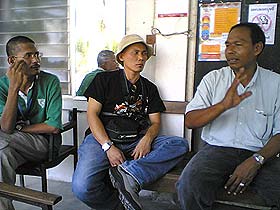 The TV crew - which included producer Fadzli Ramli and journalist Firdaus Mohammad Zainal (
photo, middle
) - was
arrested
by the Thai police and military on the third day of their assignment.
The TV crew - which included producer Fadzli Ramli and journalist Firdaus Mohammad Zainal (
photo, middle
) - was
arrested
by the Thai police and military on the third day of their assignment.
However, Zainal ( photo, far left ) said the arrest failed stop their quest from getting first-hand accounts on the situation in southern Thailand.
"We were scared but we knew that we are going to get a good story and so despite some fear and hesitation, we decided to stay on. We knew we made the right decision when we got hold of the video footage," he said when interviewed at his office in Shah Alam.
"The visual gave us a clear picture of what really happened in Tak Bai on that fateful day. I don't think such visuals had ever been shown anywhere before. The video was shot from inside the police station."
The recording showed that the military first swung into action with water cannons. This is believed to have been carried out to separate the 800 demonstrators from the police officers. Moments later, shots were fired towards the crowd, and this lasted about 30 minutes.
"You can see that the demonstrators were sitting ducks. They were totally unaware of what was coming and were defenseless," said Zainal.
According to the Thai authorities, four demonstrators were killed and a further 87 died of suffocation when those arrested were being transported in military trucks a five-hour journey to a police station in another province. In addition, 63 have been categorised as 'missing'.
Zainal said that the footage also showed how the injured demonstrators were beaten by authorities into almost a lifeless state.
The men who were stripped naked from the waist up - some of whom were only in sarongs - were lined up on the ground with their face down and hands tied.
They were then forced to crawl in that position for almost 300m to the waiting security trucks.
"You can see two 'layers' of men stacked in the lorry and the security personnel covered them with a plastic sheet before piling the next 'layers' of men on them. It's no wonder some died of suffocation during the five-hour ride to the military camp in Narathiwat," he added.
According to Zainal, a portion of the footage will be shown exclusively on the station's popular 'Edisi Siasat' programme, now renamed 'My Siasat: 60 minit', at 5pm tomorrow.
"The clips on southern Thai is a good launch for our inaugural show of 'My Siasat: 60 minit'. We will show our interview with 20 Thai Muslims who were present at the Tak Bai demonstration. We hope that our viewers would appreciate our efforts in getting the news," he said.
Treated like criminals
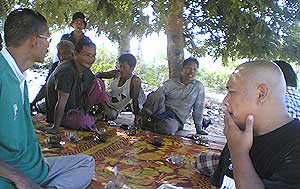 Sharing their experience on the five-hour detention Yat Rang police station in Yala, Zainal, Fadzli (
photo, far right
) and Firdaus claimed that they were "treated like criminals".
Sharing their experience on the five-hour detention Yat Rang police station in Yala, Zainal, Fadzli (
photo, far right
) and Firdaus claimed that they were "treated like criminals".
The trio said apart from the protracted interrogations, they had their "mug shots" taken and their movements monitored closely.
"We had to undergo two interrogations, two hours with the police while the military questioned us for about three hours. We really felt like criminals especially when they took our photos holding cards with our names, addresses and contact numbers.
"We were escorted everywhere including to the toilet. I had to do 'my business' with the door open and an officer staring at me," said Zainal.
He said the authorities had confiscated two Thai-made 'spy-cameras' (which were declared as banned items) and three tapes containing interviews with residents in the Yala province.
He said the interrogation at Yatt Rang (Nyior Lima) police station in Yala on Nov 20 was not as taxing. The police had accused them of entering the country illegally.
"They were very polite but we could sense that they were trying to get us to admit that we langgar (broke through) military check points, which was shocking. We were scared at that point but we managed to remain calm.
"We ignored their accusations and consistently told them that our identifications were in order, we had no problems entering the country and that the Thai embassy in Kuala Lumpur made no indication that the southern provinces were off limits to journalists. In the end, they decided that they could not pin any crime on us and decided to let us go," he added.
The trio believed that their arrests were linked to their visit to one of the most influential religious school in Yala.
"We were arrested immediately after we left the school. We went there because it was one of the biggest school there and found out that a few teachers were detained four days earlier. One of them told us that they could not say anything as they do not want to risk further complications with the authorities," said Zainal.
He said they "survived" for the remaining four days without interference from the authorities by posing as tourists.
"Our visits to the next two provinces, Pattani and Narathiwat, were greeted with the presence of the police or military. So we decided to pose as tourists for the first few hours until we were satisfied that we were no longer being followed," he added.
First-hand experience
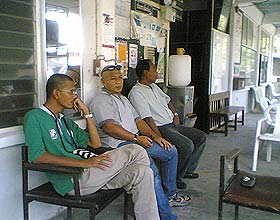 The trio expressed hope that the government would encourage the Malaysian media to get first-hand experience on the developments in the provinces of southern Thailand.
"The reports we have here which are based on foreign agencies are totally wrong. The locals there were shocked when told that the outside world perceived their struggle as quest for autonomy and as a conflict of religions.
"The Muslims are proud to be Thais and very fond of their King and Queen. So it is not a question of autonomy. They are only unhappy with the rampant kidnapping of their people which has been happening for the past 20-30 years. When the religious teachers which were highly respected were arrested, their anger peaked.
"They don't hate the Buddhists. They tell me: We go to mosques, they go to temples. So it's obvious that religious diversity is not a problem there.
"All they want are two things: economic development and freedom to practice Islam which also means an end to the kidnappings. If they get these two things, many said they would be contented," they said.


Are you sure you want to delete this comment?
This action cannot be undone.