




Unconstitutional, Suhakam slams NSC bill
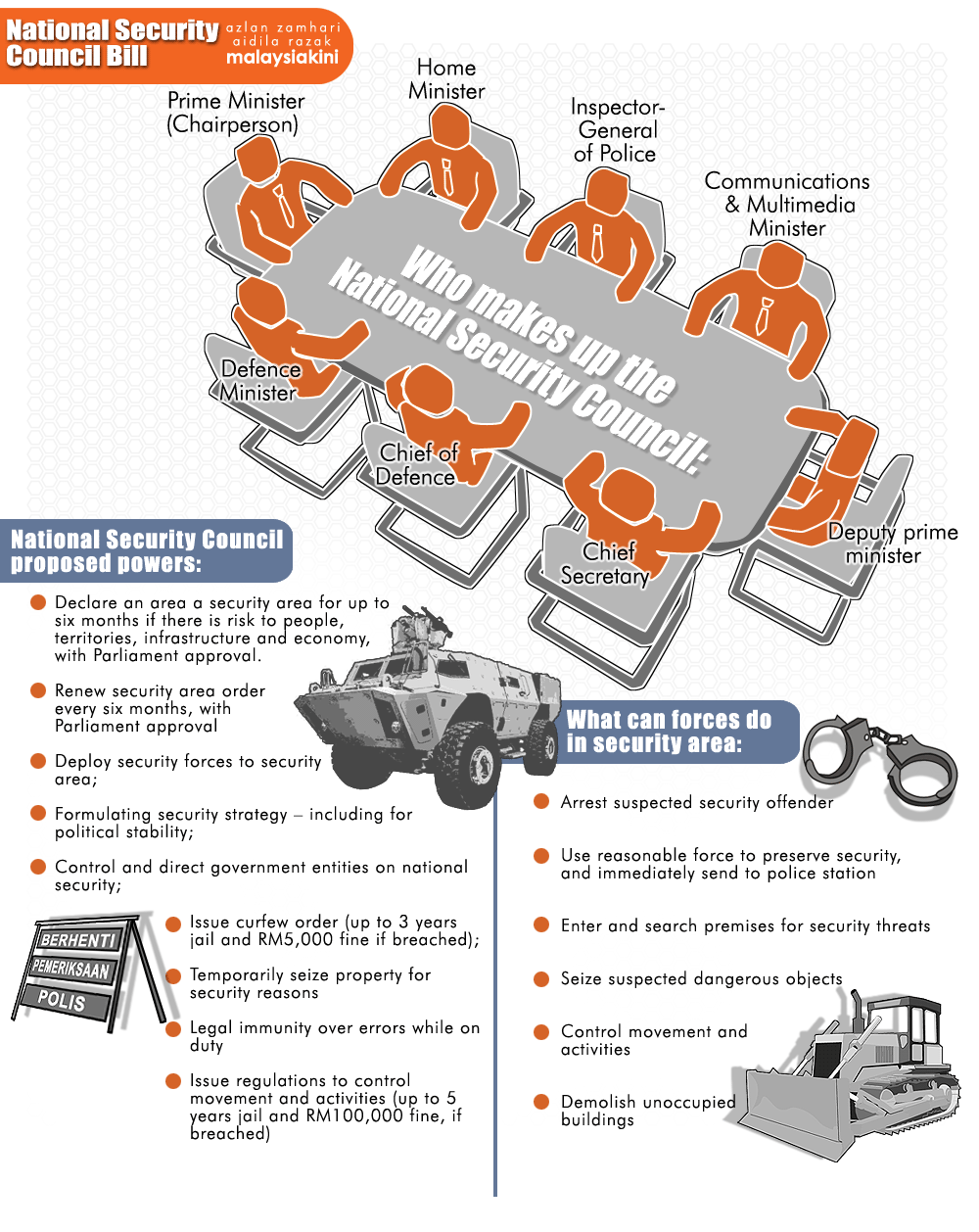
The Human Rights Commission of Malaysia (Suhakam) has described the National Security Council Bill 2015 as being unconstitutional.
"I consider the bill a violation of the Federal Constitution, fundamental liberties in the constitution and human rights principles," said Suhakam vice-president Khaw Lake Tee.
This is because, she said, none of the provisions stipulated in the bill, which was passed by the Dewan Rakyat last week, addressed human rights issues.
"If you look at the provisions of the bill, there is no reference to safeguard human rights," she said at the sideline of the Human Rights Day 2015 event in Kuala Lumpur today.
 Minister in the Prime Minister's Department Paul Low (
photo
), who was also present, responded to Khaw.
"I don't know about this legality. But from my point of view, if you talk about insurgency, for example, lives may be lost and national security is at stake.
"So, as much as you want to (talk) about human rights issues, at a time like that, you need tough measures... for areas to be under curfew, to flush out the enemy," he said.
He, however, agreed that security forces deployed to a security area need to observe human rights and should not perceive the law as a passport for them to do as they like.
Police must change mindset
Low also said if police, who are trained on law enforcement, are not instilled with awareness of human rights, they need to be retrained so that they know how to respect human rights.
"The police need to have their mindset changed. For many years, they come from the school where policing means tough enforcement, sometimes ignoring the rights of an individual. And this is what happened in custodial death cases," he said.
"When you remand people who do not respect the law, they spit on you or utter obscene words, but as a law enforcer, you need to exercise self-restraint, (you need to know) that he (suspect) has rights too," he added.
"They (police) need to be trained; their training needs to cover human rights (as well) and not just enforcement," he said.
He, however, said such training will be challenging, citing the New York police force which had spent US$681 million (RM2.86 billion) to revamp its force for five years and yet it has failed.
"So, you see how tough is it to change the men in blue," he said.
"We will be sending our representatives to observe international practices on how to prevent custodial deaths," he said.
Low, who oversees graft and human rights issues, also claimed that the Enforcement Agency Integrity Commission (EAIC) was not given enough credit by the media for its achievements.
"Without lodging complaints, EAIC had initiated an inquiry over the death of N Dharmendra. It had asked that the (police officer responsible) be prosecuted,” he said.
Dharmendran, 31, who was under remand, died in a cell at the Kuala Lumpur police headquarters on May 21, 2013. Post-mortem finding had revealed that he had died of multiple blunt force trauma and his death was classified as murder.
"There was not a single press report on the proceeding of this inquiry. How come?" he asked. He added that this has given the impression that the EAIC is not working.
He also said the government will approach civil society organisations for their ideas on issues related to human rights and to forge a long-term working relationship with the government.
"Maybe it is time you (civil society) volunteered to become a part of the government's team. I don't believe that by participating in the government you will compromise your independece," he said.
On the relationship between the government and Suhakam, Low said: "This is a love-hate relationship. I just hope there is more love than hate. I must admit that many times we have not consulted you as much as we should.
"As for me, not everything is under my control. But I believe things are changing in the human rights area," he said.
Related reports
Unconstitutional, Suhakam trounces NSC bill
'Gov't has lost some trust from people with NSC Bill'
New law a threat to national freedom and security?


Report this comment
Are you sure you want to delete this comment?
This action cannot be undone.