


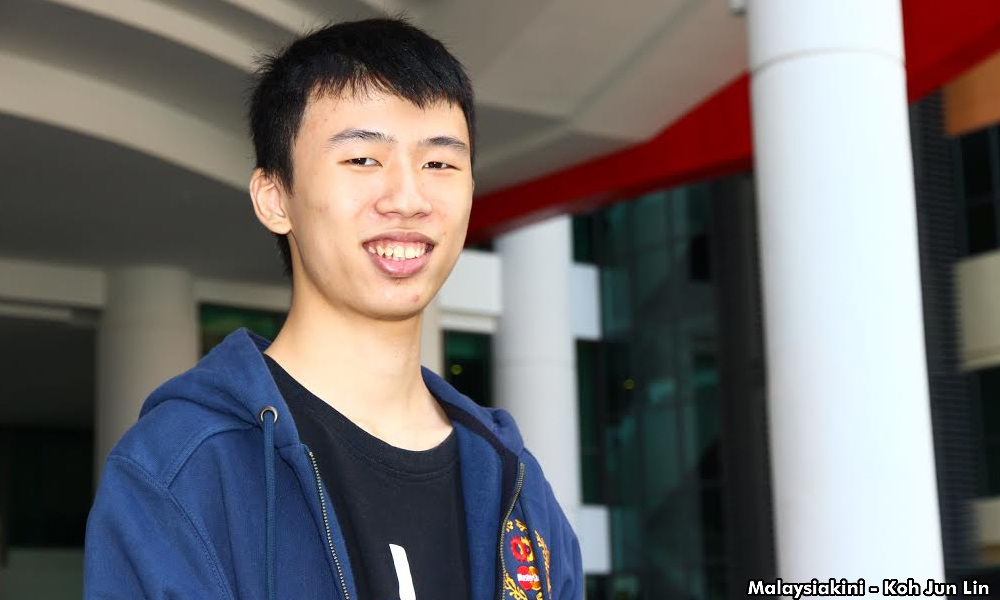

M’sian int’l hackathon champ shows computer games good for you
MALAYSIANS KINI Computer games are the scourge of many parents, who would rather see their children spend precious time sitting in front of books instead of a screen.
For one 20-year-old from Subang, Selangor, however, these games led him to teach himself coding at an age when others were learning to count and construct simple sentences.
These skills later proved invaluable. During a competition in San Francisco in last December, varsity student Lim Jay Ching and his team pitched their idea for a software platform to help domestic workers manage their salaries, dubbed MoneyRemaid.
Jay Ching and team members Daniel Lim, 28; Chew Kean Ho, 28; Wong Gwen Yi, 21, and Leonardy Kristianto, 21, reached the finals in Silicon Valley after beating other teams in regional competition in Singapore.
The product they developed in the final - inspired by Daniel’s Cambodian maid, whose friends complained of getting their wages late and high remittance fees - made them champions of the MasterCard's inaugural Masters of Code competition.
This earned them some help from the credit card company to bring their idea to market, including US$100,000 (RM425,000) in funding, an incubation program, and mentoring.
Camera-shy but clearly excited about the victory even a month on, Jay Ching’s programming journey started at the age of seven when he tried to customise an online shop he had set up as part of the game 'Neopets', an online game targeted at young children.
This is his story, in his own words:
I STARTED CODING WHEN I WAS ROUGHLY SEVEN OR EIGHT. It was a game called 'Neopets'. In Neopets, you have the ability to create a shop, and you get to sell items.
So Neopets has this guide where you can learn HTML, CSS, and Javascript, which is the programming language for the web. So I picked up on that and started liking it.
That is when I started my programming journey.
If I were to compare now and back then, now it is very easy to learn programming. Just Google 'How to programme' and you'll have tonnes of resources out there.
Back then people weren't using Google, all of them were using Yahoo!. If you're going to type 'How to programme', it is very hard to actually find articles on programming languages, and if they do, it is not in-depth enough.
So Neopets wrote a sufficient guide on for you to write HTML, CSS. Of course, I started out copying and pasting codes, but later on, I realised how they worked.
WHEN I WAS IN FORM ONE, I started playing a game called 'Maple Story'. There is this thing called a 'private server'.
It is not exactly legal but I see it as more towards learning, for me. Of course, there are legal issues if you do all these and transform it into a business, but for me, it was more towards doing it on my own for personal use.
So I started writing Java then. There is this online forum where people post codes and talk about all these. That's where I learnt Java, PHP, and all, until Form Four or Five, when I started making websites and freelancing.
WHEN I PLAYED GAMES , after a few months I'd realise that I got bored of them. Then I started to think, like, how were those games made? That's where programming comes in and I would try to make a replica of it, like what people usually do, to see how it works.
When you're done with it, because you've got bugs to fix, you need to constantly attenuate it.
MY PARENTS used to (worry about me spending too much time on the computer) when I was very young, like typical Asian parents.
But after A-Levels when I started doing my own thing, they just let me go and do my own stuff. I don't think they minded.
Initially, when I told them I wanted to take a gap year, they weren't very supportive of it. But I kept talking about it - Gap year. Gap year. Later on, they were like, ' Okaylah , I'll just let you do one gap year since you want to go and learn.’
I PARTICIPATED IN THIS BOOT-CAMP called Next Academy Boot-camp located at the Malaysian Global Innovation and Creativity Centre (Magic).
The nine-week intensive bootcamp was where I met all my team members except Leo who I knew at Sunway College, where I did my A-Levels.
So through that boot-camp, I learnt about start-ups, entrepreneurship stuff, and enhanced my networking skills.
'One Small Step'
MASTERS OF CODE IS A HACKATHON , which takes place in 12 cities. They have two stages, one is the regional one, and one is the international one, which is the final. The regional ones, for example, there is one in Singapore, Australia and a couple of other regions.
In that hackathon, you need to come up with a product, which fits a theme. In Singapore (the regional competition), the theme was 'women empowerment'. What we did was to create an app called 'One Small Step'.
'One Small Step' is a platform that allows women in particular, to learn how to code. They would be able to play around with the app by engaging with all these popular apps like Instagram, Facebook, and they would be able to learn to code through these things.
So we were trying to teach them the basics of programming so that they would be able to kickstart their programming journey.
THIS IDEA (for the final competition) sparked from one of my teammates, Daniel. He had this conversation with his maid from Cambodia.
She mentioned that her previous employer didn't pay her on time and she had friends whose employers don't pay on time. We realised this was a major problem.
Maids also have this problem of transferring money back to their country. To transfer the money, they need to deal with Western Union, banks, and all. They need to incur very high remittance costs, so we realised there is an issue here.
The third thing was that they do not know what to do with the money. If they were just going to send back money every time (they get paid), it would be the whole cycle all over again.
They cannot improve their financial standing. So we realised there is another issue here, and created a platform to help solve these three problems.
WE AUTOMATE THE PAYMENT OF MAID SALARIES . We created a platform to tack employers' credit cards to the maids' bank accounts. So through that, payments are automated every month, and we managed to solve the first problem, which is maids not getting paid on time.
As for the high remittance cost, we realised that maids need to send money back to their country every month.
For every transaction, there is a percentage fee (based on the amount transferred) and then there is a fixed flat fee.
To reduce that flat fee, we aggregate it (remittances from many maids) into one transaction. So we managed to reduce that fee.
On top of that, maids have this option that allows them to invest into fixed deposit accounts. We have two different options – one is to send the money back, and the other is to put the money in fixed deposits.
From there, there is this system where they could learn, if they save RM200 this month for example, how much could they get in 10 years. So they learn financial literacy.
FOR US, THE TEAM LEADER DOESN'T REALLY MATTER . It is more towards who can do the right task, at the right time. So all of us (the team members) trust each other.
Daniel knows how to do research because he was an ex-consultant. Gwen knows how to do public relations, she is good at pitching and all. They trusted me and a couple of friends for programming.
So we don't really (instruct) each other, like, I don't say you need to research this, this, and this, I don't really tell her to do PR on this, and you don't really need to tell me to code this and that.
We just talk about general ideas like, 'We want this to happen', and the 'how' is in our own team discussions.
WHAT'S NEXT FOR ME PERSONALLY? Join the (Master Card) incubator program and perhaps explore more opportunities in programming. Currently, I'm sort of taking another...half gap year?
I've started in July last year at Monash University (studying for a degree in computer science). That was one semester. It ended in November, I went for the trip (to the finals), and then I'm supposed to resume class in February.
I might be joining some community kind of stuff, like teach workshops on programming, host programming sessions and all. So I'd guess that would be my plans for the next few months.
MALAYSIANS KINI is a series on Malaysians you should know.


Report this comment
Are you sure you want to delete this comment?
This action cannot be undone.