


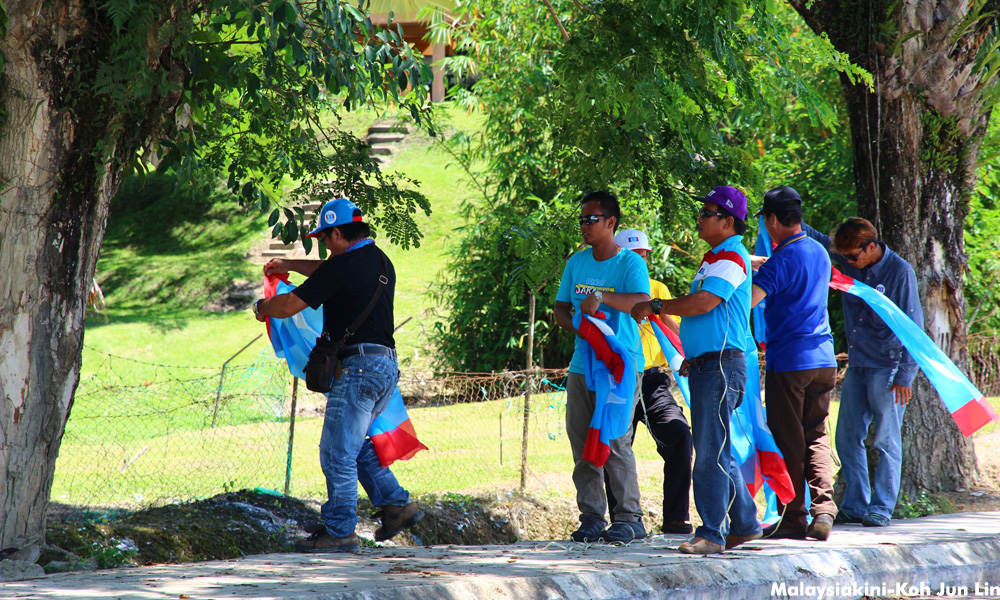

PKR inroads due to strong roots in rural areas
ANALYSIS PKR's performance in the interiors of Sarawak during the state election last Saturday is because they have deeper roots in the rural areas compared to DAP, said a political analyst.
“PKR did much better in rural areas simply due to brand recognition. The PKR symbol is much better known in the interiors unlike the rocket (DAP’s symbol).
“This works the other way in the cities, where the DAP’s rocket has better brand recognition.
ANALYSIS PKR's good performance in the interiors of Sarawak during the state election last Saturday is because it has deeper roots in the rural areas compared to DAP, said a political analyst.
“PKR did much better in rural areas simply due to brand recognition. The PKR symbol is much better known in the interiors unlike the rocket (DAP’s symbol).
“This works the other way in the cities, where the DAP’s rocket has better brand recognition.
“PKR has been present in rural Sarawak far longer than DAP which only emerged there these past few months, and that too, in only a few Impian localities,” said University Malaysia Sarawak associate professor Andrew Aeria when contacted by Malaysiakini.
He pointed out that Sarawak is huge, geographically, and rural Sarawak is underdeveloped in terms of infrastructure, so DAP’s Impian Sarawak project only managed to cover a few localised areas.
The impact of the Impian Sarawak project was limited compared to what the ruling government could do, he said, so people voted for BN as voters already knew it would continue to form the state government.
“Voting DAP would only see them being discriminated against by BN, especially if they are rural voters and completely dependent upon the BN government,” he explained.
Need to reach out
For DAP parliamentary leader Lim Kit Siang, the Impian Sarawak projects were never dictated by the constituencies the party planned to contest in.
“It was more about the need to reach out and provide basic needs not yet met by the government, and we are in no position to match government resources anyway,” he told Malaysiakini.
However, he refused to make comparisons between DAP and PKR’s election performance in the interiors of Sarawak.
He did point out that DAP was very close to winning Tasik Biru, but its efforts were hampered by visits to the constituency from Prime Minister Najib Abdul Razak and Sarawak Chief Minister Adenan Satem, among other prominent BN leaders.
DAP Wanita assistant publicity secretary Syerleena Abdul Rashid also agreed that the projects were not about getting votes but more about helping communities, though she admitted that PKR managed to retain its seats in the Sarawak interiors because it had a solid base there.
“(PKR had) strong support from locals. It has a solid base in these three constituencies,” she said.
She also explained that the three-cornered fights between DAP and PKR were what led to their defeat, as voters refrained from voting due to being upset over the fights.
Despite her claims that people refrained from voting due to the three-cornered fights, voter turnout was high in some of the rural areas they were contesting.
In Mambong, where she had campaigned and also where there was a three-cornered fight, turnout was 68 percent, and spoilt votes were an insignificant one percent.
Sarawak PKR chief Baru Bian attributed the party’s success in rural areas to its improved organisation, pointing out how candidates were selected much earlier this time around compared to the previous state election.
Apart from being more organised, Baru said issues brought up had indeed been relevant, citing the native customary rights (NCR) issue.
“The NCR issue is still very relevant. In my area, I think it’s still a relevant issue,” he told Malaysiakini.
Baru, who retained his Ba’kelalan state seat with an improved vote majority, also admitted that his party was confident that it was the preferred party in rural areas than any of its coalition partners.
“The people are more connected, accepting of our people,” he added.
On DAP’s Impian Sarawak projects, Baru said there were times when projects would work in getting more votes and there are also times when they would not.
For Baru himself, at least 10 mini-hydro projects were built in the Ba’kelalan constituency.
And PKR did go through with projects in several areas but Baru, however, is not in the know about the impact as the party has yet to see the voting patterns on the projects.
Ultimately, however, the PKR leader stressed that a continuous presence in a particular area and the services rendered are more important.
Gov’t can’t be outdone
Meanwhile, Selangor executive council member Elizabeth Wong - who assisted the party’s candidates in the Marudi, Batu Kitang and Mambong constituencies - said that the party had long contended that it cannot outdo the government in terms of development projects.
“I knew from the start that it would not sway votes. It merely felt good for peninsular voters to be contributing to a good and worthwhile cause - to assist the less fortunate. But it does not bring in votes,” she said.
Wong is of the same belief as Baru - that one needs to work on the ground in Sarawak.
“Most of our candidates have been working there between five and 10 years, at least,” Wong pointed out, adding that the party’s presence and flag held some sway in Marudi, for instance.
Commenting on the party’s ‘YB Angkat’ programme - a support system for candidates to obtain advice and encouragement from the party’s incumbent elected representatives - Wong said it had somewhat helped the party’s Telang Usan (Ronald Engan) and Mulu (Paul Baya) candidates.
“But their success is entirely all their hard work,” she said.
Ronald lost the Telang Usan constituency by a mere vote difference of 167 while Paul gave BN candidate Gerawat Jala a run for his money for the Mulu state seat.
For Kuantan MP Fuziah Salleh, who acted as the party’s campaign manager in Jepak, local issues were definitely more dominant than national issues.
Apart from the NCR, issues on land and poverty had resonated deeply among the locals, she said.
Although many locals were understandably angry over the issue of poverty, Fuziah lamented how they had, in the end, fallen victims to BN through the coalition’s last-minute goodies.
For the seat of Jepak, itself, although earlier ground sentiments were more of a win for PKR, the last-minute swing to BN had occurred due to the goodies dished out, said Fuziah.
‘Sarawak for Sarawakians’
Meanwhile, University of Tasmania’s Asia Institute director James Chin pointed out several reasons why DAP did not perform as well as it had hoped in the rural areas of Sarawak.
The first is that DAP focused on national issues such as 1MDB and Prime Minister Najib Abdul Razak’s alleged corruption, but Chin said that this was effectively countered by Sarawak Chief Minister Adenan Satem with the ‘Sarawak for Sarawakians’ sentiment.
“It (Sarawak for Sarawakians) was just ‘kopitiam’ talk, but it was very effective in countering it (DAP’s focus on national issues),” he said.
Secondly, he said that voters were very unhappy about DAP’s inability to solve the seat negotiations issue with PKR.
“Chinese voters in urban areas, we went all out to give you guys a chance to be a major party to represent the Chinese community and we expected you to be a major challenge to BN, but something as small as seat negotiations with PKR also they cannot settle,” he said.
Thirdly, though Chin said this was not a major factor, the voters felt that DAP did not come across strong enough on state rights, though he stressed that it was not DAP’s fault.
The problem is that DAP’s Impian Sarawak projects had too many West Malaysian leaders and volunteers involved, which was not received well by the locals, he said.
“This was very true for rural areas. A lot of the natives whom I spoke to, they said they knew immediately there were too many West Malaysians involved.
“This goes back to Adenan’s ‘Sarawak for Sarawakians’ thing. It’s just ‘kopitiam talk’ but during the election period, the sentiment of ‘kopitiam talk’ is very damaging,” he explained.
However, Chin did not think PKR did any better either in the interiors, despite the numbers of votes they managed to pick up in rural areas.
He said that one should not look at voting trends in this situation as voting trends do not matter in Sarawak and Sabah.
“Five years on, the trend can move any time. Statistical analysis only works in logical electorate, and the Sarawak electorate is illogical.
“You should measure success (in an election) not by number of votes, but by Members of Parliament elected,” he explained.
Despite that, he praised DAP’s campaign machinery during the state election, describing it as scientific and clinical.
Such an approach would have worked very well in other places in peninsular Malaysia, he said, but not in an illogical Sarawak electorate.
“They (DAP) put in a wonderful plan, but the only problem is Sarawak is not like the rest of Malaysia.
“The Sarawak electorate is very unpredictable, emotional and illogical. If you take the scientific approach, you will never be able to capture Sarawak politics,” he said.


Report this comment
Are you sure you want to delete this comment?
This action cannot be undone.