


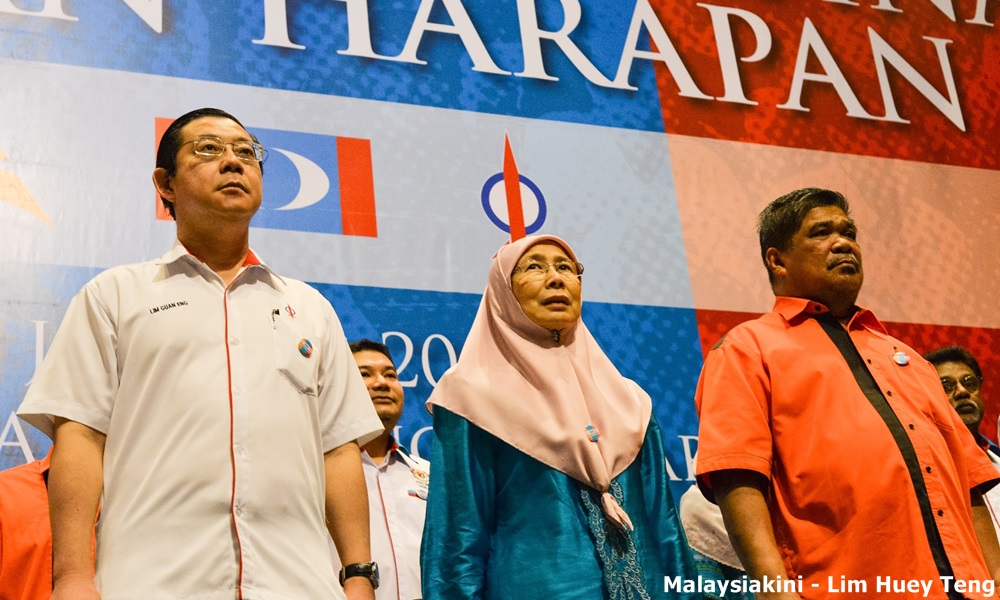

Harapan should stay out of twin by-elections, say analysts
Pakatan Harapan, particularly Parti Amanah Negara, has been warned to stay out of the upcoming by-elections in Sungai Besar and Kuala Kangsar as it would be counterproductive.
Political analysts say the consequence of more multi-cornered contests - as seen in the Sarawak election - would be worse than losing the actual by-elections.
Seeing opposition parties contesting against one another may cause voters to lose faith in the opposition, which had positioned themselves as the alternative to the BN government in the next general elections.
Indeed, it was this very issue that is said to have caused the opposition to suffer reversals in the recently concluded Sarawak elections, the polls marred by Harapan parties PKR and DAP facing each other in multi-cornered fights.
Pakatan Harapan, particularly Parti Amanah Negara, has been warned to stay out of the upcoming by-elections in Sungai Besar and Kuala Kangsar as it would be counterproductive.
Political analysts say the consequence of more multi-cornered contests - as seen in the Sarawak election - would be worse than losing the actual by-elections.
Seeing opposition parties contesting against one another may cause voters to lose faith in the opposition, which had positioned themselves as the alternative to the BN government in the next general elections.
Indeed, it was this very issue that is said to have caused the opposition to suffer reversals in the recently concluded Sarawak elections, the polls marred by Harapan parties PKR and DAP facing each other in multi-cornered fights.
To head off another disaster, the eight-months old opposition pact should let PAS stand in its traditional seats in the twin by-elections, to allow straight fights against Umno, said Ibrahim Suffian, the programme director of independent pollster Merdeka Centre.
"It is better to keep things simple. If PAS wants to contest both seats, it is best for the opposition let them. Let the Islamic party contest on their own and measure their own strength," he told Malaysiakini.
"The problem now is we have Amanah, which sees itself as the successor and replacement for PAS (in Harapan). Despite Amanah's enthusiasm, they should see that they do not have the political brand and outreach that PAS has," he pointed out.
The by-elections were triggered following the deaths of Deputy Plantation Industries and Commodities Minister Noriah Kasnon who was also Sungai Besar MP and BN Kuala Kangsar MP Wan Mohammad Khair-il Anuar Wan Ahmad in a helicopter crash on May 5.
Amanah has hinted that it may contest in Sungai Besar, a seat BN won with a slim majority of 399 votes in the 2013 general election.
While PAS, which is determined to stand in the two seats, has told Harapan to stay out of the by-elections.
Observers argue that Harapan and PAS should negotiate among themselves to ensure a straight fight against BN.
Or else, Ibrahim warned of a repeat of the seat clashes seen in the Sarawak state polls, which may dampen the voters' mood and further impact the turnout rate.
No opposition consensus
Agreeing, political analyst Tang Ah Chai said the failure to agree to straight fights may spill over to the next general election, unless the opposition can try to repair the situation by working towards a consensus.
"The by-election carries far more significance than winning or losing. If the opposition (Harapan and PAS) fail to arrive at a consensus, the people will harbour doubts against them.
"If you can't even come to an understanding on seat negotiations, how are you going to rule the country? This is what the voters will ask," he posited.
Despite its importance Tang however saw no effort among the opposition to engage in negotiations.
"From how I look at it, it seems very difficult (to arrange for a straight fight)," he said.
Though another political analyst Liew Wui Chern was more pessimistic about the chances of such a consensus.
"They talk about lessons learnt from the Sarawak state polls. But, the defeat hit DAP and PKR badly, but never PAS and Amanah.
"Both PAS and Amanah contested in the state poll, but they knew that they are not going to win anyway," he added.
Liew does not rule out the possibility of a breakdown in negotiations, even if there is one, as both parties seem adamant to stand in both seats.
Ball in PAS' court
But whether PAS will contest or not in the by-elections, both Ibrahim and Universiti Kebangsaan Malaysia (UKM) senior fellow Mohd Faisal Syam Abdol Hazis are sceptical if the Islamic party would go all out against its traditional rival - Umno - given its seemingly cordial relationship with the Malay party recently.
"It is interesting to see how PAS is doing things now, would it let Umno have an easy win?" questioned Ibrahim.
The analysts argue that PAS must now choose its stand.
Faisal said that this is where PAS needs to be put on the spot and asked to make a firm decision on where it really want to fit in the whole Malaysian context.
"Harapan should allow PAS to make a stand, whether they want to be really close to Umno or it want to be in the opposition. The common enemy of the opposition is Umno, not PKR and DAP," he noted.
Faisal said that if PAS chooses to be a BN friendly party, it should apply to join the ruling coalition rather than choose to contest in the twin by-elections.
Though Ibrahim warned that the PAS leadership will be at the losing end if it decided to give Umno an easy win, as they would have a tough time answering to the grassroots about the need to cooperate with Umno.
In any case, despite being a predominantly Malay seat, Sungai Besar has a 31 percent Chinese and two percent Indian population while Kuala Kangsar has 24 percent Chinese and seven percent Indian population, which may change the dynamics of the game.
Non-Malays may reject PAS
And the analysts believe that the non-Muslim voters in particular may not vote in favour of PAS, given its hardline Islamic policy stance, particularly its determination to implement hudud.
"Of course PAS will not touch on the hudud issue in its campaign, but MCA will harp on it. MCA may not be able to persuade these voters to swing back to BN, but it may be successful in making them not to come out and vote," said political scientist Wong Chin Huat.
Wong acknowledged that the diverging ideologies among the opposition, makes it all the more complicated for them to deal with each other.
He proposed that PAS allow PKR to contest in Sungai Besar, so PAS would not have to deal with the 33 percent non-Malay voters, while Harapan can campaign for the Islamic party in Kuala Kangsar.
Tang however noted that Harapan, especially DAP may risk angering the non-Malays if they were to cooperate with PAS, be it in the by-election or in next general election.
But be that as it may, he argued that the opposition parties need to cooperate among themselves as none of them can win the by-election or the next general election on their own.
He said if the opposition party are able to suppress their rivalry and cooperate, then they may show that they are capable of collective governance, rather than just harping on particular issues to attract the voters.
"Part of the reason why the opposition failed in the Sarawak state polls, was they couldn't come out with a constructive idea of forming the state government," he stressed.


Are you sure you want to delete this comment?
This action cannot be undone.