
The ABC of Guan Eng’s corruption charges
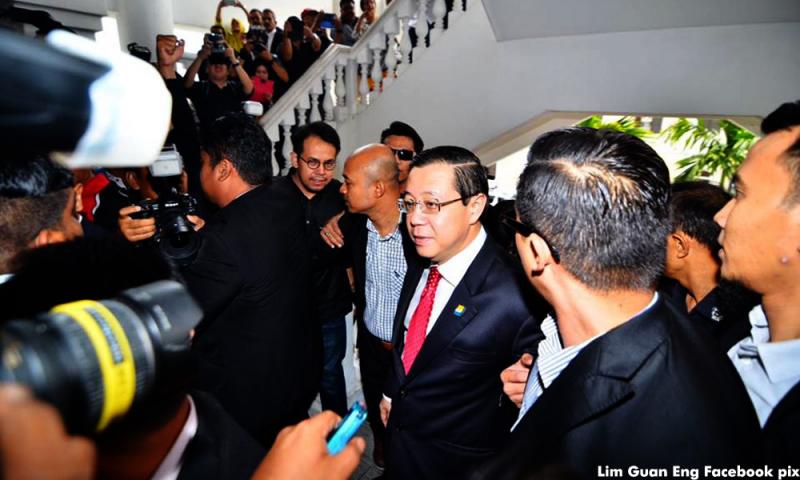
KINIGUIDE Penang Chief Minister and DAP secretary-general Lim Guan Eng was slapped with two charges of corruption yesterday.
Also charged was businesswoman Phang Li Koon, who is accused of abetting Lim to commit the alleged offences.
In this instalment of KiniGuide, we break down the details in the charge sheet and take another look at Lim’s bungalow scandal.
What happened yesterday?
Lim and Phang were charged at the Sessions Court in Penang and their cases were immediately transferred to the High Court in Penang. The charges were personally brought by attorney-general Mohd Apandi Ali.
Once at the High Court, the duo pleaded not guilty to their respective charges and claimed trial.
Lim has since been released after posting a RM1 million bail, with one surety, while Phang posted a RM200,000 bail with one surety.
You can read more of what transpired in court in Malaysiakini’s live reports yesterday.
What were Lim’s charges about?
Lim’s first charge is under Section 23 of the Malaysian Anti-Corruption Commission Act 2009 (MACC Act), which criminalises the use of a public office for personal gratification.
The law presumes that the officer (in this case, Lim) has used his office for gratification when he makes a decision in which he, a relative, or his associates, have a direct or indirect interest in.
The burden of proof would be on Lim to challenge this presumption, rather than for the prosecution to show that he has actually benefited from the decision made.
Lim was accused of having committed this offence on July 18, 2014, at a Penang State Planning Committee meeting by approving the re-zoning of a land from agricultural to housing in favour of Magnificent Emblem Sdn Bhd.
This is purported to have benefited him and his wife, Betty Chew...
KINIGUIDE Penang Chief Minister and DAP secretary-general Lim Guan Eng was slapped with two charges of corruption yesterday.
Also charged was businesswoman Phang Li Koon, who is accused of abetting Lim to commit the alleged offences.
In this instalment of KiniGuide, we break down the details in the charge sheet and take another look at Lim’s bungalow scandal.
What happened yesterday?
Lim and Phang were charged at the Sessions Court in Penang and their cases were immediately transferred to the High Court in Penang. The charges were personally brought by attorney-general Mohd Apandi Ali.
Once at the High Court, the duo pleaded not guilty to their respective charges and claimed trial.
Lim has since been released after posting a RM1 million bail, with one surety, while Phang posted a RM200,000 bail with one surety.
You can read more of what transpired in court in Malaysiakini’s live reports yesterday.
What were Lim’s charges about?
Lim’s first charge is under Section 23 of the Malaysian Anti-Corruption Commission Act 2009 (MACC Act), which criminalises the use of a public office for personal gratification.
The law presumes that the officer (in this case, Lim) has used his office for gratification when he makes a decision in which he, a relative, or his associates, have a direct or indirect interest in.
The burden of proof would be on Lim to challenge this presumption, rather than for the prosecution to show that he has actually benefited from the decision made.
Lim was accused of having committed this offence on July 18, 2014, at a Penang State Planning Committee meeting by approving the re-zoning of a land from agricultural to housing in favour of Magnificent Emblem Sdn Bhd.
This is purported to have benefited him and his wife, Betty Chew.
The said land is located at Lot 436 and 437, Mukim J, Daerah Barat Daya, Penang.
Upon conviction, Lim can be jailed for up to 20 years, as well as pay a fine of no less than five times the value of the gratification, or RM10,000, whichever is higher. He will also face a five-year ban from active politics after serving his sentence.
Lim’s second charge is under Section 165 of the Penal Code, which bans public servants from accepting valuables from someone whom the public servant knows is likely to be linked to a public business that he is engaging in.
In Lim’s case, he is accused of knowingly buying a bungalow at Jalan Pinhorn, Penang, at below market price. Lim and Chew now reside in the bungalow.
According to the charges, Lim purchased the house from Phang on July 28, 2015, which is over a year after the land conversion was approved.
The 10,161.13 square-foot property was supposedly worth RM4.27 million at the time, but was transacted at only RM2.8 million – an alleged difference of RM1.47 million.
If convicted on this charge, Lim can be imprisoned for up to two years, fined, or both.
What about Phang?
Phang is the owner of Magnificent Emblem Sdn Bhd, and she also has a stake in several other companies. She is the former owner of Lim’s bungalow.
The businesswoman was charged under Section 109 of the Penal Code for abetting an offence, referring to Lim’s second charge. It was read together with Section 165.
If convicted, Phang can be imprisoned for up to two years, fined, or both.
But wasn’t it about the Taman Manggis land awhile back?
Penang Umno, which accused Lim of buying the Jalan Pinhorn Bungalow at below market price, had at that time linked it to the Taman Manggis land deal.
The 0.4-hectare plot along Burma Road, Penang, was sold to Kuala Lumpur International Dental Centre Sdn Bhd (KLIDC) in 2012 for RM11.6 million, through an open tender.
Lim does not sit on the tender committee, while Phang has no stake in KLIDC. However, some had argued that KLIDC’s majority shareholder, Tang Yong Chew, is Phang’s business partner in another company, Windbond Management & Consultant Sdn Bhd.
Nevertheless, the Taman Manggis issue was not mentioned in Lim and Phang’s charge sheets. The matter may still resurface during their trial, but for now, the issue appears to be moot.
For more information on the Taman Manggis row, check out a previous instalment of KiniGuide here.
What’s the story about the bungalow?
The 10,161.13 square-foot property is located at 25, Jalan Pinhorn, Penang.
According to previous media reports, Phang originally bought the property for RM2.5 million, or RM246 per square foot, on Sept 27, 2008.
She then had the building renovated and later rented it to Lim for six years at RM5,000 per month, before finally selling it to Lim.
Lim bought it for RM275.56 per square foot on July 28, 2015, or at a total cost of RM2.8 million.
You can read more about Lim’s bungalow purchase in a previous instalment of KiniGuide here.
What became of the Taman Manggis land and the Magnificent Emblem land?
The Taman Manggis land had been earmarked as the site of the Penang Island Dental College, which will include a 200-chair dental hospital, resource centre, hostel and recreational facilities.
However, the site remains undeveloped to date. Despite allegations on the contrary, the land is reportedly still majority-owned by KLIDC.
As for the Lots 436 and 437 that Magnificent Emblem sought to develop, a federal government website listing development projects states that the company’s application for planning permission was rejected on Dec 1 last year by the Penang City Council.
According to Lim yesterday, it is still classified as agricultural land.
However, it should be noted that the ultimate fate of the land is irrelevant in proving the charges.
For Lim’s first charge, the only facts that would be salient are whether Lim had indeed made a decision - any decision - in relation to the land conversion application, and whether Lim can prove that he did not benefit from the decision.
Why does all this sound so familiar?
Since Lim’s arrest on Tuesday evening, comparisons had been drawn between his bungalow purchase and that of former Selangor menteri besar Dr Mohd Khir Toyo.
Khir had bought two plots of land at No 8 and 10, Jalan Suasa 7/11, Shah Alam from Ditamas Sdn Bhd director Shamsudin Hayroni on May 29, 2007.
He then demolished a bungalow sitting on one of the plots and replaced it with a Balinese-style mansion.
Like Lim and Phang, Khir was subsequently charged under Section 165 of the Penal Code, while Shamsudin was charged under Section 109 of the Penal Code, read together with Section 165 of the same code.
However, unlike Lim, Khir was no longer a menteri besar when he was charged on Dec 6, 2010, having lost the post in the aftermath of the 2008 general election.
The charges against Khir and Shamsudin were brought by then attorney-general Abdul Gani Patail, who urged for a RM1 million bail for each person. However, the court set the bail at RM750,000 instead.
Like Lim and Phang, Khir claimed that the transaction was done on a willing-buyer, willing-seller basis.
However, the High Court in Shah Alam was unimpressed with Khir’s arguments and found him guilty. Khir’s subsequent appeals were unsuccessful.
The Federal Court found that while Khir paid RM3.5 million for the property, it was actually worth RM5.5 million at the time of the transaction, citing two valuation officers.
Khir was sentenced to one year’s imprisonment but only served eight months. He has since been released on parole and is now free.
The property, however, was forfeited.
Lim objects to being compared with Khir.
“Unlike Khir Toyo’s case, Phang did not make a loss of RM5 million but recorded a small profit of RM300,000 from her original purchase price of RM2.5 million.
“Unlike Khir Toyo’s case, Phang is not a housing developer who has to be reliant on the state government to continue her business,” Lim said.
This instalment of KiniGuide is compiled by KOH JUN LIN.


Are you sure you want to delete this comment?
This action cannot be undone.