




Q&A: Professionalism over politics in labour issues
The MTUC, in embracing a new philosophy combining politics and professionalism, is clear about drawing a distinction between political interests and professional conduct.
Its president Syed Shahir Syed Mohamud, himself a member of an opposition political party, shares his vision with malaysiakini in a series based on an exclusive interview with malaysiakini .
The MTUC, in embracing a new philosophy combining politics and professionalism, is clear about drawing a distinction between political interests and professional conduct.
Its president Syed Shahir Syed Mohamud, himself a member of an opposition political party, shares his vision with malaysiakini in a series based on an exclusive interview with malaysiakini .
Malaysiakini: Are you a member of Parti Keadilan Rakyat (PKR) and do you plan to contest in the next general election? Did you also decline a nomination during PKR's congress last December in Ipoh?
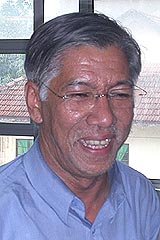 Syed Shahir:
I am a PKR member but whether or not I will contest in the next election is for the party to decide. At the moment, I'm not holding any posts in PKR and yes, I did turn down a nomination for the post of the executive council member. I wanted to focus on the MTUC work as I cannot be doing work here and there at the same time. Even now, I need more time to sort out the workload here.
Syed Shahir:
I am a PKR member but whether or not I will contest in the next election is for the party to decide. At the moment, I'm not holding any posts in PKR and yes, I did turn down a nomination for the post of the executive council member. I wanted to focus on the MTUC work as I cannot be doing work here and there at the same time. Even now, I need more time to sort out the workload here.
The situation now is that each of us has political beliefs. I have the right to be a member of any party and nobody can deny me the opportunity to exercise a right guaranteed by the Federal Constitution. Whether or not I can be actively involved in politics is a different matter. My position in the MTUC does not stop me from attending political ceramah (talks) or if I'm invited to speak on workers' issues.
In fact, (opposition parties) PAS and DAP have invited me to speak at a workers' programme and the restoration of local government election respectively. While I've not been invited by the ruling coalition (Barisan Nasional), I have no problems if the slot is (one provided) for workers. Recently, I spoke at a Jakim (Malaysian Islamic Development Department) programme on understanding the concept of Islam Hadhari .
What are you going to do about the perception of the MTUC as a pro-opposition body coupled with your membership in PKR?
Well, people can say anything (they want) but they can also see your conduct and your practice. We will be gauged by that, by the language in the press, the statements you make. People are not stupid and they understand what you are doing. In the end, they decide whatever they want to. I also don't think that our working relationship with the government would be jeopardised. From my experience over the last 100 days, I didn't have much problem. In fact, I managed to create good rapport with (Human Resources) ministry officials and even the minister. We worked, we talked, we discussed and they are also quite open sometimes. I've visited them and they've invited me for their programmes.
The idea that I want to implant in my friends and colleagues in the MTUC is that you can't expect everything to happen just like instant noodles, within two minutes. We have to consciously work on raising the awareness. We've been getting a lot of calls from members, employers, government officials and affiliates who want to have a discussion with us. This is a good sign. I don't see why we cannot work with these parties if it will benefit the workers. If we have an opening with any of these parties, then we could include a much bigger and specific issue of national interest.
Ministry officials including the minister have contacted me to discuss several issues pertaining to workers, which I find to be quite an interesting development. I've always emphasised on dialogue, which seems to be the practice nowadays. We want to have a continuous dialogue with officials, the minister and among our affiliates. In fact, we're meeting with the Industrial Court chairpersons for a discussion on outstanding issues that need to be resolved immediately. We are trying to create a more pleasant working relationship between all parties.
Our agenda is (focused on needs of) workers. If you're retrenched, the employer will not ask you whether you are a member of any party and withhold the retrenchment. I don't think so. But you will still be retrenched regardless of your party membership if they go by way of the last in, first out (principle). On that basis, we have to have a clear mind on where we're heading. I think this is where we really need to understand workers' aspirations. For instance, if I'm a member of a party and someone from another party was retrenched, I can't tell him I won't help him. The bottom line is professionalism. It is immaterial whether or not you're a member of the party.
At the same time, you cannot detach yourself from politics. Politics and political parties are two different things. I believe it's naive for a person to say he or she is apolitical. This is impossible because everything you do is political in nature. For instance, my comment as the MTUC president on the recent pay hike for members of Parliament would be a political statement but my political inclination is a different issue. I've been involved with political parties for some time and I cannot simply detach myself from politics now.
Would you consider accepting a datukship or senatorship if you were offered either/both, based on the track record of your predecessor as well as the leader of a very large union?
Oh, this is something very heavy for me (laughs). Oh my God! I don't know what to say. This is the last thing I want to answer. Look, by not being conferred anything yet, I'm already carrying the title datuk (grandfather) by virtue of having two grandchildren (laughs). Should that happen, I think I'd have to bring this to my working committee, (to hear) what they say about it. It will be a collective decision and I don't know which way it will go. But given a choice, I'd prefer not to accept it.
Titles are conferred because of the post you hold and the organisation you represent. Talking about accountability and responsibility, of course, I need to (refer) back to my constituents or else, we shouldn't talk about collective decision and teamwork. If a title is conferred to you based on the post you get by yourself, then it's a different story. In my case, I'm the president of the MTUC. I was put here by the people. At the moment, I'd rather avoid all this... it's disturbing my focus.
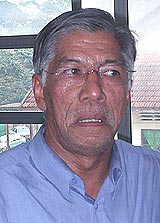 Much as we don't like to idolise or iconise a person, that is the reality in our country. There is a certain element of interest, charisma which makes people listen to you. You have a certain quality, a certain standing or something that they like to listen to. You'll have your own followers who love you for whatever reason.
I don't know if I'm one of them and I can't really say that I look at myself that way, except that maybe one or two people had told me so. Having said that, I know that my job involves cleaning up and mobilising the membership. It is important to know what people want. We have to clean up (in the MTUC) whatever that's left behind (by the previous leadership), a sort of damage control, before we can move forward in full force.
What are your plans to enhance the MTUC's professionalism and image/quality following widespread public perception that it has either been co-opted by the government or stuck in a time warp unable to handle increasingly challenging situations?
You cannot run away from the fact that workers now, at least to a certain extent, possess certain academic qualifications. I'm not saying that this is the criteria but I think they are now at a stage where they possess a certificate or a diploma or a degree. Their standard is expected to be higher than others. In other words, by virtue of them being able to read, write and articulate their views will definitely bring about improvement in terms of professionalism. This is where I think we need more people with a combination of good academic qualifications and experience. More importantly, we need people of conviction. I mean, you have academic qualification and good experience (but) if you don't have (any) conviction, there's no point to it all because you're going to sit down and not work for the union, perhaps even say "why should I work, because the union is paying me peanuts?".
The second point is, we talk about transparency and accountability. We have to practise what we preach. We cannot say to others "you must be transparent" when we ourselves are not. We want the kind of leadership that is open and clear on what we're doing. Then, we can tell the constituents that "I tried, I tried my level best but I just couldn't do it". Let's take the open office concept. A committee must be open to others and not remain as an exclusive kind of thing. Everyone should know what's going on, the plans, projects, objectives, at least among the affiliates. How do you translate this (into practice)? By having more frequent meetings and minuting the decisions accordingly. Also, we're talking about consensus where anything that is decided upon is done collectively. This is where all of us are subject to public scrutiny.
What policy changes are you planning within the MTUC to achieve this?
A policy change is not necessary because transparency is not about policy, it's about practice. Take for example the open-door concept. You allow people to come in and talk to you, there is less protocol. All this are required to build the image of the MTUC and its affiliates. I always emphasise to my colleagues to go to the ground...go to your base, this is where your strength (is). I ask them, "why are you here?" (It is) because of the membership, because of the union. And why the union? Because of the membership. So, what do you do? You have to go back to them, talk to them, understand their problems. It is about going back to basics.
We have emphasised that training must be easily accessible to our affiliates without being too theoretical. For example, we have to be practical about training manuals and seminars which are suitable for adult education. The aim is to encourage more critical thinking, more articulate arguments and this is possible only if workers know what is happening around them, why certain statements are made and by whom. At the same time, there are also practical problems such as finding the time to read or watch TV. Most of the time they're working because the responsibility and the burden on them is tremendous. They've got schoolgoing children, in college or university, the need to feed them, house them. It's a very tough life for workers out there. But I'm quite positive about it. If the number counts and if we can mobilise workers, consolidate them, put them into unions affiliated to the MTUC and the numbers grows, I think we can do a lot, reach a lot of people.
What are your plans to raise the political consciousness among workers, given the legal limitations on the labour movement?
In Korea, for example, many things changed. But we're not going follow them, that's also important to note. The issue is not merely to demonstrate, picket or strike, which also doesn't mean that we can't carry them out if the need arises. What I'm saying is that if we can bring about this political consciousness, people will know their rights, be more critical and more articulate, form unions and join the MTUC. Then, we can become a force to reckon with and able to do a lot more, like ask the political parties whether or not they support us on our minimum demands. This is what we need people to understand, and we want to support the (political) party that genuinely and historically has proven that it's going all out for workers.
Previously, there were efforts to conduct political education but it was not serious enough. There was also some kind of a split in the leadership over this. The argument against pursuing political education was that the MTUC should be apolitical. But now, as and when there is a need, we will meet and discuss (the need for) political consciousness among other things. At the moment, we have enough committees to handle various issues.
As I've said earlier, everything we do is political and therefore it is all part of the same thing. For example, the consumer committee is now working on water privatisation, healthcare financing and research. We can only create political consciousness through seminars and training programmes, or by distributing flyers and newsletters on Labour Day. Of course, we are also encouraging people to get into IT. The MTUC has a website and I was told that we're getting somewhere between 5,000 and 7,000 hits a day, which I think is quite an interesting development.


