




Key to unlocking shackles of self-policing
Trade union leaders must first know their constitutional rights before they can free themselves from the shackles of self-policing or self-censorship, said Malaysian Trades Union Congress (MTUC) president Syed Shahir Syed Mohamud.
Trade union leaders must first know their constitutional rights before they can free themselves from the shackles of self-policing or self-censorship, said Malaysian Trades Union Congress (MTUC) president Syed Shahir Syed Mohamud.
He was responding to comments last week by veteran unionist A H Ponniah, who had called for trade unions to break free of executive control and to strengthen the movement by formulating a clear and open national labour policy.
 Ponniah said that, without this, the movement will continue to suffer from inertia, giving the government the edge in pushing for amendments to labour laws that will adversely impact workers' rights.
Syed Shahir blamed the prolonged mental conditioning of the labour movement over the years for its overly-cautious approach in handling trade disputes and when demanding workers rights.
"The movement's leaders should first shed their own perception that every trade union activity must be accompanied with a permit or should be sanctioned by the government," he said in an interview.
"This is a wrong attitude as it has led to some trade union leaders embracing self-policing and self-censorship."
Syed Shahir conceded that not many union leaders know that the right to peaceful assembly is a constitutional right.
"Take the right to strike, for example. How many leaders dare to carry this out although it is a legal right?
"I agree with what (Ponniah) is saying. But to get (to that point), union leaders must know their rights. Only then will there be mindset change and the courage to break free and get out of the cocoon."
Active approach
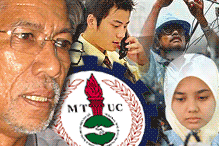 On the MTUC's shifting role, Ponniah had noted that as an umbrella organisation, it should be focused on formulating national labour policies instead of solving "household issues" involving affiliates.
While acknowledging the point, Syed Shahir maintained that the base has to be strengthened first.
"We're in the midst of consolidating and mobilising affiliates and members to adopt an active participatory approach in labour issues through teamwork.
"But it takes time to strengthen the membership base. We would rather not do it drastically. We prefer to be more systematic and consistent."
Referring to his Labour Day speech, Syed Shahir said thrusting the MTUC into the mainstream of policy-making is not a new issue.
"We realise it is something that must be done, and done quickly and properly because the challenges are increasingly difficult and workers' rights are being steadily and gradually eroded."
He said, however, that a large section of trade union leaders did genuinely believe that they were on the side of national interest and public order.
"This is where the young people come into the picture of a changing labour movement and taking over, bringing with them a different kind of thinking. Why must anyone think that by holding a strike, we are trying to destroy the country?"
Noting that provisions on organising strikes were tightened in the 1970s, he said the government should not treat workers like juveniles.
Arguments that trade unions were aping the West, he said, were outdated and no longer held water.
"Whenever we protest or hold pickets, the government says we're aping the West. But wouldn't wearing ties and business suits also be aping the West too?"
Syed Shahir said trade union actions were only aimed at "getting what is rightfully ours".


Are you sure you want to delete this comment?
This action cannot be undone.