


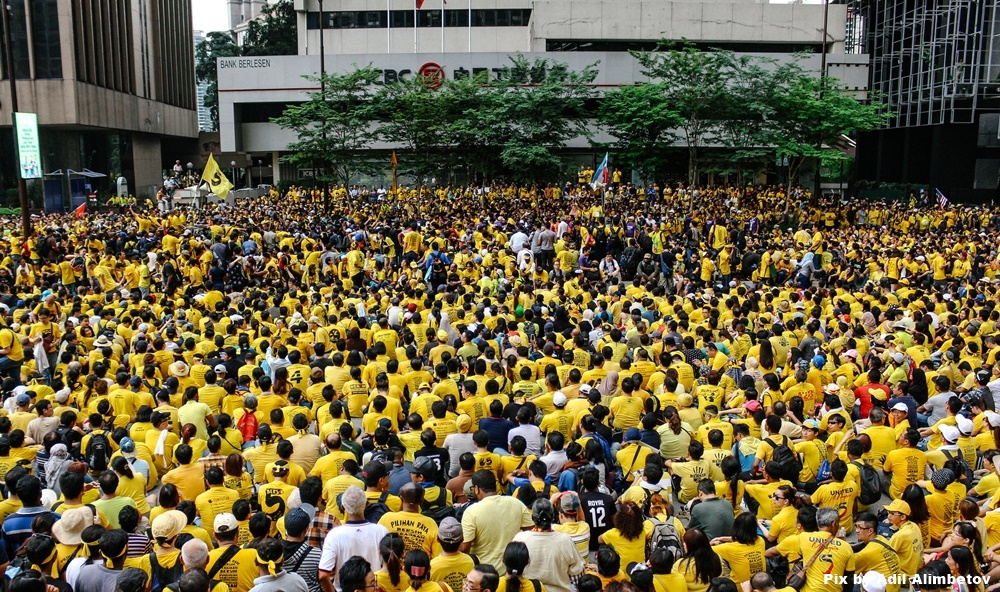

Can the Bersih movement bring change?
The first Bersih rally in 2007 was widely hailed as having contributed to the ruling coalition's loss of its all-time two-thirds majority in Parliament, while the Bersih 2 rally in 2011 prompted the government to set a parliamentary select committee on electoral reform.
However, after five Bersih rallies - the most recent being last Saturday - the question now is where the movement is at. And, is it still capable of bringing the changes it seeks in Malaysia?
The first Bersih rally in 2007 was widely hailed as having contributed to the ruling coalition's loss of its all-time two-thirds majority in Parliament, while the Bersih 2 rally in 2011 prompted the government to set a parliamentary select committee on electoral reform.
However, after five Bersih rallies - the most recent being last Saturday - the question now is where the movement is at. And, is it still capable of bringing the changes it seeks in Malaysia?
These questions were raised at a post-Bersih forum titled ‘Bersih 5 Lessons’ in Kuala Lumpur yesterday.
One of the panellists, Universiti Malaya senior lecturer Khoo Ying Hooi, said the people should appreciate that the process of change, through protests, may take time.
"(The changes) are not immediate," Khoo told the forum organised by The Society for the Promotion of Human Rights (Proham).
She added that in the context of Malaysia, change is not likely to take place on the back of protests alone.
Khoo said follow-up actions need to be undertaken to bring about meaningful change.
"It is not easy to measure the success of a movement," she conceded.
A question on many people's minds, she said, is whether rallies are still relevant in Malaysia.
The definitive answer, she said, is an emphatic ‘yes’.
"Rallies take place all over the world, be these in a democratic or autocratic country.
"Street rallies are relevant in all corners of the world and will always be," she said.
Another speaker at the forum, Bersih steering committee member Rama Nathan reflected on the Bersih 5 rally and the convoys that were carried out to promote it.
Rama commended the police on the ground for a job well done but admonished those in the higher echelons.
The decision of the police to use the Security Offences (Special Measures) Act 2012 (Sosma) against Bersih chairperson Maria Chin Abdullah, but not against red-shirts leader Jamal Md Yunos, shows their bias, Rama said.
‘Misinformation campaign’
Rama also condemned the actions of the police in arresting opposition politicians and activists before and after the Bersih 5 rally, claiming that this was part of their "misinformation campaign".
"They want to give you an impression that Bersih is a tool of the opposition," Rama said.
The Bersih 5 rally and the red-shirts counter-rally took place simultaneously in Kuala Lumpur on Nov 19.
Malaysiakini estimated the Bersih rally to have numbered 40,000-strong at its peak, while the red-shirts number peaked at 4,000.
However, the Bersih 5 organisers put the crowd at 100,000, while the police claimed a turnout of 15,000. These figures are nevertheless lower than in earlier Bersih and red-shirts rallies.
Maria and Jamal were both arrested on the eve of the rallies, but the red-shirts leader was released four days later.
Maria, who is held under Sosma, can be detained for up to 28 days. It has also been reported that she is being held in solitary confinement.
The Bersih 5 rally last Saturday made five demands - for clean elections to be held in the country, for a clean government, for parliamentary democracy to be strengthened, for citizens to have the right to dissent freely and to empower Sabah and Sarawak.


