




Youth chief: PAS ulama council neither alive nor dead
PAS' Majlis Syura Ulama (Consultative council of religious scholars) has been told that it must re-invent itself in the face of new challenges and to meet the aspirations of members of this era.
PAS' Majlis Syura Ulama (Consultative council of religious scholars) has been told that it must re-invent itself in the face of new challenges and to meet the aspirations of members of this era.
Equating the present state of the council to an old Malay saying in Malay " hidup segan mati tak mahu " (neither alive nor dead), PAS Youth chief Salahudin Ayub pointed out that he has no intention to demean the contributions made by the council in the past, but the current weakness was too glaring to ignore
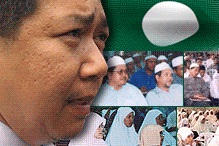 In his policy speech at the opening of the PAS Youth muktamar in Kota Baru last night, Salahuddin said that the council - which is the supreme institution in the party that guides the policy making process - has failed to live up to the expectations of many in the party.
"The council should not only give religious guidance on issues affecting women and ties with non-Muslims. It must also provide guidance on other issues like banking, science and technology so that its presence can be felt more," he said.
He pointed out that the process of empowering the council seemed to be on a standstill with the absence of a clear second echelon leadership, lack of commitment from the new generation ulama and the council's failure in its research for syariah laws applicable to the present scenario.
"We worry as the young ulama seem to be comfortable with the status quo and if this continues, the ulama leadership concept will not be inherited by credible ulama," said Salahuddin who is also the Kubang Kerian MP.
"Have we identify anyone to take over from Tuan Guru Nik Aziz and Abdul Hadi Awang? Are we merely hoping for a miracle that there will be credible replacements for these two top leaders without proper planning?"
He proposed that by next muktamar , a quota for young religious scholars to be elected into the council will set the tone for the grooming up of future leaders.
"We hope that in five years, we will be able to see some success," he added.
Continuing his speech, Salahuddin also touched on the need for the party to do some "self-reflection" adding that the existing internal problems will be a threat to the party's well-being if left unattended.
Lost touch with grassroots
"We think that we are strong; we stand at the window looking out and criticising the weaknesses of others. Today, we must be bold enough to stand in front of a mirror and reflect on our own shortcomings," he said.
He also said there is a need to reform the attitude of PAS leaders that has lost touch with the grassroots and are seen to be more occupied with luxury lifestyle.
"Some of these leaders are too comfortable driving luxury cars, wearing branded clothes, building palaces, staying in expensive hotels and fascinated with the titles of Datuk and YB. They can no longer care for the sufferings of the farmers, squatters, settlers, fishermen and hungry labourers."
"What worries me that these leaders are repeating the mistakes of Umno and Barisan Nasional leaders in ignoring the people's need and welfare."
He also spoke on the party's need to strengthen the opposition coalition stating that past coalitions - 1986's Harakah Keadilan Rakyat (HAK), Angkatan Perpaduan Ummah (APU) in 1990 and 1995 and Barisan Alternatif (BA) since 1999 - bore positive results.
"We hope Anwar Ibrahim will be the factor to unite the political parties and together with the people's power, a strong coalition will rise to face the Barisan Nasional."
He also expressed his support to Anwar's proposal to rename the coalition " Barisan Rakyat " (People's Coalition) and hoped that other opposition parties including DAP will be a willing partner to the coalition.
Salahuddin had noted that political phenomenon in the country is imbalanced due to many factors including the concept of Islam Hadhari introduced by Pak Lah, worsened corrupt practices, deteriorating social ills and the failure of the education system in moulding the young to be responsible citizens.
He also described the "threats by certain factions in society" that aim to challenge and discredit the purity of Islam as a multi-dimension challenge to PAS.


Are you sure you want to delete this comment?
This action cannot be undone.