




Anwar could reignite reformasi movement
Vigour could return to the reformasi movement if ex-deputy premier Anwar Ibrahim picks up from where he left off, said his friend and Indonesia's former parliamentary speaker Dr Amien Rais.
Vigour could return to the reformasi movement if ex-deputy premier Anwar Ibrahim picks up from where he left off, said his friend and Indonesia's former parliamentary speaker Dr Amien Rais.
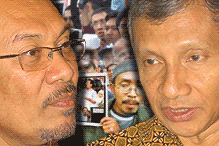 "However, I am aware that it is not easy for him to re-enter the political arena. Not only does he face some political restrictions, I was told he has to wait for a few years to be able to enter politics. And it depends on the perception of the Malaysian people," he added.
As a result of his conviction and six-year imprisonment for corruption, Anwar is barred from holding any political office for five years.
The politician, released last year after his sodomy conviction was overturned by the Federal Court, is now the adviser to Parti Keadilan Rakyat (PKR), helmed by his wife Dr Wan Azizah Wan Ismail.
Amien, in a recent exclusive interview with malaysiakini , said Anwar enjoyed a 'unique position' as his charismatic leadership appeals to people from all walks of life, both here and abroad.
"...when he speaks people listen and the international community from the Middle East to Washington are sympathetic towards him.
"This is his unique position. He is accepted widely by Arab countries but at the same time Washington, London and Paris are also very much sympathetic to him too. So this is unique," he added.
Amien, who was in Kuala Lumpur to attend a forum organised by PKR over the weekend, said this when asked to comment on the status of the reformasi movement here.
Pak Lah not serious
 The Indonesian politician, who was among the key figures behind Indonesia's
reformasi
movement, also believed that Prime Minister Abdullah Ahmad Badawi is not serious in pushing for reforms and that it is 'business as usual' here.
The Indonesian politician, who was among the key figures behind Indonesia's
reformasi
movement, also believed that Prime Minister Abdullah Ahmad Badawi is not serious in pushing for reforms and that it is 'business as usual' here.
"Malaysia , it ( reformasi ) is only in its inception...the beginning level. Probably because (ex- premier Dr) Mahathir (Mohamad) had been in power for too long and I don't see Pak Lah (Abdullah) seriously changing the political substance in the country.
"I think it's business as usual... I mean under Abdullah, I see politics in Malaysia as business as usual," he said.
Amien also stressed on the importance of support from university students for the reformasi movements.
"... I believe it is only students who can initiate reforms. But if students are complacent and not sensitive enough to the political ecology and environment, there will be no hope that reforms will take place. Students are the key factor," he said.
He warned that Malaysian students will become 'social parasites' if the grief of others fails to impact their lives.
"...if students concentrate only on their studies, go to libraries and spend most of their time reading, when they graduate they will be very insensitive..I mean...they would only think of flashy cars, good houses and big income and that's it...I think these kind of students could become social parasite," he added.
Malaysia-Indonesia ties
According to Amien, besides Indonesia, no other South East Asian nation has undergone serious reformation.
The 1998 reformation movement in Indonesia not only saw the falling of the 32-year ruling of Suharto but also amendments to its Federal Constitution which ended the dual function of the military ABRI ( Indonesia's People Armed Forces) and provided freedom of expression and information.
On the ties between Indonesia and Malaysia, Amien said the two countries, which share many common traits, must not only resort to formal diplomatic ties in solving problems like the illegal immigrants issue which he believed could have been handled in a better manner.
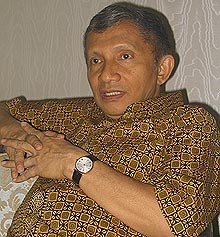 "I think as two brotherly countries any issues or problems must be solved through deliberations or musyawarah... not only through formal diplomatic channels. I think the leaders of the two countries can always meet each other in Kuala Lumpur or Bogor in Jakarta because we are only about an hour and a half flight away from one another.
"Every time I see Indonesian workers return from Malaysia and treated sometimes like sub-human...I protested. I criticised Mahathir severely and harshly for imposing the whipping sentence - an archaic law used in the Roman empire," he added.
Illegal immigrants in Malaysia face a stiff punishment such as jail and whipping.


Are you sure you want to delete this comment?
This action cannot be undone.