




PJ residents see red over changes to local plan
Thousands of Petaling Jaya residents are enraged that the municipal council had drafted changes in their areas without consulting them.
Thousands of Petaling Jaya residents are enraged that the municipal council had drafted changes in their areas without consulting them.
The 10,000-odd residents from different parts of PJ insist that the proposed changes benefit no one but the proponent.
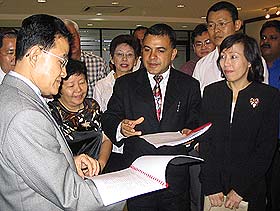 According to them, even the PJ Municipal Council (MPPJ) is clueless as to who had initiated the amendments to the gazetted local plan, a 10-year development blueprint for the densely-populated suburb.
Alleging mal-administration and lack of transparency and accountability, the residents now want the state and federal governments to scrap the proposed changes.
Protest memo
To record their dissatisfaction, about 20 representatives from 11 residents associations and neighbourhood watch groups in Sections 5, 8, 10 and 14 handed a protest memorandum to MPPJ president Ahmad Termizi Puteh.
The 38-page document was also signed by the Selangor Chinese Assembly Hall as well as residents of Kampung Baru Damansara Section 17A, Fraser Towers, Maxwell Towers, Cameron Towers and Gasing Indah.
The group contends that MPPJ violated Section 12a of the Town and Country Planning Act 1976 which requires a local authority to locally publicise any proposed changes together with the objectives and purpose.
"We are unhappy and aggrieved that no prior consultation was ever made with residents as to who was proposing the changes, why they are necessary and what impact the changes will have on Petaling Jaya.
 "Furthermore, the relevant member of parliament, state assemblyperson and MPPJ councillors have not been briefed or consulted (on this matter)," they said in the statement.
The residents said many of the amendments were "not justified, ambiguous, vague and self-serving".
In addition to the strenuous objections to the draft amendments, the residents wanted a federal task force to probe into the manner the proposed changes were drafted.
The council's contention is that it is not bound to consult residents prior to drafting any changes to a gazetted local plan.
Provide reasons
Refuting this, planning lawyer Derek Fernandez, a resident of Section 5, said the law was clear about what a local authority can and cannot do.
"The issue here is not so much on the period of objection or the public hearing because those are our right. It is the pre-drafting process and lack of consultation, transparency and accountability that we're unhappy about."
He said the onus was on MPPJ to provide reasons and justifications for initiating any changes to the local plan.
"Who is the individual or group behind these proposed changes? We want to know who the orchestrator or architect of these amendments is. They must be exposed," he told reporters.
"If the local elected representatives did not ask for the changes, then who did?"
Furthermore, he said the draft amendment is devoid of reasons, explanations and justifications for the changes as required by law.
"This is why we believe that the proposed changes will only benefit the proponent and not the people."
Fearing the trend of myopic planning, the residents expressed their concern over worsening traffic woes, insufficient parking bays, re-development of densely-populated areas and lack of basic amenities.
Fernandez said MPPJ should make it clear who else besides residents and their representatives can initiate changes in the local plan.
Approached later, Ahmad Termizi promised to look into their objections once the deadline for public feedback expires on July 2 following a one-month extension
"All the objections will be studied carefully. We have extended tomorrow's deadline to July 2, after which there will be a public hearing chaired by the state planning committee," he said.
Asked for comments on the residents' allegations, he said it was premature to say anything until he has read their objections.
Damansara school
A similar set of objections was also handed to Ahmad Termizi by the SOS Damansara school committee members against the encroaching development around the old school area.
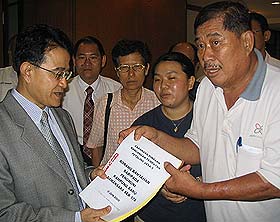 The committee's executive secretary Choong Pai Chee said they managed to collect signatures from 100 out of the total 136 households comprising 65 percent Malaysian Chinese, 30 percent Malays and about five percent Malaysian Indians.
There were contradicting colour codes between the gazetted local plan map and the one in the draft amendment.
"When asked, the MPPJ said it was a mistake in the colour scheme. They told us not to worry about development in the area and that the school will not be affected," she said.
"But till now, no one can tell us if the primary school will be closed for good."
She said locals strongly believe that future development plans include land where the school is and the surrounding areas, most of which have been earmarked for high-rise condominiums, apartments and commercial lots.
"The plans are misleading and ambiguous. We have to study the map in order to understand what the plans are but even that is difficult due to the conflicting colour schemes.
"No one is telling us anything about what is being planned in our area. We've even sent numerous letters to the state and federal government ministers but nothing happened."
The group has been fighting to re-open the SRJK (C) Damansara which was closed in January 2001, sparking protests from parents and the Chinese community.
The PJ local plan was gazetted on March 13, 2003, after objections from 8,000 residents were heard.


