




Focus on zero waste, not incinerators and landfills
'Tell your local councils that you don't want incinerators or landfills. You must prevent these destructive technologies from entering your country, or it will be too late.'
This was the general message to local communities, and specifically participants attending a waste management workshop in Kuala Lumpur on the first of a two-day National Conference and Exhibition on Sustainability 2005.
'Tell your local councils that you don't want incinerators or landfills. You must prevent these destructive technologies from entering your country, or it will be too late.'
This was the general message to local communities, and specifically participants attending a waste management workshop in Kuala Lumpur on the first of a two-day National Conference and Exhibition on Sustainability 2005.
 Advocating zero waste as one alternative to incineration and landfills, Abigail Gay Z Jabinez (photo)from the Philippine-based Global Alliance for Incinerator Alternatives (GAIA) said locals in poor developing countries have proven its viability.
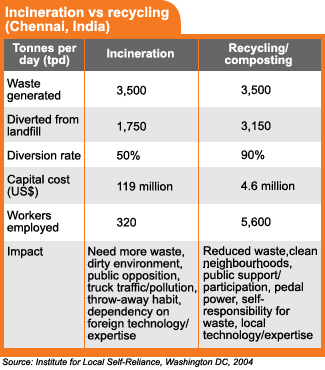
Citing the successes chalked up in India, the Philippines, Cambodia, South Korea, Lebanon, New Zealand and Japan, she said recycling and zero waste methods were cost-efficient and created self-sustaining communities by affording locals jobs and waste-related economic activities. (see table)
"The community is needed as it is the heart of any programme. Just remember that zero waste is low-tech, low-cost and local. Community participation is crucial to ensure success.
"Governments should de-centralise waste management and get communities involved in zero waste programmes so that they can own the initiative, creating a sense of belonging," she said.
Wrong question
Zero waste, which means reducing the waste volume and toxicity in raw material, is achieved by lower consumption, improved production efficiency, elimination of toxic and removal of discards or recyclables.
Asking communities to choose the lesser of two evils between landfill and incineration, according to Jabinez, is "clear evidence that someone asked the wrong question".
Expressing concern over the number of news reports announcing proposed landfills and incinerators in Malaysia, she was also disappointed at being unable to get an update on the total number of incinerators.
"Unless you stop such initiatives from entering Malaysia, zero waste has no place at all. Stop it before it's too late," she told participants.
The panelist from the Local Government Department was absent without apology.
She said the amount Asia spends on urban waste management, according to World Bank's 1999 estimates, will reach US$50 billion by 2025.
 On extended producer responsibility (EPR), a branch of zero waste, she asked if major players in the various industries knew or were bothered about where their products ended after use.
"Do big companies like HP, Macintosh and IBM know where their computers end up in? Does Gillette care what happens to its disposable shavers?"
To a question on disposable diapers, Jabinez cited the example of an all-girls school in the Philippines that composted sanitary napkins, similarly composed of cotton and plastic, before removing the plastic layer through a sieve.
The two-day conference is the first organised by Mengo, a coalition of 17 local environmental non-governmental organisations, and supported by the ministries of Natural Resources and Environment and Energy, Water and Communications.
Other partners are the Danish International Development Assistance and HSBC Bank Malaysia Bhd.
Mobilising communities
Penang state recycling co-ordinator Dr Ong Hean Tee, in expounding the benefits of empowering a local community, said recognition and motivation ensures continuing success in public campaigns.
"Mobilising communities is essential for programmes to be successful. The message in any public campaign is to empower and move people, not remain with the government as it does now," he said when speaking on 'Mobilising Communities at Grassroots Level in Waste Recycling Efforts'.
Describing neighbourhood watch groups ( rukun tetangga ) and residents associations as a 'free extension of government mechanism', he said they should be recognised and recruited to implement recycling programmes.
He said the community programme's effectiveness is proven by the increase in Penang's recycling rate from 1.6 percent to over 15 percent in the two years after the community programme was officially launched in 2002.
Ong, who chairs the Penang Environment Working Group, a local RT committee and works with the Socio-Economic and Environmental Research Institute, offered to share a training manual on mobilising communities to recycle.
Of the 20 communities involved in a pilot project in 2001, he said 10 continued to actively recycle while the other 10 did so occasionally. The island's community recycling programme was launched the following year.
He said government support and leadership was essential in ensuring the success of the community recycling programmes run by local teams.
"These community recycling teams look towards the municipal council for financial help. In fact, the councils save money for every tonne of waste that is diverted from the landfill in terms of collection, transportation, transfer and landfill costs."
Lucrative business
The Seberang Prai Municipal Council, he said, saved RM120 for every tonne of diverted waste.
 "Many fail to realise this, but recycling is a very viable and lucrative business. Part of what we do is to train people in running a recycling-related business.
"The National Unity Department has asked us to share our training manual. With 2,000 RTs in the country, just imagine the potential for implementing public programmes."
He also said that European Union directives are currently providing the momentum by regulating the import of EPR-compliant goods from Asia and other parts of the world.
Ong, also a technical consultant with Penang-based sanitary landfill manager Idaman Bersih Sdn Bhd, said Malaysia clearly did not need incinerators or sanitary landfills because they were prone to damage and risk contaminating soil and groundwater through leakage of toxic substances.
"It is the government's civic function to manage waste and crucial that it provides the necessary financial and logistical support to community recycling initiatives.
"Although I'm working with a landfill manager, I'm trying to convince the company that the way forward is recycling and resource material recovery."
The national waste recycling campaign was launched in 1993 but it is struggling due to a lack of integrated infrastructure.


