




We are wasting too much water
How can a country with copious amounts of rainfall and abundant water resources be ridden with water stress and crises - poor quality, high non-revenue water (NRW), rationing, thefts, mismanagement, etc?
How can a country with copious amounts of rainfall and abundant water resources be ridden with water stress and crises - poor quality, high non-revenue water (NRW), rationing, thefts, mismanagement, etc?
Industry watchdog Water Watch Penang president Prof Dr Chan Ngai Weng attributes it mainly to "ignorance among both policy-makers and water users", among a host of administrative, political, economic and environmental problems.
He said Malaysia has an average rainfall of three meters every year, meaning that someone here has access to more than 20 times the water available to someone in Yemen.
"Another contributor to water stress is the high domestic usage per capita," he said when giving a non-governmental organisation (NGO) perspective to the water management issue at a national conference on sustainability earlier in the week.
 He said Malaysians used less than 200 liters per capita per day (LPCD) in the 1970s but it has increased to 300 LPCD while the urban estimate is around 500 er person. In comparison, an average Indian uses about 100 while a Yemeni uses only 50 LPCD.
Citing the 200 LPCD international standard for water use, he said Malaysians were guilty of wasting between 100-300, an amount he claims could sustain six persons in Sudan.
"In Malaysia, most of the wasted water goes to flushing toilets, bathing, washing cars, clothes, floors, watering plants/gardening and other unnecessary chores."
He said it was not surprising that Malaysian rivers, the supply source of 97 percent of water needs, was polluted to such an extent largely due to poor water management.
Sign of trouble
Chiding the authorities for citing development to systematically destroy water sources, Chan sees the federal government's takeover of water management from the states as a sign of trouble.
He singled out the de-gazetting of forest reserves in many states as a major culprit in the depletion of water resources through the resultant deforestation and destruction of catchments.
"In terms of water resources, Malaysia's forests perform vital functions of water catchment, retention, storage, micro-climate moderation, rainfall augmentation, filtration, flood control and other hydrological functions."
More alarmingly, he said, states were reluctant to gazette forests as water catchments as the move that will effectively outlaw logging.
"There is adequate legislation providing for the control of forests and water catchment protection but lack of enforcement has always been a serious handicap."
Chan also proposed for carefully-controlled pricing to be used to counter wastage and abuse by charging for usage exceeding an estimate of 40,000 liters per month for a family of five.
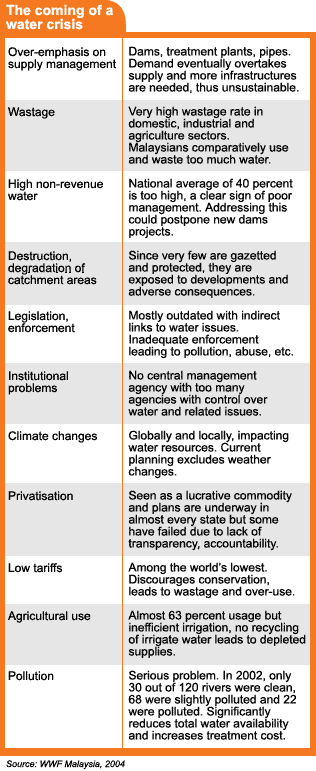 "The current rates are simply dirt-cheap!" he exclaimed in his paper, adding that it made up only one percent of an average household's monthly disposable income and was counter-productive.
He said privatisation was also not necessarily a bad thing, provided there is transparency and accountability.
"Often, alleged cronyism, unprofessionalism, corruption and mismanagement are probable factors that have inadvertently created a very disturbing pattern in many failed attempts," he said, adding that the federal government must control all privatisation of water services.
Shared portfolio
In his keynote at the same conference, Irrigation and Drainage Director-General Dr Keizrul Abdullah acknowledged similar points on privatisation as not bad in itself but could be necessary with proper control on pricing and related processes.
Keizrul, who chairs the Malaysian Water Partnership and the Global Water Partnership South East Asia, said the immediate task is to shift as many powers related to water supply to a shared portfolio.
"The Federal Constitution provides for three lists - federal, state and concurrent - with regards water supply matter.
"We need to review these to see how we can maximise the laws. For instance, the recent amendment early this year shifted water supply from the state list to the concurrent list, enabling the federal government's involvement where it was off-limits before."
He said the focus now was on how to shift other areas into the concurrent list in order to improve management of water resources and supply.
In pushing for water reform, Keizrul said it is crucial to adopt and implement the principles and practices of the Integrated Water Resources Management (IWRM), an independent advisory body to the government on related matters.
Among the reform proposed are amendments to existing laws, including the Federal Constitution.
"We have about 40 federal laws on water and land management. We probably hold the record for this, but enforcement is lacking and most are outdated," he told participants.
Key issues
At the same time, he said the government and water NGOs must consider that catchments do possess some economic value.
He said compensation must be considered along with the gazettement of catchments because, similar to a rainforest, it also has a high economic value," he said when contacted later.
"The key issues are that most of the existing laws look at controlling the process of water supply instead of conservation or management of water resources.
"Although we have laws on gazetting catchment areas, there is nothing on how to derive the benefits within the area for stakeholders.
"In fact, most laws date back to the colonial times, when conservation was not an issue."
Keizrul said political will was already visible as seen from the restructuring of the previous Cabinet portfolio which split the ministries up into specific roles.
He said for water, the Energy, Water and Communications Ministry handles the utility aspect, the Natural Resources and Environment Ministry oversees conservation and protection while the Agriculture and Agro-based Industry Ministry looks at food production.
"We need to look at water both as a resource for conservation and a service supplying drinking water, for industry, irrigation as well as how to improve the delivery service," he added.
The two-day conference in Kuala Lumpur was organised by a 17-member coalition of environmental NGOs.


