



M'sia slides down corruption index, TI-M blames leadership
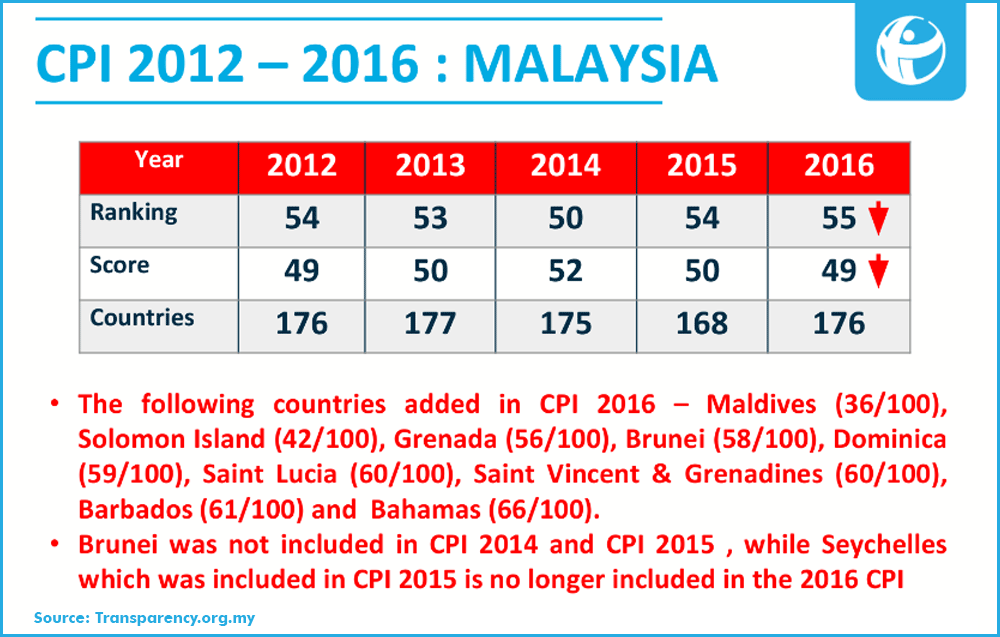
Malaysia has slid one notch down the Transparency International Corruption Perception Index (CPI) to share the 55th spot with Croatia in 2016.
According to Transparency International-Malaysia (TI-M), Malaysia's CPI score dropped from 50 to 49 on a scale of 0-100, with 100 being perceived to be very clean and 0 being perceived as highly corrupt.
The CPI measures perception of corruption in 176 countries.
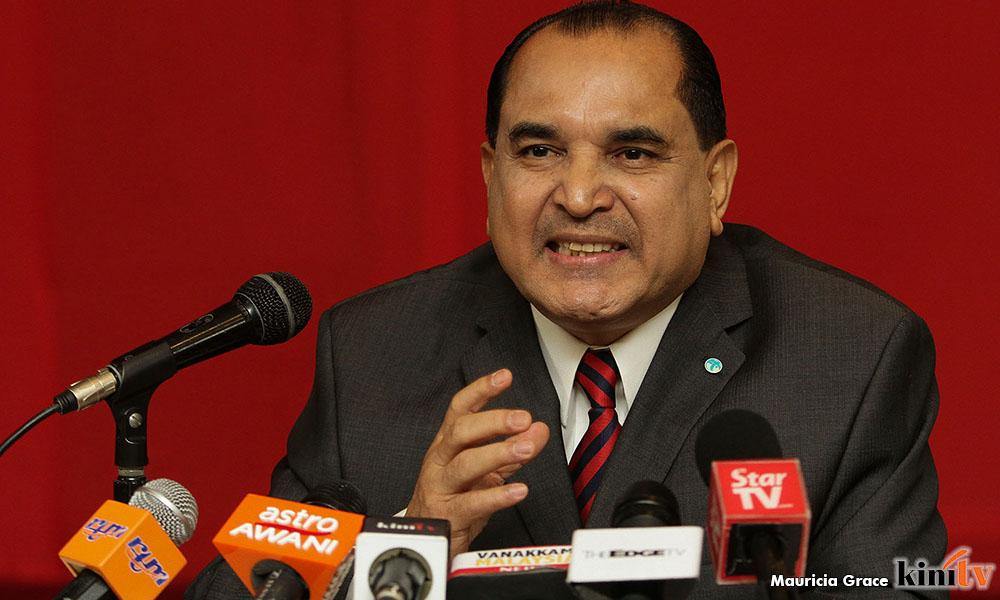
"This sad showing by Malaysia needs to be urgently addressed," TI-M president Akhbar Satar said today.
Malaysia has slid one notch down the Transparency International Corruption Perception Index (CPI) to share the 55th spot with Croatia in 2016.
According to Transparency International-Malaysia (TI-M), Malaysia's CPI score dropped from 50 to 49 on a scale of 0-100, with 100 being perceived to be very clean and 0 being perceived as highly corrupt.
The CPI measures perception of corruption in 176 countries.
"This sad showing by Malaysia needs to be urgently addressed," TI-M president Akhbar Satar said today.
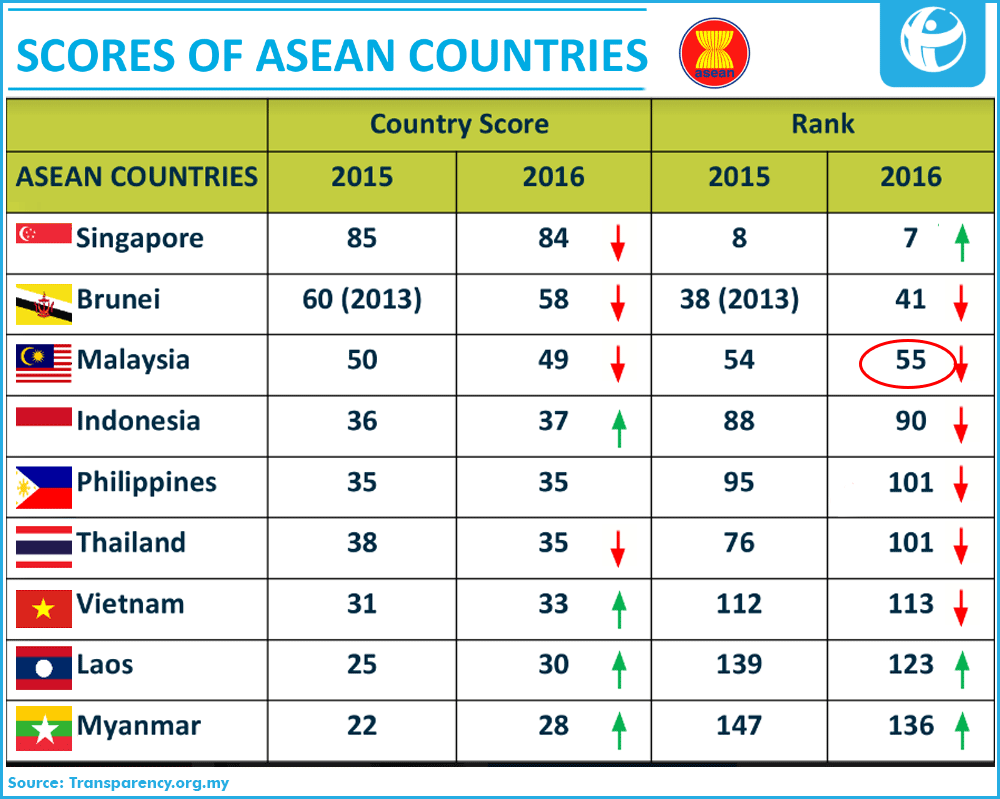
Malaysia ranked third among Asean countries, behind Singapore (7th) and Brunei (43rd).
Singapore's performance in the rankings was an improvement, and although Indonesia's score improved slightly, its ranking fell from the 88th spot to 90th spot.
Akhbar said there was a lack of leadership in combating corruption in Malaysia.
"The missing exemplary leadership from above, together with a cultural environment where corruption is a normal way to get things done, may explain why the current value/ethics training remains formalistic and may not have any practical impact on the behaviour of public officials...
"The government and the country leader must provide the leadership with strong political will to drive the message of zero tolerance for graft and 'walk the talk'," he said.
Rooting out the rent-seekers
Akhbar said the private sector was also not absolved, as the source of bribes in the public sector often came from the private sector.
Among the ways to combat public sector corruption, he said, was to eliminate "middle-man agents" who tout themselves as a means to get government procurements.
This can be done by reducing profit margins in mega projects through introducing transparency measures, he said.
Unreasonable profit margins "always suggest there is an unseen hand behind who gets the project".
Long-term utility projects should also be handled by government agencies and not by private firms, Akhbar said, to avoid the prolonging of contracts by public officials seeking bribes.
He also proposed that the roles of the attorney-general and public prosecutor be made separate, to ensure that the prosecutor is completely independent, instead of having to also act as legal adviser to the government.
"(The prosecutor) should be entirely independent to prosecute whoever is suspected to have committed a crime, regardless of how high the suspect may be in the hierarchy of government," he said.
TI-M's other proposals include:
- Registries of company ownership records to be made public;
- Ethics courses to be conducted for civil servants;
- Introduction of corporate liability provisions into current anti-corruption legislation; and
- Introducing freedom of information laws at federal and state levels.


Are you sure you want to delete this comment?
This action cannot be undone.