




Immigration official refutes refugees claims of abuse
Acehnese refugee Muhammad Nurul Al-Khalil's claims that he was treated inhumanely while held at the Damansara immigration centre lock-up have been dismissed by an official.
Acehnese refugee Muhammad Nurul Al-Khalil's claims that he was treated inhumanely while held at the Damansara immigration centre lock-up have been dismissed by an official.
Immigration enforcement chief Mohd Radzi Hussein specifically refuted the Acehnese refugee's claim that he had been confined to a small room under the elevator for nine of the 23 days he had been held at the centre.
"There is no such thing. We keep all the detainees at the holding cell on the fifth floor of the building," Mohd Radzi said when contacted today.
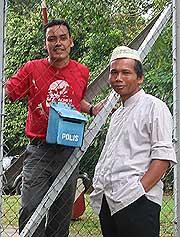 In rejecting the remaining claims, he also said all detainees are given medication if they need it and that they are not abused. However, he declined further comment.
Muhammad Nurul, 29, had also alleged he was only given one paracetamol tablet a day over the four days that he had suffered from a fever.
His allegations were made in the context of his three-month 'ordeal' while being detained in Damansara and later at the Semenyih camp.
Although he held identification documents issued by the Kuala Lumpur office of the UNHCR, he was arrested on March 17 on suspicion of being an illegal immigrant, but was released on June 17.
He said he wrote the details in a diary whenever he could and that he would use the contents as campaign material to highlight human rights violations in the detention centres and to seek a solution to the conflict in Aceh.
Muhammad Nurul left on Monday for resettlement in Philadelphia in the US, with the help of the United Nations High Commissioner for Refugees (UNHCR).
Attempted suicide
A pro-democracy activist in Aceh, Muhammad Nurul was also critical of conditions at the Semenyih camp, where he was kept for over two months, allegedly in a 20 x 30m cell holding more than 400.
"It was so hot in these places, There was no fan or proper ventilation. There were frequent water cuts and the water supply was dirty and yellow in colour," he said in an interview before he left Malaysia.
"There were so many days when we had to put up with the stench of faeces and urine. People developed rashes. Some were coughing and vomiting blood.
"While I was there, a Nepali died of illness and one guy from Uzbekistan tried to commit suicide twice. They too just wanted to get out.
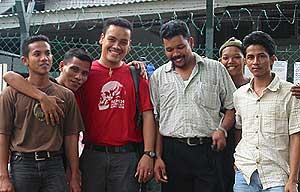 He further claimed that male detainees were denied medical treatment, but that the women had access to doctors.
"They told me there were times when the doctor would make them remove their clothes and touch them. They felt they were being molested," he said.
As a recognised refugee, he was able to get treatment when UNHCR teams visited the camp on Wednesdays. These were the only times he was allowed to leave his "cramped" cell.
He also alleged that detainees were given stale food at times and that there were frequent fights between people of different nationalities in the cells, apart from rampant smuggling and use of ganja.
Attempts to contact the press relations head for Semenyih camp, Supt Supri Hashim, at the headquarters in Kajang were unsuccessful. His assistant was said to be away on a course.
Allegations of abuse and irregularities at the centres are not new, with rights groups having highlighted these in the past.
Malaysia is not a signatory to the UN Convention Relating to the Status of Refugees 1951 which protects the safety and welfare of those who flee their country of origin because of a well-founded fear of persecution.


Are you sure you want to delete this comment?
This action cannot be undone.