



Unearthing the 25-year-old forex scandal
KINIGUIDE Sometimes, just when you thought the world has moved on, an old ghoul rises from its grave to haunt you for your past mistakes.
That is now the prospect faced by those put in charge of Malaysia’s economy in the early 1990s.
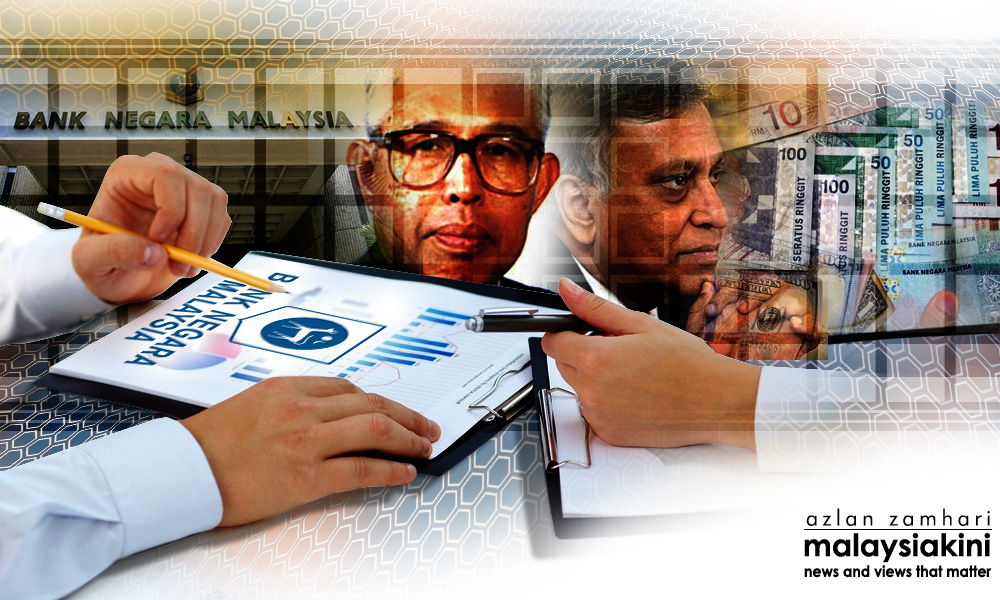
Although the events took place about 25 years ago, the government has now set up a task force to investigate Bank Negara’s foreign exchange transactions at the time.
What happened back then?
Between 1989 and 1993, Bank Negara was engaging in some foreign exchange market (forex) transactions. A 1991 Reuters report even quoted dealers claiming that the central bank was one of the top players in forex.
However, the details of Bank Negara’s dealings remain unclear to this day, and there has been no investigation of the matter to date – at least not one in public knowledge.
What is clear is that Bank Negara lost a lot of money in the transactions. The loss was initially reported as being RM9.3 billion, which was the fall in the central bank’s reserves.
The sum is now believed to be closer to RM31.3 billion, or about US$10 billion at the exchange rate at the time.
The then Bank Negara governor, Jaafar Hussein, and his deputy Nor Mohamed Yakcop resigned in the fallout of the scandal...
KINIGUIDE Sometimes, just when you thought the world has moved on, an old ghoul rises from its grave to haunt you for your past mistakes.
That is now the prospect faced by those put in charge of Malaysia’s economy in the early 1990s.
Although the events took place about 25 years ago, the government has now set up a task force to investigate Bank Negara’s foreign exchange transactions at the time.
What happened back then?
Between 1989 and 1993, Bank Negara was engaging in some foreign exchange market (forex) transactions. A 1991 Reuters report even quoted dealers claiming that the central bank was one of the top players in forex.
However, the details of Bank Negara’s dealings remain unclear to this day, and there has been no investigation of the matter to date – at least not one in public knowledge.
What is clear is that Bank Negara lost a lot of money in the transactions. The loss was initially reported as being RM9.3 billion, which was the fall in the central bank’s reserves.
The sum is now believed to be closer to RM31.3 billion, or about US$10 billion at the exchange rate at the time.
The then Bank Negara governor, Jaafar Hussein, and his deputy Nor Mohamed Yakcop resigned in the fallout of the scandal.
How did the RM31.3 billion figure came about?
The forex losses appear in Bank Negara’s accounts between 1993 and 2002 as "deferred expenditure", and it totals to that figure.
An accompanying footnote reads: “This represents the net deficiency arising from foreign exchange transactions in 1993. The government has undertaken to make good this deficiency as and when required to do so by the bank. The amount outstanding has been amortised over a period of ten years beginning from 1994.”
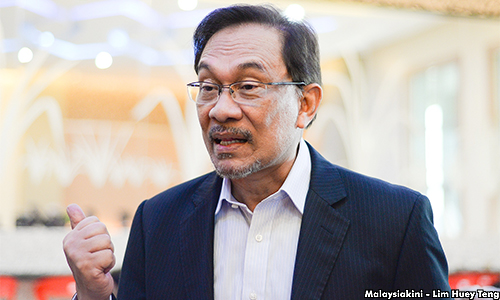 The then finance minister Anwar Ibrahim also cited the same figure during a 2007 press conference – a loss of RM33.8 billion offset by a RM2.5 billion profit in 1990.
Why was Bank Negara doing this?
Critics of the scandal have repeatedly accused Bank Negara of speculating on forex for profit, which is a risky proposition that did not pan out for the central bank at the taxpayer’s expense.
Instead, a central bank’s role should be to ensure the health and stability of a country’s economy and financial systems, not taking risks abroad for profit.
During a parliamentary debate on April 27, 1993, Anwar argued that taking such risks was precisely what Bank Negara tried to achieve and had succeeded in strengthening the ringgit.
“This is not speculation as in gambling - which is certainly something Bank Negara wouldn’t do – but a healthy transaction to defend… for example if the value of the deutschmark falls and would cause losses to us, then we sell the deutschmark for dollars if the dollar seems strong.
“These are skills and expertise that one should have, and surely the Western media is uneasy because our reserves are strong, and our economic management is not bad whereby it sometimes goes up and it sometimes goes down,” he said.
 About being ousted from government, Anwar would later claim he had been kept in the dark on the full extent of the forex problem.
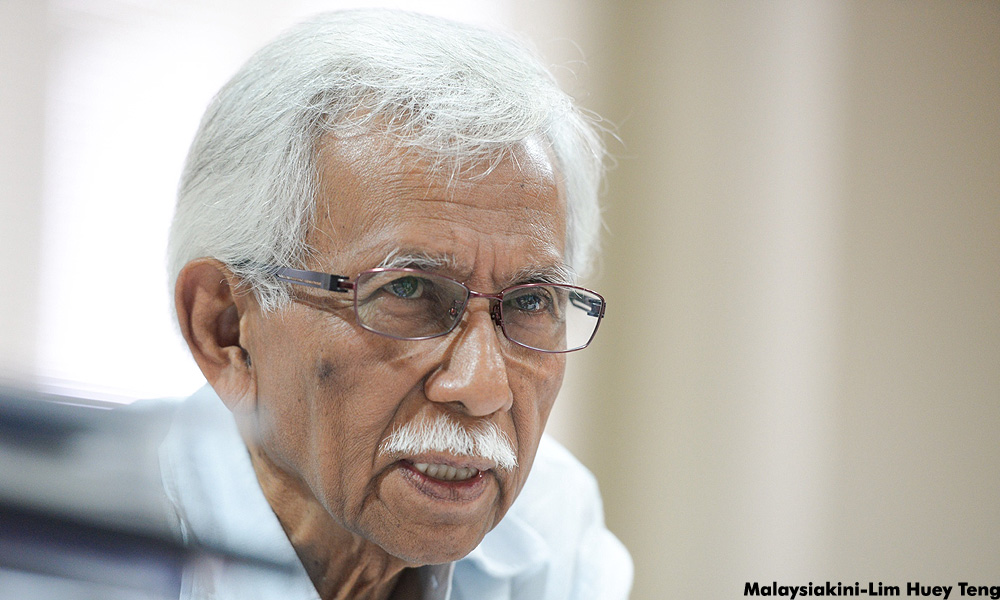
He claimed that the then prime minister Dr Mahathir Mohamad was in cahoots with former finance minister Daim Zainuddin (photo) and then Bank Negara deputy governor Nor Mohamed Yakcop on the transactions.
What did Mahathir have to say about it?
In his memoir published in 2011, Mahathir picked up the story in 1985 when the Organisation for Economic Cooperation and Development (OECD) decided to revalue the Japanese yen and European currencies against the US dollar.
This meant trouble for Malaysia, Mahathir said, as the country then had significant borrowings in yen and could see its debt almost triple in face of a stronger yen. This was unless Malaysia kept its foreign reserves in yen.
“Bank Negara… accordingly decided that it could not be caught holding devalued currencies, particularly the US dollar. It therefore set up foreign currency trading operations which traded only in currencies of developed countries, principally the US dollar, German deutschemark, Swiss franc, the yen and pound sterling.
“The bank also set up currency trading offices in London and New York, manning them with experienced personnel who worked in shifts around the clock. They did quite well, making good profits,” Mahathir wrote, adding that every central bank also does to some extent defend its reserves.
In the 1990s, he continued, many people believed that the US dollar would crash again as it did following the OECD agreement. This time, it was because of the move towards European integration.
However, these hopes were dashed when Denmark refused to ratify the Maastricht Treaty that was to lead to the creation of the European Union.
 It was European currencies that faltered instead of the US dollar, and Malaysian currency traders had large holdings in several European currencies in anticipation that it would appreciate following the ratification.
Nevertheless, he said, Bank Negara’s top two leaders did no wrong.
“They had not acted improperly – they had simply taken a risk and lost,” Mahathir wrote.
What is the task force supposed to do about all these?
The cabinet had decided to set up the task force on Feb 15. In a statement, the Prime Minister’s Office reportedly said it would conduct a preliminary investigation of Bank Negara’s forex trades.
It would gather and analyse facts regarding the transactions, and recommend follow-up action to the cabinet, such as setting up a royal commission of inquiry (RCI) if deemed necessary.
It would also find out what were the actual losses incurred, whether there was wrongdoing, and whether there was any cover-up.
Former chief secretary to the government Mohd Sidek Hassan has been appointed as the chairperson of the task force, while the other members have yet to be named.
Who were the key players and where are they now?
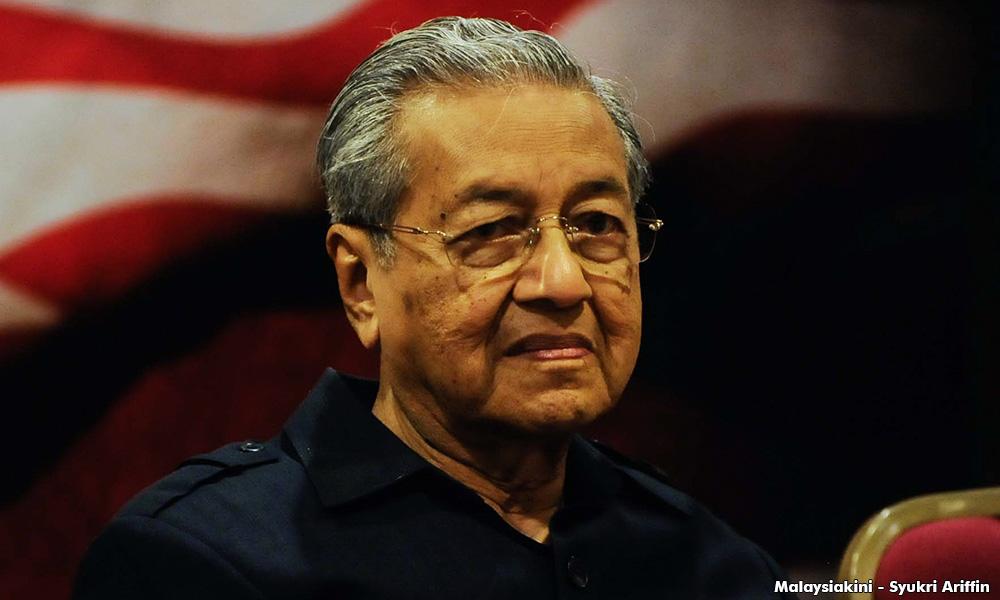
The then prime minister Mahathir is now chairperson of the opposition party, Parti Pribumi Bersatu Malaysia, and has made it his goal to oust Prime Minister Najib Abdul Razak.
He was also the home minister at the time, while Najib was the defence minister.
Anwar was ousted from government in 1998. After a brief stint as the opposition leader, he is now serving a five-year jail sentence in Sungai Buloh prison for sodomy.
Jaafar, the then Bank Negara governor, passed away in 1998.
His deputy Nor Mohamed rejoined Bank Negara in 1998, and later served in Abdullah Ahmad Badawi’s cabinet as finance minister II. Jaafar is now the deputy chairperson of Khazanah Nasional.
Daim was the finance minister from 1984 until 1991, and again from 1998 until 2001. He now largely stays away from the public eye.
What is the response towards the new task force?
Mahathir said he would cooperate with the task force, but only on condition that the same level of scrutiny is applied to Najib and the 1MDB scandal.
Anwar said he would prefer a RCI, but is prepared to assist the task force.
However, some quarters, such as former de facto law minister Zaid Ibrahim, view the task force as an attempt to discredit Mahathir and Daim, since Najib had been silent on the forex issue until now.
Anwar also warned that the task force should not be used to divert attention from current affairs, including the 1MDB scandal.
This instalment of KiniGuide is compiled by Koh Jun Lin.


Report this comment
Are you sure you want to delete this comment?
This action cannot be undone.