



Black swan moments - the regime’s options
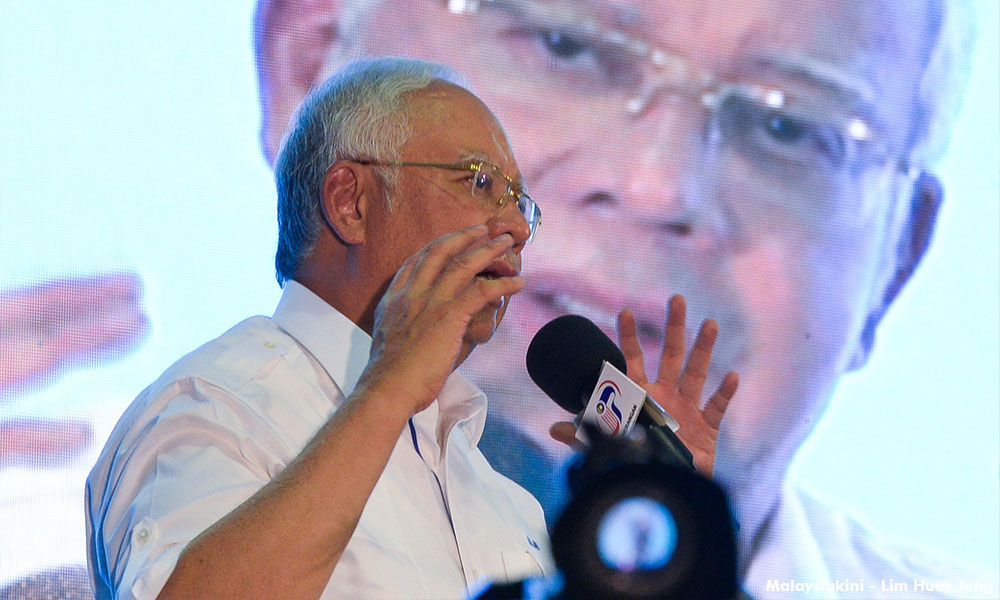
COMMENT | Yesterday, in the first half of my article, I explained why Prime Minister Najib Abdul Razak was in a precarious position. What then are Najib’s strategies for survival? It is not that Najib doesn’t understand the precarious position he is in. He does know that Umno will not be able to win an outright mandate in the coming election.
Hence, Najib has been trying to break up the opposition as soon as the 2013 general election was concluded.
There were even attempts by Indonesian Vice-President Yusof Kala, between June and August 2013, to broker deals between Najib and Anwar Ibrahim, which Anwar rejected.
And, since then, Najib’s strategies have included:
- Putting Anwar Ibrahim behind bars, hence depriving the opposition of its prime ministerial candidate and unifying figure;
- Luring PAS into a de facto alliance with Umno on the pretext of promoting hudud legislations; and
- Portraying the opposition as a DAP/Chinese-dominated alliance.
However, in his grand scheme to win by default, Najib did not anticipate:
- The opposition surviving despite Anwar’s imprisonment;
- A sizable number of ousted PAS leaders forming Parti Amanah Negara in September 2015 to continue the struggle, and many in PAS still disagreeing with their top leaders’ collusion with Umno; and
- Umno splitting in 2016, and Parti Pribumi Bersatu Malaysia being formed and joining Pakatan Harapan...
COMMENT | Yesterday, in the first half of my article, I explained why Prime Minister Najib Abdul Razak was in a precarious position. What then are Najib’s strategies for survival? It is not that Najib doesn’t understand the precarious position he is in. He does know that Umno will not be able to win an outright mandate in the coming election.
Hence, Najib has been trying to break up the opposition as soon as the 2013 general election was concluded.
There were even attempts by Indonesian Vice-President Yusof Kala, between June and August 2013, to broker deals between Najib and Anwar Ibrahim, which Anwar rejected.
And, since then, Najib’s strategies have included:
- Putting Anwar Ibrahim behind bars, hence depriving the opposition of its prime ministerial candidate and unifying figure;
- Luring PAS into a de facto alliance with Umno on the pretext of promoting hudud legislations; and
- Portraying the opposition as a DAP/Chinese-dominated alliance.
However, in his grand scheme to win by default, Najib did not anticipate:
- The opposition surviving despite Anwar’s imprisonment;
- A sizable number of ousted PAS leaders forming Parti Amanah Negara in September 2015 to continue the struggle, and many in PAS still disagreeing with their top leaders’ collusion with Umno; and
- Umno splitting in 2016, and Parti Pribumi Bersatu Malaysia being formed and joining Pakatan Harapan.
Broadly, even without Najib at the helm, Umno is weaker than in the 2013 general election for the following reasons:
First, since independence till the 2004 general election, Umno had ruled through an extended coalition of Alliance/Barisan Nasional, and governed with substantial support from the non-Malays.
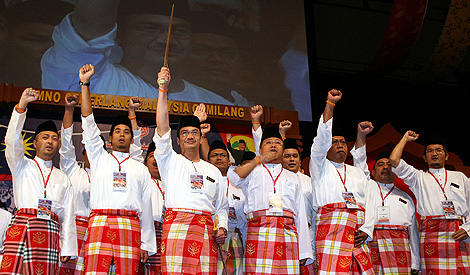 But the comfort of buffers formed by BN component parties in the peninsula eclipsed after Umno made a right turn - becoming more visible in its claim of Malay supremacy - in July 2005 with Hishammuddin Hussein waving the kris at the Umno general assembly, which led to massive defeats for its allies, the MCA, MIC and Gerakan, in both the 2008 and 2013 general elections.
Umno dug in deeper since 2008 to push racial politics in the hope of expanding Malay support, but has achieved surprisingly little.
Second, since Umno had been incapable of expanding its support base since 2013, collaborating with PAS became an attractive option. Umno hopes that by colluding with PAS to polarise society into a struggle between Muslims and non-Muslims, the Umno-PAS de facto alliance will win enough seats between them to form the next government.
However, as an unintended consequence, such a move further alienates non-Malay voters in the peninsula, as well as a majority of voters in Sabah and Sarawak.
Third, while Najib the man managed to command more support among Malay voters compared with Umno the party in the 2013 election, such is no longer the case. Najib is now a burden to Umno due to the 1MDB mega scandal, and unpopular economic policies such as the implementation of the goods and services tax (GST), fuel hikes and cuts to subsidies for basic amenities like health and education.
Angry Umno leaders and members have formed Bersatu and this new Malay party is making inroads in areas previously inaccessible to the opposition.
In short, Umno under Najib is on a narrowing path that now relies on a much smaller base than ever. If Najib is still perceived as strong, it is because the opposition is seen as weak and disunited.
What lies ahead?
The known knowns are that Najib is not popular, and there is serious discontent among the Malays. But there are certainly challenges for the opposition to overcome in order to precipitate change.
First, the opposition needs to stand for something inspiring and visionary, and not depend solely on the anger against Najib as its forward strategy. The opposition must stand for more than just removing Najib. The economy and the well-being of the people should be its number one priority.
Second, the coming together of Bersatu and the Pakatan Harapan parties, namely Parti Keadilan Rakyat, Parti Amanah Negara and Democratic Action Party is a reconciliation of former foes.
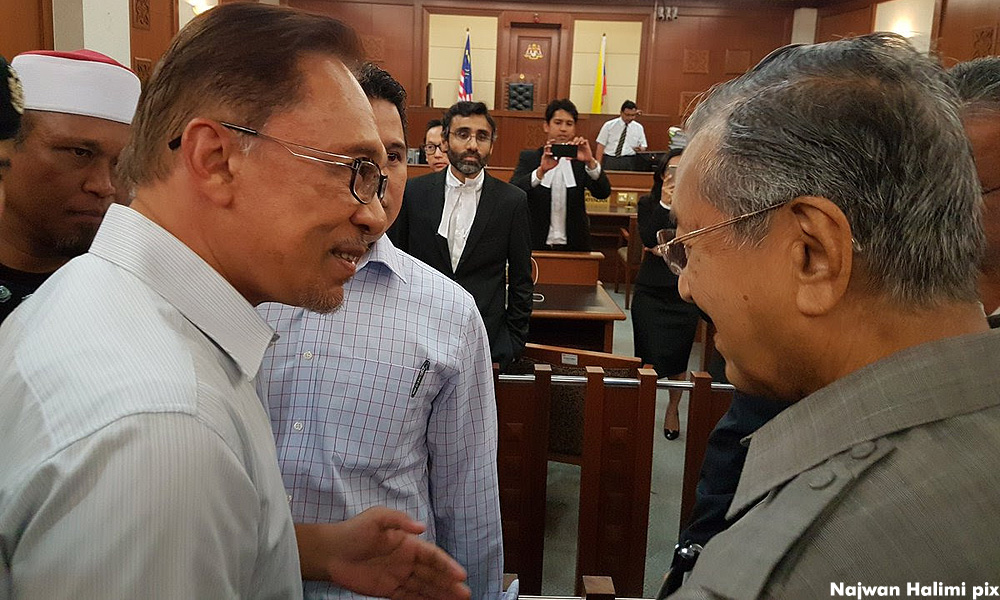 Who could imagine Dr Mahathir Mohamad and Anwar Ibrahim forming an alliance nearly 20 years after their very bitter fallout in 1998? But the coming together of the once political father-and-son can unleash huge energy, if handled properly.
After all, both Mahathir and Anwar are positive leadership figures compared to Najib, and they each appeal to certain segments of the Malay electorate.
Third, to present a common agenda that appeals to both Mahathir’s audience and to DAP’s supporters is a big challenge. If Mahathir and Bersatu go on a racial campaign, it will depress the support of non-Malay voters and create a lose-lose situation for the entire Pakatan Harapan coalition.
Likewise, the regime’s argument against Mahathir and Bersatu is that they are associating with the DAP. The presence of the DAP can also depress the support for Bersatu and other Malay-based parties like PKR and Amanah if the opposition is unable to break out of Umno’s racial playbook, and articulate a new narrative that can rally all groups in a larger vision.
In short, Pakatan Harapan needs to ‘reset’ the national conversation to one that centres around ‘Bangsa Malaysia’ and ideas of common destiny for the nation.
Fourth, PAS, as Umno’s ‘new friend’ as Zahid calls the party, is a reality, and the sooner a deep line is drawn between the genuine/official opposition, Pakatan Harapan, and the pseudo ‘third force’ PAS, the clearer the situation becomes for voters. This will weaken PAS’ usefulness as an Umno-directed spoiler in the coming election.
Fifth, the ultimate challenge for the newly re-aligned Pakatan Harapan that includes Bersatu will come if Najib suddenly exits the scene and takes out the raison d’être for the opposition and dissipates much of the anger in the Malay community.
If this is to happen, can the opposition in its present format survive this unlikely, but not impossible, Black Swan?
Yesterday Part I: Expect more black swans to appear in Malaysian politics
This perspective is based on a public seminar given by LIEW CHIN TONG at the Institute of South-East Asian Studies (Iseas)-Yusof Ishak Institute on April 13, 2017. Liew was formerly a visiting fellow at the institute. He is the Member of Parliament for Kluang, and a member of the central executive committee of the Democratic Action Party (DAP).
The views expressed here are those of the author/contributor and do not necessarily represent the views of Malaysiakini.


Are you sure you want to delete this comment?
This action cannot be undone.