



M'sia scores poorer marks in press freedom, but better ranking
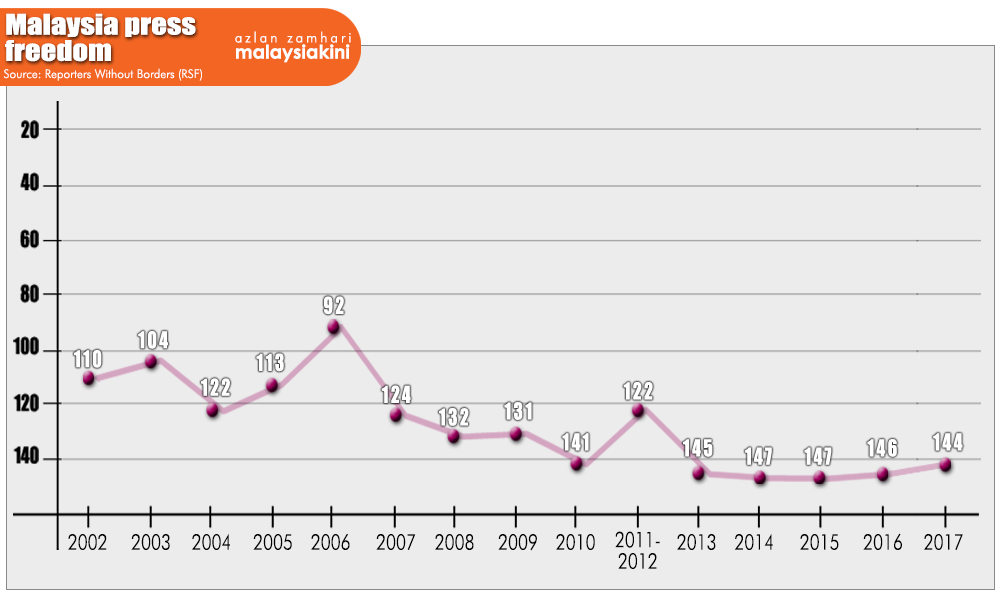
Malaysia has placed 144th out of 180 countries in the latest Reporters Without Borders (RSF) press freedom rankings, up two spots from the year before.
However, Malaysia’s relative press freedom has declined given its overall score of 46.89, up 0.32 points from the year before.
A higher score indicates less press freedom. The lowest-ranked country is North Korea with a score of 84.98, while the highest-ranked country is Norway with a score of 7.6.
Last year, Malaysia climbed the rankings by one spot, despite increasing scores...
Malaysia has placed 144th out of 180 countries in the latest Reporters Without Borders (RSF) press freedom rankings, up two spots from the year before.
However, Malaysia’s relative press freedom has declined given its overall score of 46.89, up 0.32 points from the year before.
A higher score indicates less press freedom. The lowest-ranked country is North Korea with a score of 84.98, while the highest-ranked country is Norway with a score of 7.6.
Last year, Malaysia climbed the rankings by one spot, despite increasing scores.
Overall, RSF noted that press freedom the world over was increasingly under threat as the situation had worsened in nearly two-thirds of the 180 countries on the index.
Malaysia is currently sandwiched between Gambia and South Sudan on RSF's ranking system.
Regionally, Malaysia is behind Indonesia (124), Philippines (127), Myanmar (131), Cambodia (132), and Thailand (142), while ahead of Singapore (151), Brunei (156), Laos (171) and Vietnam (175).
Myanmar, which is undergoing a democratic transition, showed the most improvement according to the ranking system, followed by Indonesia.
According to RSF, last year saw a campaign by the Malaysian government targeting journalists, media outlets, and a cartoonist for being overly independent and critical of the government, following the 1MDB affair.
This included Putrajaya's decision to block access to The Malaysian Insider, eventually forcing the website to close down, and the continued harassment of cartoonist Zunar.
The RSF noted that the Printing Presses and Publications Act 1984, which required newspapers to renew their operating licenses each year, remains intact, with further legislation that would stifle press freedom being developed.
"Several proposed amendments would reinforce the already draconian Official Secrets Act 1972 and Communications and Multimedia Act 1998, but the Sedition Act 1948 continues to be the biggest threat to journalists," said the RSF.


Are you sure you want to delete this comment?
This action cannot be undone.