



'Some workers can't even afford to buy food'
SPECIAL REPORT | Nestled inside the sprawling workers' hostel is a canteen. The food is far from cheap. A plate of rice with meat can cost between RM8 and RM10, whereas fruits are sold at RM2 per piece and a glass of herbal tea can be as much as RM5.
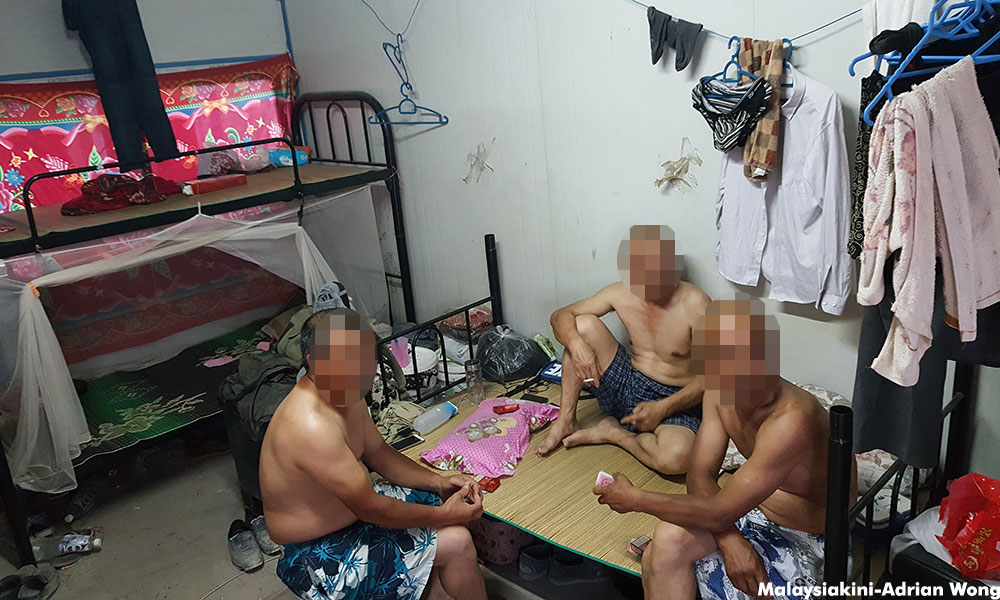
For the migrant workers, who have not been paid their salaries and are forced to sustain themselves on the pocket money ranging between RM300 and RM600, these prices are nothing short of exorbitant.
The canteen operator, who wished to be identified only as Mah, is aware of their plight.
“Pity them, some of them have no money to buy food," Mah told Malaysiakini during a visit to the site recently.
Mah, whose canteen rental is more than RM10,000 per month, claimed that some 20 to 30 workers would leave the hostel, which houses those working on the Forest City project, on a daily basis.
“Both my friend and I will take them to the airport for a fee of RM60 or RM80," he said, referring to the international airport in Senai, which is located some 40km from the hostel.
Mah was talking about Chinese nationals who had just arrived on social visit passes returning home after hearing about the exploitation as well as those who, after working for a period of time, decided to pack their bags and leave.
The canteen operator suspects that some individuals hired by the sub-contractors are in cahoots with shady agents in China, luring nationals there to the Forest City project with the promise of lucrative salaries...
SPECIAL REPORT | Nestled inside the sprawling workers' hostel is a canteen. The food is far from cheap. A plate of rice with meat can cost between RM8 and RM10, whereas fruits are sold at RM2 per piece and a glass of herbal tea can be as much as RM5.
For the migrant workers, who have not been paid their salaries and are forced to sustain themselves on the pocket money ranging between RM300 and RM600, these prices are nothing short of exorbitant.
The canteen operator, who wished to be identified only as Mah, is aware of their plight.
“Pity them, some of them have no money to buy food," Mah told Malaysiakini during a visit to the site recently.
Mah, whose canteen rental is more than RM10,000 per month, claimed that some 20 to 30 workers would leave the hostel, which houses those working on the Forest City project, on a daily basis.
“Both my friend and I will take them to the airport for a fee of RM60 or RM80," he said, referring to the international airport in Senai, which is located some 40km from the hostel.
 Mah was talking about Chinese nationals who had just arrived on social visit passes returning home after hearing about the exploitation as well as those who, after working for a period of time, decided to pack their bags and leave.
The canteen operator suspects that some individuals hired by the sub-contractors are in cahoots with shady agents in China, luring nationals there to the Forest City project with the promise of lucrative salaries.
The increase of direct flights from Sichuan and Guangdong in the past few months have created an opportunity for these agents to recruit workers, especially middle-aged men who are charged a fee of between 10,000 yuan (RM6,288) and 24,000 yuan (RM15,092).
A large portion of the migrant workforce are from China and Bangladesh, while the rest are from Sri Lanka, Indonesia, India, Nepal and Myanmar.
The area appears to house more than 100 single-storey and three-storey blocks, with more under construction. Apart from canteens, there are grocery stores, shops selling second-hand clothes and even mobile phone stalls.
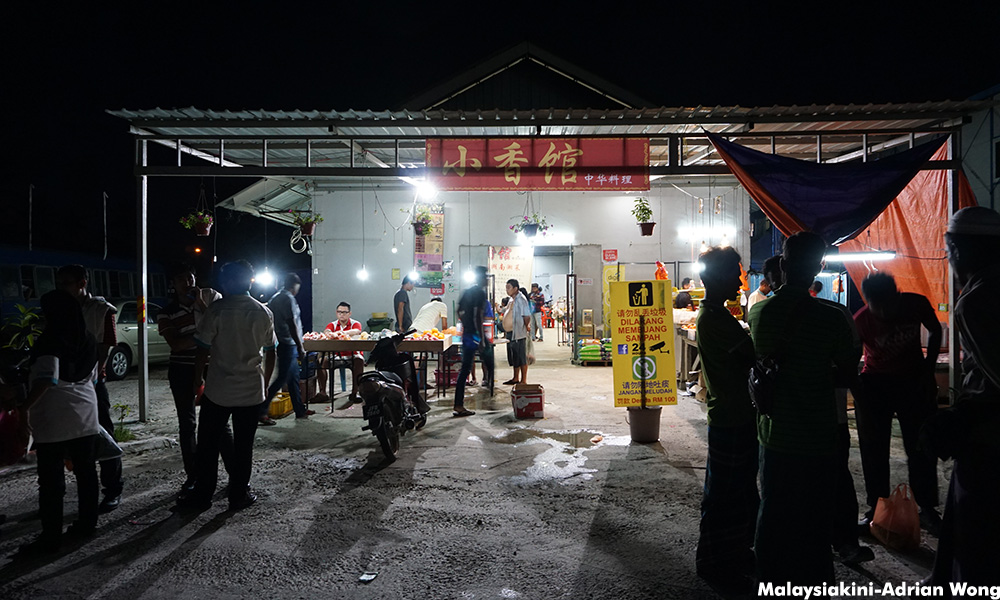 Those with valid documents and earning up to 15,000 yuan (RM6,279) a month frequent these shops and can be seen drinking beer and eating there as well.
But for the undocumented workers, the scenario is different. With their social visit passes having expired, these workers prefer to remain in their rooms, fearing arrest.
Mah recalled how, on April 30, he sent 32 bags of rice to one of the blocks because the workers were afraid to come out due to the presence of Immigration Department officers.
No employment letters or payslips, only passes
There is often no paper trail to link the subcontractors and individuals to the undocumented workers as these workers have not been given employment letters or payslips.
These workers only possess passes, on which the firms' names are printed.
One group of workers claimed that their boss, whom they identified as Ma, kept their passports, purportedly for safety reasons.
Without their passports, these workers, who claim to have not been paid their salaries for four months, are vulnerable to exploitation and therefore fear seeking the help of the Malaysian authorities.
"We dare not fight with the boss (for our salaries). We're afraid we might get arrested if we do this and be deported. We cannot do anything,” said Chen Jianguo (name changed to protect his identity).
However, this group of workers decided to issue an ultimatum to their boss. They warned him that if he does not settle their outstanding salaries, they would expose their plight to the media.
"We will contact you if we do not get our wages. Then, we will expose the matter to the media. You (media) drive us to the Chinese embassy," said Ah Xing (not his real name), who came to Malaysia from Shandong with seven friends.
"I have no money to go home," he said, adding that they are now surviving on pocket money of RM300 per month.
Ah Xing also asked why the Malaysian government had not inked an agreement with China on labour, especially since China was investing a lot of money in Malaysia.
Another worker, who was present during the interview, said he has lost contact with his boss and now has no pocket money either.
"All I have is RM120 and I have to share this with a friend," he said, showing Malaysiakini all the money he had.
'Should conduct interviews in China'
On the night of April 21, when Malaysiakini visited the Senai airport, a Malaysian, who identified himself as Dickson, said he was there on behalf of his boss to pick up two Chinese nationals.
Dickson claimed that his boss works for the Shenyang Giant Leap Construction Co.
He said the two Chinese nationals would have to undergo an interview before the company decided on employing them, because some had lied about their skills in the past and the company suffered losses.
"They are coming with a social visit pass. We will monitor their work. If they can perform, we will hire them and apply for employment passes,” Dickson told Malaysiakini.
 However, DAP's Senai assemblyperson Wong Shu Qi (photo) told Malaysiakini that the developers should conduct all the necessary interviews in China, instead of having the China nationals fork out money to come here with the hope of securing employment, only to be rejected.
"They are the top developers in China, they should be able to do that," Wong said.
On the same note, she urged the developers to ensure that the workers received the salaries owed to them by the sub-contractors.
Wong also called on the Malaysian government to act against those who exploited the migrant workers.
"If we cannot protect the well-being of the migrant workers, then other investors too will prefer to employ migrant workers instead of Malaysians because it's easier to exploit them,” she said.
In an email to Malaysiakini, Country Garden Pacificview Sdn Bhd (CGPV) executive director Md Othman Yusof said the company would not tolerate the mismanagement of workers.
CGPV vowed to investigate the matter and take action against errant contractors.
Related Reports
PART 1: Broken dreams - the plight of Forest City's migrant workers


Are you sure you want to delete this comment?
This action cannot be undone.