


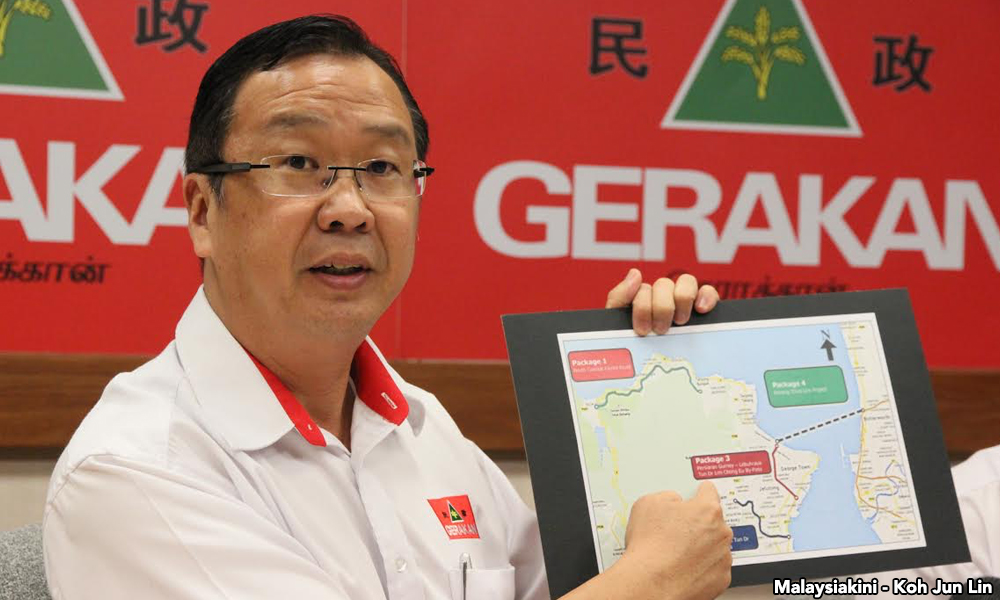

Gerakan mulls injunction bid to stop Penang tunnel project
Gerakan is mulling the filing of an injunction to put a halt to the Penang Undersea Tunnel project, including the three land roads that are a part of the project.
Its vice-president Dominic Lau said the party’s legal bureau is currently studying the matter.
“When we look at it, there is something wrong with this project. So Gerakan may consider applying a court injunction to stop the entire road and tunnel project.
“(This is) pending the investigations into allegations of corrupt practice, misconduct, misinformation, abuse of public funds and illicit horse-trading,” Lau told a press conference at party’s headquarters in Kuala Lumpur today...
Gerakan is mulling the filing of an injunction to put a halt to the Penang Undersea Tunnel project, including the three land roads that are a part of the project.
Its vice-president Dominic Lau said the party’s legal bureau is currently studying the matter.
“When we look at it, there is something wrong with this project. So Gerakan may consider applying a court injunction to stop the entire road and tunnel project.
“(This is) pending the investigations into allegations of corrupt practice, misconduct, misinformation, abuse of public funds and illicit horse-trading,” Lau told a press conference at party’s headquarters in Kuala Lumpur today.
The RM6.34 billion project is part of the Penang Transport Master Plan that is slated for completion in 2030, but the start of the tunnel project’s construction has been delayed since 2013.
The tunnel project comprises four packages: A road from Tanjong Bungah to Teluk Bahang, a road from the Dr Lim Chong Eu Highway to Ayer Itam, a road from the Dr Lim Chong Eu Highway to Gurney Drive, and the undersea tunnel itself, which would serve as the third roadway connecting Penang Island to the mainland.
Asked when Gerakan plans to file the injunction, Lau said a decision would be made once the party has finished its investigation and all its papers are in order.
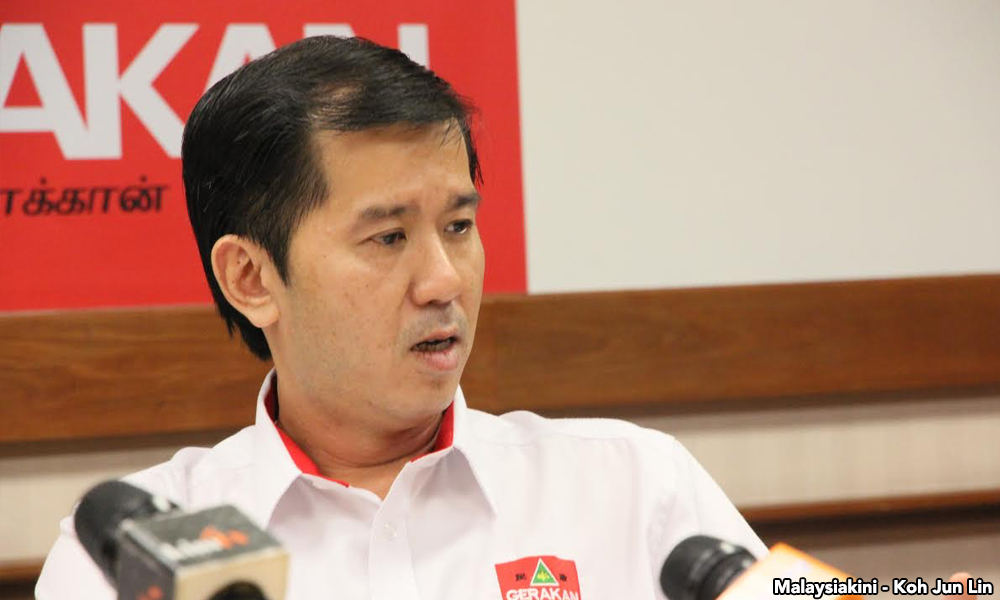 Gerakan Youth deputy chief and lawyer Andy Yong (photo) added: “The Gerakan legal team is currently studying (the matter).
"Due to the involvement of many documents and legal papers, we are going through them in detail before we prepare our relevant statement of claims and the writ. It will take time.”
Meanwhile, Lau questioned the Penang government on the high cost of the feasibility study on the Tanjong Bungah to Teluk Bahang stretch.
Quoting a statement by Penang exco member Lim Hock Seng at the Penang state assembly, he said the feasibility study of the package was cited at RM120.4 million
In comparison, the construction cost of the road is RM377.6 million, whereas the feasibility study for the tunnel was RM96.25 million and this would cost RM3.503 billion to construct.
Lau said the feasibility study for the undersea tunnel should have been higher, as Malaysians are already experts in feasibility studies for roadworks.
“Why is it so expensive in Package 1? It is only 10 kilometres, but the feasibility study is RM120 million. I think the (Penang Chief Minister) Lim Guan Eng-led government has to explain this,” Lau said.
Asked if this may be due to complications caused by the hilly coastal terrain at the stretch, he said the study is merely supposed to determine whether the project is feasible.
“I think it is ridiculous. I think even laypersons - no need for engineers - can also explain that the tunnel is more difficult than the roads over here,” Lau said.
He also urged Penang exco member Chow Kon Yew to explain his admission that the state government had overpaid the contractor Consortium Zenith Sdn Bhd by 17 percent in civil and structural consultancy fees, and why the overpayment was made.
Disclose a detailed breakdown
Lau also urged the Penang government to disclose a detailed breakdown of the project's cost.
Zenith chairperson Zarul Ahmad Zulkifly had said that the company has been paid RM305 million for feasibility studies and detailed design (FSDD) and RM129.6 million for environmental impact assessment (EIA) works, of which RM64.3 million are for civil and structural consultancy.
According to The Malaysian Insight, Chow had already justified the overpayment as "reimbursables and other studies like the road safety audit and other fees fixed in the Registration of Engineers Act 1967, the Notification of Scale of Fees that might not have been taken into account by the Board of Engineers of Malaysia (BEM)".
BN Strategic Communications director Abdul Rahman Dahlan had previously quoted a BEM letter to back his claim that Zenith had been overpaid.
The letter said the maximum engineering consultancy fee is 2.54 percent of a project's construction cost, which comes to RM50.46 million.
Alternatively, different parts of the project may be allocated to different consultants, in which case the rate varies between different packages but comes to RM54.7 million in total.
It added that the fees due up to the Design II stage are only 75 percent of the total fees, or RM37.84 million and RM41.05 million respectively.
The figure excludes feasibility studies but includes preliminary works such as data collection and consultation, design preparation, including calculations and drawings and preparation of specifications, the condition of the contract and quantity surveying.
Meanwhile, Lau questioned the state government for supposedly paying Zenith's FSDD costs in full, whereas the project hasn't even started.
Quoting the Registration of Engineers Act 1967 Scale of Fees, Lau said only 75 percent of the fees are due.
When pointed out that this may be because the FSDD fees may represent work that is already completed, Lau said the Act requires that the payment comes in stages.
"You'd have to pay a preliminary stage 20 percent, design stage 20 percent, tender stage five percent, construction stage 20 percent.
"The construction hasn't even started, but you've already paid in full," Lau said, omitting the Design II stage, where 35 percent of the fees referred in the schedule are due.
Separately, MCA women’s chief Heng Seai Kie said DAP leader Lim Kit Siang should call for an investigation on Zenith’s “exorbitant” fees.
“As a responsible politician who hollers the fight against kleptocracy, DAP stalwart Kit Siang, should request the DAP-led Penang state government helmed by his son Lim Guan Eng to investigate as to why the consultancy fees for three roads for the undersea tunnel is so exorbitant.
“Even before any reports were released, the fees for the said three roads which cost 400 percent higher than the standardised gazette scale by the BEM, were fully paid to the consultant,” she said in a statement today, quoting figures raised by Rahman.
Zarul had previously countered Rahman’s allegations saying that BEM’s figures only refer to civil and structural costs.
It does not include Zenith’s other works such as civil, structural and geotechnical engineering design, quantity surveyor fees, land tunnel design, architectural design, mechanical and electrical works, project management, social impact study, traffic impact study, financial feasibility and funding management, among others.


Are you sure you want to delete this comment?
This action cannot be undone.