

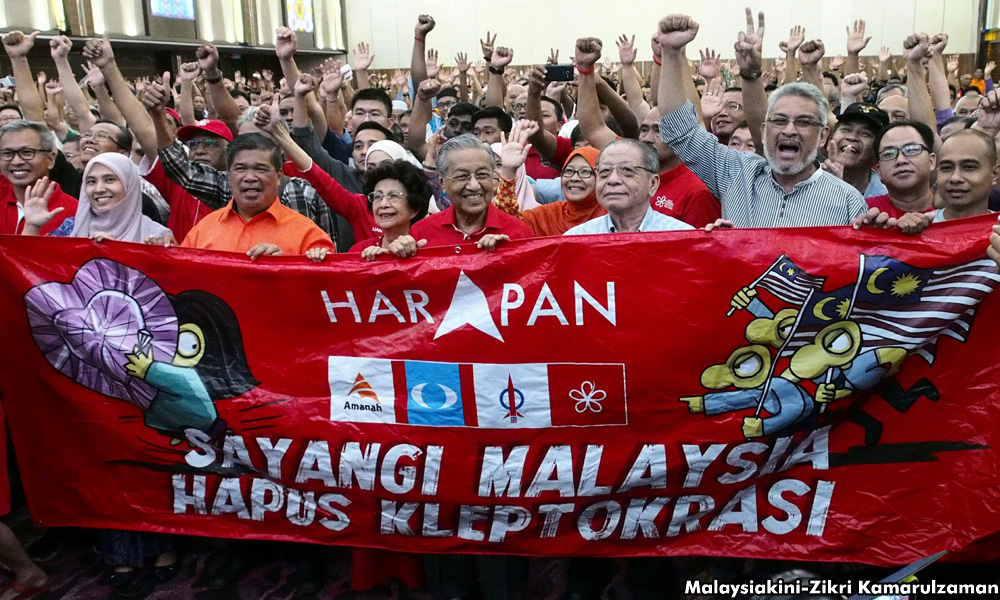
Can Dr M trigger Malay tsunami? Harapan supporters uncertain
Can Dr Mahathir Mohamad and Parti Pribumi Bersatu Malaysia (Bersatu) trigger a Malay tsunami for Pakatan Harapan in the next general election?
While the coalition's supporters are optimistic about Harapan's chances, they were a bit more reserved when estimating just how a big a wave Mahathir and Bersatu could generate.
Malaysiakini spoke to some of them who attended a Harapan ceramah in Shah Alam last night...
Can Dr Mahathir Mohamad and Parti Pribumi Bersatu Malaysia (Bersatu) trigger a Malay tsunami for Pakatan Harapan in the next general election?
While the coalition's supporters are optimistic about Harapan's chances, they were a bit more reserved when estimating just how a big a wave Mahathir and Bersatu could generate.
Malaysiakini spoke to some of them who attended a Harapan ceramah in Shah Alam last night.
Megat Fariz, 42, was more confident about the tsunami than others, predicting that at least 75 percent of Malay voters would swing to Harapan because of Mahathir.
"People are afraid to support the opposition, but with Mahathir around they will support (Harapan)," he said.
However, others at the event were a bit more cautious.
"The possibility is there, but I don't dare to say because I don't want to be overconfident," said Johari Rosli.
Likewise, Vincent Ong was also hesitant.
"To say there will be a tsunami, I'm not too sure, but I believe there will be a swing of Malay votes to Harapan.
"Maybe Mahathir will be able to pull in Malay support, especially in Kedah, Perak and maybe in Johor," he said.
Setiawangsa Parti Amanah Negara (Amanah) member Mohd Zamhuri Abu Tahir, 68 (left in photo), believes a tsunami would be hard to achieve.
"It's more likely that we will just be able to defend what we have," he said.
Sources within Harapan previously told Malaysiakini that the idea of Bersatu triggering a Malay tsunami was among the key reasons to let the Umno-offshoot have a more prominent role in the coalition.
If the opposition wants to win over more supporters, then it must focus on new ground, such as Malay dominated Felda settlements, where the high percentage of BN supporters means there are more people for it to win over.
The opposition has already made significant gains among urban Malaysians, as well as the non-Malays, meaning that their potential to convert more supporters among this voter demography is plateauing.
This can be seen in the results of the last two general elections.
With their efforts focused on urban and semi-rural voters, the opposition made significant gains in 2008, pushing up its popular vote share by almost 14 percent, compared with 2004.
The opposition largely maintained this strategy in 2013, but preaching to the converted meant the pay-off was far smaller. Its popular vote share rose only three percent, compared with 2008.


Are you sure you want to delete this comment?
This action cannot be undone.