


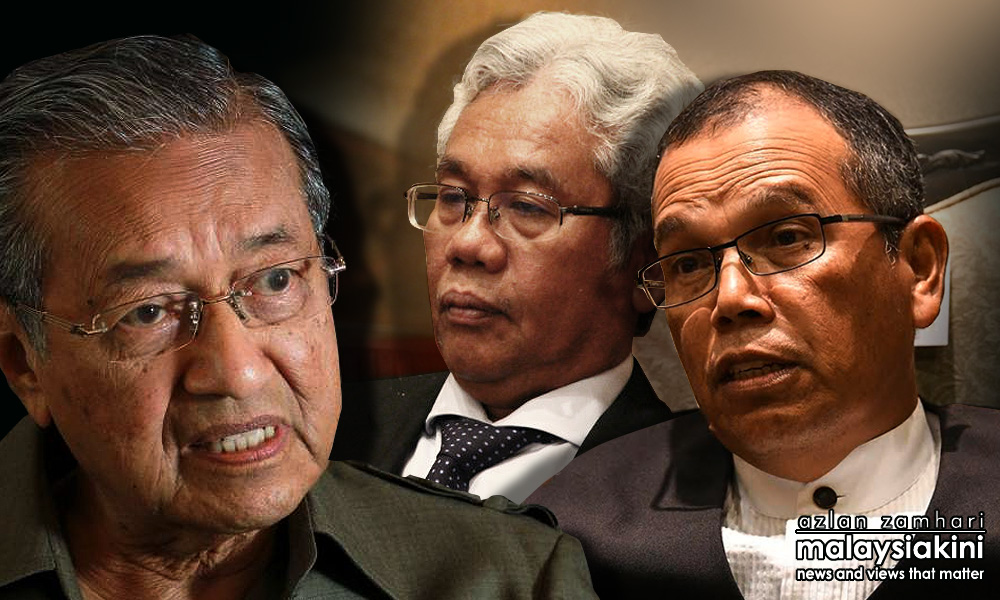

Extensions for Raus, Zulkefli smack of favouritism, claims Dr M
The "unusual" extension of services for two of the country's top judges is a move that will further undermine public confidence in the judiciary, said former premier Dr Mahathir Mohamed.
"It is not as if there are no other candidates.
"It (the extension) has all the earmarks of favouritism... of special favour by the government," said Mahathir who referred to the appointment of Chief Justice Md Raus Sharif and Court of Appeal president Zulkefli Ahmad Makinudin as additional judges in order to extend their tenures...
The "unusual" extension of services for two of the country's top judges is a move that will further undermine public confidence in the judiciary, said former premier Dr Mahathir Mohamed.
"It is not as if there are no other candidates.
"It (the extension) has all the earmarks of favouritism; of special favour by the government," said Mahathir who referred to the appointment of chief justice Md Raus Sharif and Court of Appeal president Zulkefli Ahmad Makinudin as additional judges in order to extend their tenures.
Critics have described the appointments as unconstitutional but the government insists that everything was done by the book.
Retired Federal Court judge Gopal Sri Ram had in April said there are other capable judges to take over the position of chief justice, including Chief Judge of Malaya Ahmad Ma'arop, Chief Judge of Sabah and Sarawak Richard Malanjum and Federal Court judge Hasan Lah.
Writing on his blog, Mahathir further pointed out that a judge who was especially favoured could not be accepted as "unbiased" in his decisions.
"And when the PM (prime minister Najib Abdul Razak) himself is faced with a number of cases before the courts, his clear role in the extension of the term of service of the judges cannot but be regarded as interference in the due process of law in his favour," he claimed.
The Parti Pribumi Bersatu Malaysia (Bersatu) chairperson also claimed that the extensions will give the impression that the judiciary is under the prime minister.
He, however, also said it is not too late to rescind the extensions of the two judges.
"Do that and the independence and impartiality of the judiciary will be restored.
"Failure to do so will mean the condemnation of Malaysia as a kleptocracy, a corrupt country, and the failure of the judiciary," he stressed.
'Interference in judiciary'
On appointments to the judiciary, he reminded that the process is governed by the federal constitution, rules and procedures, so that there would be no suspicions of influence from the executive.
"If these laws, rules, and procedures are adhered to, the trust in the judiciary by the public is ensured.
"But when there is deviation or interference by the political head of government which results in the laws, rules, and procedures being ignored, then the credibility of the judiciary is lost," he said.
During his 22-year tenure as prime minister, Mahathir received international condemnation for his role in the series of events that began with Umno's party elections in 1987 and ended with the suspension and the eventual removal of the Lord President of the Supreme Court, Salleh Abas.
The period was since recorded in history as the 1988 Malaysian constitutional crisis or also known as the judicial crisis.
In an immediate reaction, Youth and Sports Minister Khairy Jamaluddin alluded to the same crisis critics have called the death of independence for the judiciary.
"With all due respect, Mahathir has no credibility to speak about the judiciary.
"(It's) an institution emaciated during his premiership," tweeted Khairy, who is also Umno Youth chief.


Are you sure you want to delete this comment?
This action cannot be undone.