


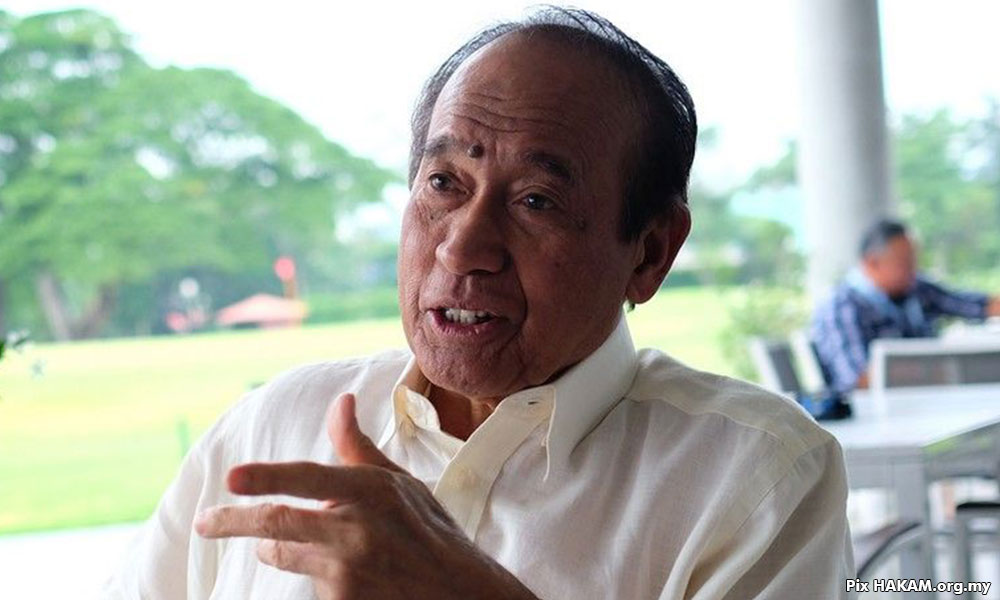

Suhakam unlikely to ever receive enforcement powers, says former chief
Former Human Rights Commission of Malaysia (Suhakam) chairperson Abu Talib Othman believes it is unlikely that the commission will ever be given enforcement powers.
He says this is because human rights, which are often regarded as individual rights, must be balanced with the rights of society.
"The approach of the human rights commission and the government just cannot meet because the government's duty is to protect the rights of the people while human rights are individual rights...
Former Human Rights Commission of Malaysia (Suhakam) chairperson Abu Talib Othman believes it is unlikely that the commission will ever be given enforcement powers.
He says this is because human rights, which are often regarded as individual rights, must be balanced with the rights of society.
"The approach of the human rights commission and the government just cannot meet because the government's duty is to protect the rights of the people while human rights are individual rights.
"If you give powers of enforcement to the human rights commission, there will be chaos," said Abu Talib in an interview with Malaysiakini.
So does this mean that he does not agree with the idea to give Suhakam enforcement powers?
"I won't say that. I will say the government should give due consideration to the recommendations of Suhakam.
"They have done a good job. They made pertinent observations and recommendations," he said.
Abu Talib, who was previously the country's attorney-general for 13 years, served as Suhakam chief commissioner from 2002 to 2010.
He had lamented that the commission was nothing but a toothless tiger.
Without enforcement powers, the commission can only make recommendations to the government relating to human rights.
"When we were there, we strongly recommended the abolition of the Internal Security Act (ISA). Instead (of being listened to), we were severely criticised. I was severely criticised.
"Eventually, the government abolished the ISA, so the government must give due consideration to the recommendation of the human rights commission," he said.
Under his leadership, Suhakam also recommended establishing a selection committee for the appointment of judges.
"No one listened to us at that time but eventually they accepted it. So that's why I said we can only make recommendations.
"It is in that light that I said our human rights commission is a toothless tiger," explained Abu Talib.
Asked whether anything had changed after he left the commission, Abu Talib joked that a lot has changed as the commission seemed to be coming out with more statements.
"The change is they make more statements than me but I don't see any action taken," he said.
Despite various recommendations made by Suhakam with regard to human rights, it has been perceived that the government does not seriously heed the commission’s advice.
Abu Talib's successor, Hasmy Agam had even taken his analogy a step further, saying that the commission was "worse than a toothless tiger".
One example cited by Hasmy then was the lack of genuine consultation with Suhakam by the government before amending or introducing new laws such as the controversial Prevention of Terrorism Act 2015 (Pota).
Apart from this, the government has never debated any of the commission's annual reports in Parliament since the organisation began its work in 2000.


Are you sure you want to delete this comment?
This action cannot be undone.