




Interim plans used to fight haze, says Asean official
Indonesia's failure to ratify the Asean Agreement on Transboundary Haze Pollution need not be a stumbling block for signatory countries to pool resources to overcome the problem, said an official at the Asean secretariat in Jakarta.
Indonesia's failure to ratify the Asean Agreement on Transboundary Haze Pollution need not be a stumbling block for signatory countries to pool resources to overcome the problem, said an official at the Asean secretariat in Jakarta.
Environment division co-ordination and support unit head, Adelina Kamal told malaysiakini that the agreement is currently supported by "interim arrangements" which allows the secretariat to rationalise the agreement.
The agreement, signed in June 2002, binds a group of contiguous states to tackle transboundary haze pollution resulting from land and forest fires.
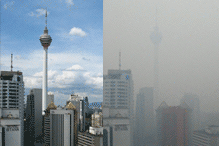 To date only Brunei, Malaysia, Burma, Singapore, Thailand, Vietnam and Laos have ratified the agreement while Indonesia, the Philippines and Cambodia have yet to do so.
"We are not waiting for the ratification to start working. It does not mean the agreement cannot provide the framework for action. To mobilise assistance, all that is needed is a request or offer by any of the signatories," said Adelina in telephone interview today.
"For example, if Indonesia wants help from any other countries it can use the agreement to seek assistance. As what happened last week, Malaysia offered its assistance to Indonesia to overcome the fires in Sumatra and this started a series of talks between the two countries."
She said Malaysia's offer had also spurred Thailand and Singapore's interest and that the secretariat is now in the course of determining the scope of assistance to be provided to Indonesia based on the mechanism outlined in the agreement.
"We have done all that we can to implement the agreement," she assured.
Full ratification
To date, she said, Indonesia has agreed to accept Malaysia's assistance with cloud-seeding exercises which will be implemented this week, as well as investigations against Malaysian plantation companies that are said to be among those behind the open burning in Sumatra.
Apart from that, the signatories have been constantly informed of the latest developments in each country since the agreement came into force in November 2003.
"In terms of reporting and communicating, this has been happening since the agreement was enforced. We have been submitting weekly reports and at the start of the drought season this month we provided daily reports which is also available on the website - another product of the agreement."
She said the report also provided recommendations for action by participating countries to overcome the haze.
As to getting the remaining countries to ratify the agreement, Adelina said that it was difficult to provide a time-frame for this to be achieved since each country faces different problems.
"Indonesia requires its Parliament to approve the haze agreement before it can ratify this. We are informed that the matter is already being discussed by the members of Parliament and that they are expected to make it formal soon. We hope that the ratification will be done by the end of this year."
Changes in the Philippines government have held back the ratification process which was to have been finalised last year.
"But these countries have given a commitment that they will ratify the agreement as soon as possible and we will ask for reports on developments."
No punishment
However, she conceded that there is no avenue to censure, reprimand or punish a member that fails to abide by the terms of the agreement.
"There is no clause for punishment in the agreement. To have such a clause would have gone against the spirit of co-operation of Asean as intended by our founding fathers in 1967," she said.
"To understand this we need to go back to Asean's intention in drafting the agreement - to make sure that governments of the participating countries are more committed in combating the haze."
 She stressed that there are more constructive ways of ensuring that each signatory abides by the agreement, such as through meetings and talks that have been conducted in the past.
"The agreement is to provide a legal framework for co-operation between the countries...not to punish each other. For example when a country reaches a certain standard (in terms of legal and human resources), there is some kind of peer pressure to ensure others keep up."
The agreement obligates member countries to, among others:
* Co-operate in developing and implementing measures to prevent, monitor, and mitigate transboundary haze-related pollution by controlling sources of land and/or forest fires, establishment of early warning systems, exchange of information and technology, and the provision of mutual assistance
* Respond promptly to a request for relevant information sought by a state or states that are or may be affected by such transboundary haze pollution when it originates within their territory;
* Take legal, administrative and/ or other measures to implement their obligations under the agreement.


Are you sure you want to delete this comment?
This action cannot be undone.