




Cyberwar over Ayah Pin
Malaysian cyberspace has been invaded by discussions on religious freedom ever since the issue of Ayah Pin and his band of followers made headlines two months ago.
Malaysian cyberspace has been invaded by discussions on religious freedom ever since the issue of Ayah Pin and his band of followers made headlines two months ago.
Thanks to the mushrooming of numerous threads in weblogs, many commentators have freely aired their two cents worth on the issue that has become contentious from a legal and religious point of view.
 A random survey of nine blogs and online forums revealed views ranging from intellectual debate and creative use of graphic software to calls for Ayah Pin (
photo
) and two self-professed apostates to be lynched.
A random survey of nine blogs and online forums revealed views ranging from intellectual debate and creative use of graphic software to calls for Ayah Pin (
photo
) and two self-professed apostates to be lynched.
One posting attributed the unwavering loyalty of Ayah Pin's followers to the ingestion of 'faeces-filled capsules' and 'water mixed with dog-bone ashes'.
The same blog also posted a comprehensive reference material on deviant teachings in Malaysia including the definition, forms, causes and contributing factors.
 It also posted a list of Muslim deviant groups, followed by
photos
of the 'Sky Kingdom' commune from
malaysiakini
archives since July 2004 (and used without permission).
It also posted a list of Muslim deviant groups, followed by
photos
of the 'Sky Kingdom' commune from
malaysiakini
archives since July 2004 (and used without permission).
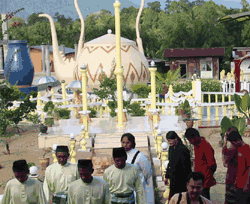
In December 1997, the Terengganu fatwa committee had declared that Ayah Pin - whose real name is Ariffin Mohammad - a deviant and warned the public against any involvement with him or his teachings, which were described as a threat to public order and the Islamic faith.
He went missing just before a raid led by the Besut religious affairs department on his 'Sky Kingdom' commune in Kampung Batu 13 in Hulu Besut on July 20.
Demolition welcomed
Most of the anti-Ayah Pin blogs have postings in Malay or English and are overwhelmingly critical of the 65-year-old native Kelantanese.
 Blogger Mohd Elfie Nieshaem Juferi who claims to promote the free exchange of religious views
lauded
the demolition of several giant structures in the commune, saying that ridding the country of Muslim heretics was a move "long overdue".
Blogger Mohd Elfie Nieshaem Juferi who claims to promote the free exchange of religious views
lauded
the demolition of several giant structures in the commune, saying that ridding the country of Muslim heretics was a move "long overdue".
A number of intellectual discussion threads also warned non-Muslims against discussing or advising Muslims on their religion, such as 'We don't need others' advice about Islam' by Mohd Elfie, whose blog initials are MENJ.
In addition to brief comments peppered with expletives in chatrooms, almost all bayed for Ayah Pin's blood, illustrated by gun-toting emoticons (the Internet version of moods or visual expressions).
Some of the content contained vicious threats and calls to plot the killing of Ayah Pin by cutting him up into pieces and feeding him to pigs.
A few blogs thrived on postings that combined graphic art and religious sentiments courtesy of creative contributors while others expressed surprise over the existence of such a group in Malaysia.
Then, they went on to 'expose' the purported oddities and disgusting habits of Ayah Pin.
 For example, one posted a
satire
comparing the journey of Ayah Pin with that of the discovery of Malacca, insisting that the replicas were built to draw tourists and that the torching of the giant teapot (among other structures on July 18) had in fact prepared hot water for him to make coffee.
For example, one posted a
satire
comparing the journey of Ayah Pin with that of the discovery of Malacca, insisting that the replicas were built to draw tourists and that the torching of the giant teapot (among other structures on July 18) had in fact prepared hot water for him to make coffee.
A campaign on another website carried a logo similar to the government's Tak Nak anti-smoking campaign that read 'Say No! to Ayah Pin'.
There was an invitation for creative contributions from readers including caricatures, cartoons and altered images of celebrity figures, and the changing of the title of blockbuster movie posters and magazine covers.
One blog showed an altered Phantom Menace poster from the Hollywood blockbuster Star Wars trilogy with the title The Pin Menace starring Pin Vader, a Rolling Stone magazine cover featuring the hip-hop king Puff Daddy as Pin Daddy while Che Guevera 'morphed' into Pin Guevera.
Some commentators made Ayah Pin the butt of jokes, using vulgar language to describe him and his followers as "stupid pigs who deserved to be killed" as a stipulated punishment for Muslim deviants. Many advised his followers to "return to the right path" of Islam.
One site that had regular updates on the issue is a news tracker that picks up religious news from all over the world.
The other side
However, a group of cyber-savvy Ayah Pin followers appear to have become fed-up with the brickbats, hate speech and threats over the last two months. They have countered with several blogs of their own.
 The Kuala Lumpur-based group claimed it was disillusioned by the media's badly twisted reports of the words, actions and presence at the commune that they want their side of the story to be heard and for the truth to be revealed.
Speaking to malaysiakini , a follower who wanted to be known only as Julie, cited several reports by the print and electronic media which were said to lack balance.
"The content and slant of the reporting (amounted to) slander and religious incitement," she said.
Citing private station ntv7's Chinese edition of Siasat aired on Saturday evenings, she said its angle on the Ayah Pin issue had been much better than the Malay edition.
"My Chinese friends told me what was aired. Apparently, the programme had asked viewers for their opinion on freedom of religion whereas the Malay edition had demonised (Ayah Pin)and the rest of us.
"At the same time, we're trying to counter the statements made by those who, to us, are irresponsible people," she said, adding that the group's statements have largely been ignored by the country's print and electronic media.
"We are trying to counter many other hate blogs that are creating falsities about us," she added.
Julie said blogs were one way of bridging the gap in understanding over the issue.
 "No one has published our side, so we wanted to give this a try. We're trying to publish the followers' views, personal experiences at the hands of the authorities following the last two raids by the religious authorities.
"For instance, when we ask the public what they know about Ayah Pin, they said he is sesat (deviant), that he claims to be God and that he's murtad (apostate)."
Conceding that some followers may disagree with the blog content, she explained that Ayah was not God but someone they respected immensely.
"We respect him, (we don't) sembah (worship) him," she insisted, although Ayah Pin himself has reportedly claimed to be God.
"He speaks on different wavelengths. Different people have a different understanding of Ayah's indirect speech. Some people do sembah him but only as a show of respect, not as God or anything else."
She said that, although many people have visited Ayah Pin at the commune, "not all get the same understanding" of his teachings.
Ayah Pin remains at large and has reportedly left the country. A number of his followers have been charged with offences under the Islamic criminal code and are awaiting trial.


