


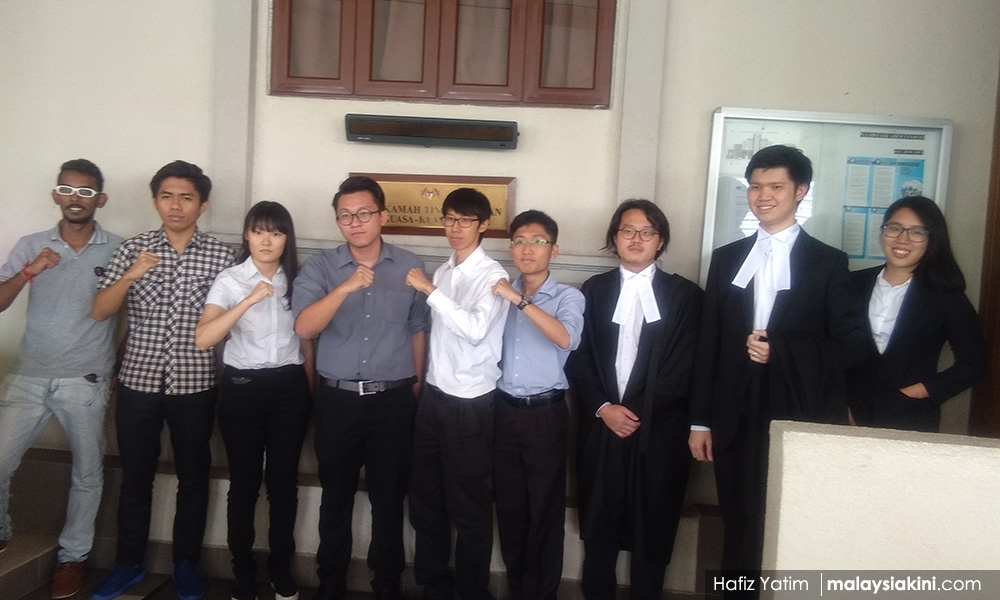

'Students in 1MDB town hall protest merely exerting freedom of speech'
The four Universiti Malaya students who lifted placards at the end of a town hall session on 1MDB were merely exerting their rights to free speech and expression as stipulated under Article 10 (1) of the Federal Constitution, their lawyer argued today.
Lawyer Lim Wei Jiet, who is representing the students, told the High Court in Kuala Lumpur that the students were merely expressing their opinion on an issue of public importance, and did so in a peaceful manner.
“It had not resulted in a situation of indiscipline, disruption of an event or violation of public order or morality,” he said.
The four UM Association of New Youth (Umany) students – former president Ho Chi Yang, current deputy president Tan Jia You, publicity bureau head Chua Hun Ti and secretary-general Lau Li Yang –were sanctioned by university authorities when they raised placards bearing the words “1MDB pulangkan duit rakyat” (Return the people's money 1MDB) at the town hall event in Oct 2016...
The four Universiti Malaya students who lifted placards at the end of a town hall session on 1MDB were merely exerting their rights to free speech and expression as stipulated under Article 10 (1) of the Federal Constitution, their lawyer argued today.
Lawyer Lim Wei Jiet, who is representing the students, told the High Court in Kuala Lumpur that the students were merely expressing their opinion on an issue of public importance, and did so in a peaceful manner.
“It had not resulted in a situation of indiscipline, disruption of an event or violation of public order or morality,” he said.
The four UM Association of New Youth (Umany) students – former president Ho Chi Yang, current deputy president Tan Jia You, publicity bureau head Chua Hun Ti and secretary-general Lau Li Yang –were sanctioned by university authorities when they raised placards bearing the words “1MDB pulangkan duit rakyat” (Return the people's money 1MDB) at the town hall event in Oct 2016.
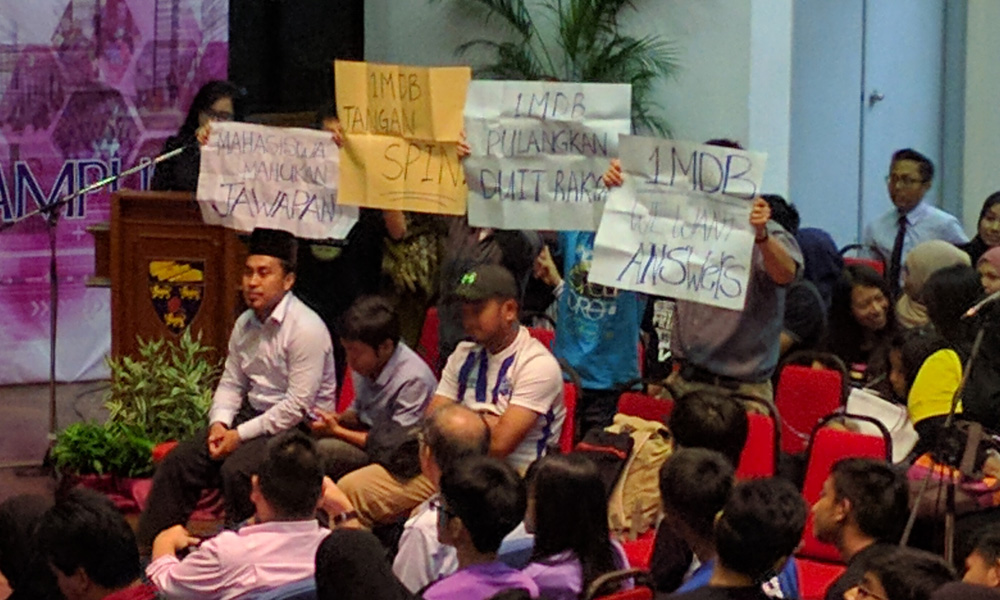
UM's Disciplinary Authority had found them guilty of being detrimental to public order and decency, and interfering in an official university event.
Lim argued, however, that the students had not disrupted the town hall session, which featured 1MDB's president Arul Kanda Kandasamy, as they only lifted the placards at the end of the Q &A.
As such, he said, UM acted irrationally by finding them guilty.
They were initially fined between RM200 to RM600. The fines were removed on appeal but the guilty verdict remained.
Last September, the four obtained leave to challenge UM’s decision, naming the Appeals Committee and UM as respondents.
The four claimed the verdict on them was unconstitutional, as it violated Article 10(1) (a) on freedom of expression.
The students also claim that the provisions of Kaedah-kaedah Universiti Malaya (Tatatertib Pelajar) 1999 are unconstitutional because the same disciplinary authority carried out the investigation, prosecution and judgement.
Lim also said the disciplinary proceedings did not accord to the principle of natural justice, as university authorities had already cross-examined and demanded evidence from the students before they decided that there was a case to answer.
Representing the university, lawyer Adam Abdullah told the court that university authorities could not accept such disruptive behaviour to an event organised on campus.
Adam said the applicants exercised their right to be heard, as it was not the Disciplinary Authority who prepared the initial charge, but the secretariat.
“The charge was prepared by the secretariat. Given the factual matrix, the applicants have been given the due full right to say their case,” he said.
Justice Azizah Nawawi has fixed Jan 23 for clarification or deliver a decision in the case.


Are you sure you want to delete this comment?
This action cannot be undone.