




Amri Che Mat’s wife complains of police inaction after disappearance
SUHAKAM INQUIRY | Norhayati Ariffin, the wife of missing activist Amri Che Mat, has complained of police inaction over her husband’s case at the Suhakam public inquiry.
She said she had lodged two police reports on Nov 25 and Dec 8, 2016, and had her statement recorded by the Kangar-based investigating officer, one Insp Khor, on five occasions.
The police had also collected saliva samples from her and her children, and asked about identifying features on Amri’s body.
Apart from these, however, she said police had not updated her on the case, being repeatedly told that there had been no new developments...
SUHAKAM INQUIRY | Norhayati Ariffin, the wife of missing activist Amri Che Mat, has complained of police inaction over her husband’s case at the Suhakam public inquiry.
She said she had lodged two police reports on Nov 25 and Dec 8, 2016, and had her statement recorded by the Kangar-based investigating officer, one Insp Khor, on five occasions.
The police had also collected saliva samples from her and her children, and asked about identifying features on Amri’s body.
Apart from these, however, she said police had not updated her on the case, being repeatedly told that there had been no new developments.
Visibly trying to hold back tears during her testimony, she voiced her disappointment in the police.
“After over a year since Amri disappeared, I and my daughters are still confused because there is no information or effort by the police on my husband’s whereabouts.
“I am now a single mother and have to raise all four of my daughters singlehandedly, and the youngest one is only 11 years old, and in dire need of a father’s love.
“I had to receive all kinds of insinuations because there is not one clear answer about his disappearance. My husband is a person who likes to help the unfortunate and often brings happiness wherever he goes.
“His loss has a great impact on me, my children, and our family,” she told the inquiry.
The 45-year-old primary school teacher said she hopes that the inquiry would bring truth and closure to her predicament.
Norhayati told the inquiry that in January last year, she had asked Khor about the case's developments at the latter’s office.
In particular, she asked whether the police had erected roadblocks, inspected CCTV recordings, or obtained Amri’s mobile phone records.
“He just said ‘no’. Because they are treating this as a missing person’s case (rather than an abduction),” she said.
Norhayati also expressed scepticism at the police only finding Amri’s fingerprints on a Toyota Fortuner, which was found abandoned in Bukit Cabang in the wee hours of Nov 25.
She and Amri had used the vehicle to fetch their daughter the evening before.
Norhayati said she and Amri’s friends had resorted to conducting their own investigation into her husband’s whereabouts, including asking a car workshop operator near the site where the vehicle was abandoned if he had seen anything suspicious.
She added that the police had failed to do even this.
Later, she stated that Khor informed her about instructions to forward the case to Bukit Aman, but could not provide any further information, including the name of the new investigating officer.
She said she and a group of Amri’s friends then made the journey from Perlis to Bukit Aman and managed to meet several police officers who agreed to speak to her.
She added, however, that the officers there appeared clueless on the details of Amri’s case.
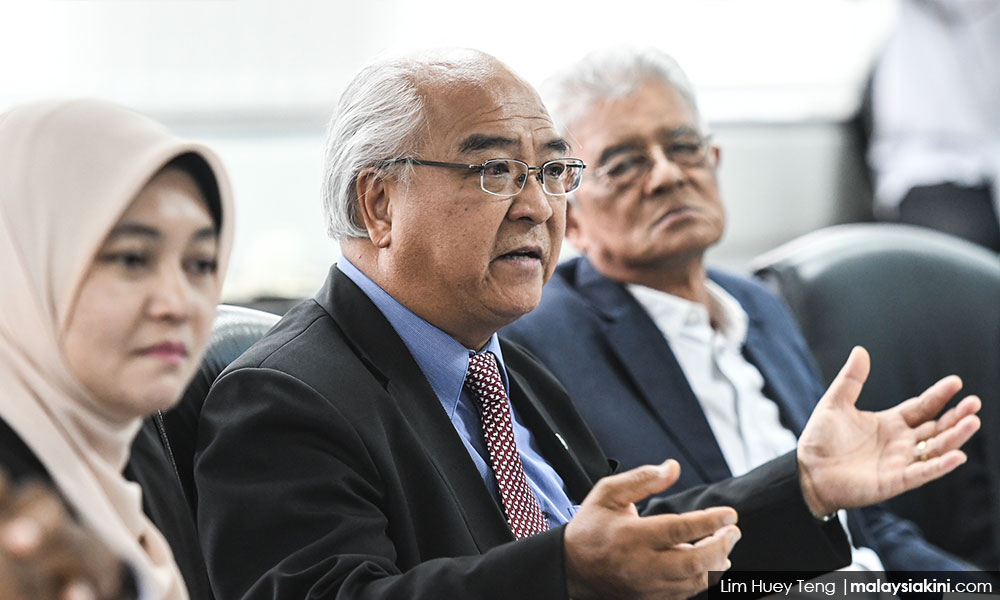
The Suhakam inquiry is chaired by its commissioner Mah Weng Kwai (photo), together with commissioners Aishah Bidin and Nik Salida Suhaila Nik Saleh.
Suhakam is currently investigating whether the disappearances of Amri and two others are “enforced or involuntary,” as defined by the International Convention for the Protection of All Persons from Enforced Disappearance (ICPPED).
This is defined as the arrest, detention, abduction or any other form of deprivation of liberty by agents of the state or by persons, or groups of persons, acting with the authorisation, support or acquiescence of the state.
The instrument was adopted by the United Nations General Assembly in 2006. Malaysia is not a signatory to the ICPPED.
The two other disappearances being investigated are that of pastor Joshua Hilmy and his wife Ruth Sitepu.
The commission had previously been investigating pastor Raymond Koh’s disappearance, but was forced to suspend proceedings when former Uber driver Lam Chang Nam was charged in court for allegedly abducting Koh.

According to Norhayati, she first realised Amri’s disappearance on Nov 25, 2016, when she was contacted by her brother Norhafizal Ariffin at 6am that day.
The night before, she said her husband went to sleep after Maghrib prayers, and asked her to wake him at 10.30pm. After she woke him, she went to sleep herself.
At about 11.30pm, Amri left home, informing their eldest daughter that he was going to see a friend.
Norhafizal later contacted her and said that Amri’s car was found abandoned, before asking if Amri was at home.
When she reached the site at about 8.30am, she said she found out that the car had been stripped of its license plate, road tax sticker, and other documents, such as the car ownership certificate. Nevertheless, she was able to recognise the car based on its damaged side skirt.
There were police officers inspecting the crime scene.
They had found a receipt for tyre replacement and traced it to Norhafizal’s company, to which the car is registered, and contacted him at 5am.
Norhayati said she also learned that Amri was also supposed to meet one Ustaz Jamil at a restaurant on the night he went missing, but Jamil told her that Amri never showed up and was unreachable after 11.30pm.


Are you sure you want to delete this comment?
This action cannot be undone.