


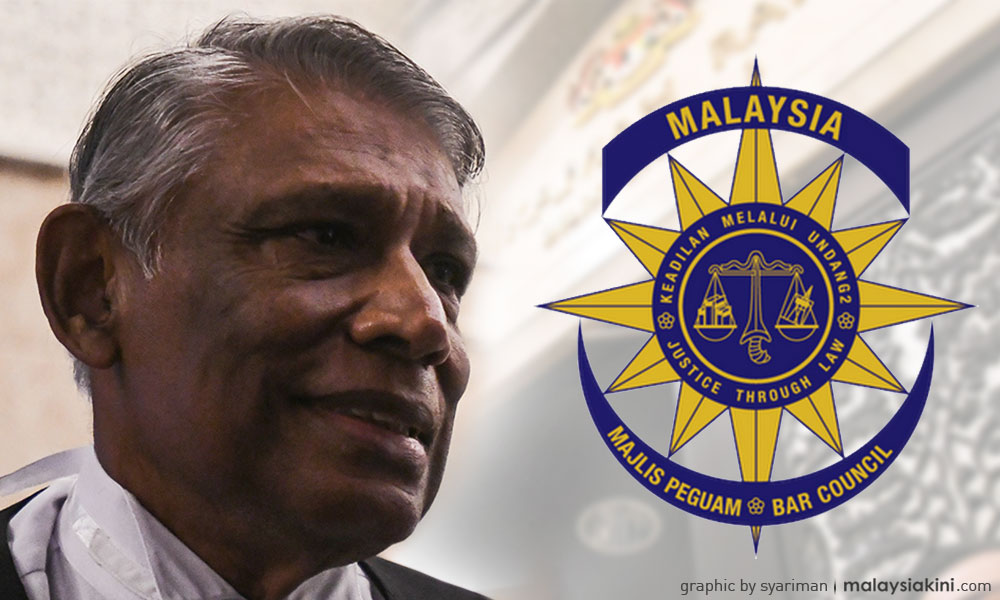

PI Bala's second SD: Court rules no misconduct by senior lawyer
The Court of Appeal today ruled there is insufficient direct evidence for the Bar Council's action against senior lawyer Cecil Abraham, who was alleged to have drafted or prepared the second statutory declaration of the late private investigator P Balasubramaniam in relation to the Altantuya Shaariibu murder.
Justice Tengku Maimun Tuan Mat, who led the three-member bench, said the evidence was not enough to prove the Bar's complaint of misconduct against Abraham, based on a balance of probabilities, let alone beyond reasonable doubt.
"In summary, the complaint and evidence were patchy and largely hearsay and wholly unsafe to warrant a finding of misconduct within Section 94 of the Legal Profession Act...
The Court of Appeal today ruled there is insufficient direct evidence for the Bar Council's action against senior lawyer Cecil Abraham, who was alleged to have drafted or prepared the second statutory declaration of the late private investigator P Balasubramaniam in relation to the Altantuya Shaariibu murder.
Justice Tengku Maimun Tuan Mat, who led the three-member bench, said the evidence was not enough to prove the Bar's complaint of misconduct against Abraham, based on a balance of probabilities, let alone beyond reasonable doubt.
"In summary, the complaint and evidence were patchy and largely hearsay and wholly unsafe to warrant a finding of misconduct within Section 94 of the Legal Profession Act.
"We are unanimous in our view that the appeal (by the Bar Council) should be dismissed. There is no order made as to costs," she said.
The other members of the bench were Justice P Nalini and Justice Mary Lim.
The Bar Council is appealing against a decision made on Dec 2016 by the High Court in Kuala Lumpur to review the Advocates and Solicitors Disciplinary Board's verdict not to take action on Cecil.
The bench was not convinced that an April 4, 2013 letter sent by the Bar to the respondent amounted to a complaint.
Tengku Maimun said that the correspondence only asked if Cecil had any knowledge of the preparation of the second SD, and whether he was involved in its drafting and preparation.
"Cecil's reply was that he was unable to divulge this information, as solicitor-client privilege applied.
"It was then submitted that at the disciplinary committee (that conducted the hearing) that the senior lawyer had altered his stance by denying any involvement in the preparation of the second SD.
"It was submitted that this amounted to a departure and constituted circumstantial evidence warranting an irresistable inference that he had in fact been involved in second SD.
"However, the committee reasoned that Cecil's reliance on solicitor-client privilege was puzzling, until it was explained by the respondent in the course of the hearing that his firm had given advice on the second SD, which warranted invoking solicitor client privilege.
"While we agree that there may be no specific conclusions drawn on the circumstantial evidence whether considered on its own or with the rest of the evidence, it does not establish the misconduct complained of," she said.
The Bar, represented by lawyer Bastian Vendargon, told reporters that they will take instructions on whether to appeal.
Earlier, Vendargon said Cecil's response to the complaint should have been that he did not draft or prepare it, but he invoked solicitor-client privilege instead, and took to denying the allegation later during the hearing.
"If there is no link then the answer should be 'I had nothing to do with it,'" he stated.
Vendargon also claimed the committee had misdirected itself in not finding Cecil liable for misconduct, which itself requires appellate intervention.
Meanwhile, Rishwant Singh, appearing for Cecil, denied that his client citing privilege should be considered as part of his defence, as at that time the senior lawyer was trying to seek a waiver from the client.
He also pointed out the inconsistency in Americk Sidhu's testimony, who first claimed that Cecil had confessed to him, but later agreed during the hearing that he only presumed it was a confession.
"Furthermore we have other witnesses denying such a confession from Cecil to Americk took place," Rishwant added.
Americk was the lawyer who drafted Balasubramaniam's first SD in July 2008.
The former private investigator then retracted the SD, and he and his family went on exile to India for five years and returned in 2013.
Americk had claimed that Cecil had confessed to him that he help draft the second SD on instructions from Najib Abdul Razak, who was then Deputy Prime Minister, which is the subject of the disciplinary proceeding.
Najib has always denied knowing the Mongolian.
The advocates and solicitors board freed Cecil of a misconduct charge two years ago.
RELATED
Najib, wife fail to strike out suit by PI Bala's widow


Are you sure you want to delete this comment?
This action cannot be undone.