
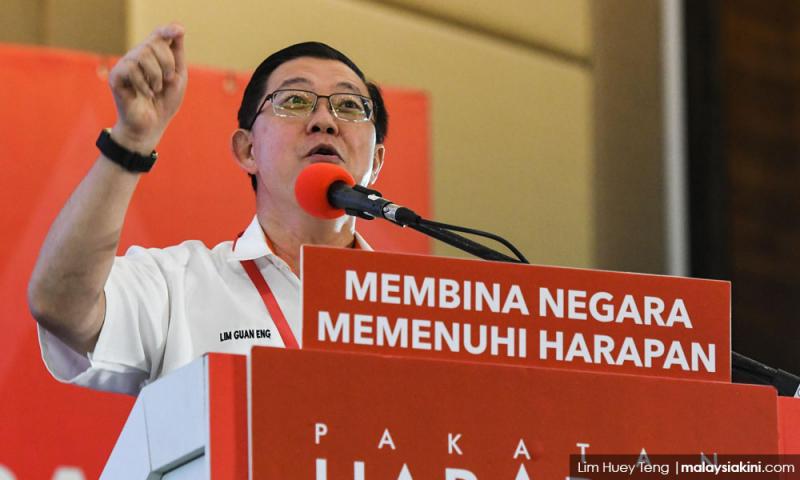
Guan Eng: Harapan can pay BR1M, just follow Penang model
Questions abound over how the Pakatan Harapan government, if it wins power in the coming general election, will be able to continue paying the 1Malaysia People's Aid (BR1M) handouts without money from the goods and services tax (GST).
However, Penang Chief Minister Lim Guan Eng insisted that the Harapan government would be able to continue paying the handouts even if it abolishes the GST, which was introduced in 2015.
"Just do what we do in Penang," said Lim, at a press conference in Komtar today.
"It is not true that only by imposing the six percent GST on the people, we can afford to pay BR1M," added Lim, who is also DAP secretary-general...
Questions abound over how the Pakatan Harapan government, if it wins power in the coming general election, will be able to continue paying the 1Malaysia People's Aid (BR1M) handouts without money from the goods and services tax (GST).
However, Penang Chief Minister Lim Guan Eng insisted that the Harapan government would be able to continue paying the handouts even if it abolishes the GST, which was introduced in 2015.
"Just do what we do in Penang," said Lim, at a press conference in Komtar today.
"It is not true that only by imposing the six percent GST on the people, we can afford to pay BR1M," added Lim, who is also DAP secretary-general.
"We do not impose GST in Penang but still manage to pay out our cash awards to the people - RM130 for senior citizens, RM1,000 for university students, among others.
"How can we do it? It's because we practise a clean governance, open tender system and efficiency. If you want money, easy, do not eat dedak (animal feed) and do not ‘eat money’ (be corrupt)," he said.
Prime Minister Najib Abdul Razak has said that BR1M is not "dedak" but was proposed by Bank Negara in an effort to enable targeted subsidies to be carried out.
Based on Budget 2018, households earning less than RM3,000 monthly will receive RM1,200 in BR1M payment while households earning between RM3,000 and RM4,000 will receive RM900 each.
For singles making less than RM2,000 a month, they will receive RM450.
The BR1M policy was first introduced in 2012 with a payment of RM500 to households making less than RM3,000 a month.
'Why can't cash be paid?'
Lim then cited a case where Najib had promised an RM200 cash award to be paid to newly-born Malaysians.
He was glad upon hearing Najib's promise at first, thinking that he had borrowed the idea from Penang.
However, Lim was shocked to know later that the money would only be banked into the child's account when she or he reaches the age of 21.
"The federal government is big, so why can't the cash be paid to the child instead? Penang is just a small government and yet we pay out cash to those who qualify for the cash awards," Lim said.
He said a similar method would be used to deal with BR1M.
After all, Penang was also known for being able to complete 99 percent of its projects by utilising only 55 percent of its budget.
"In the past 10 years, we never suffered a loss in our budget but had a surplus of RM667 million, compared to RM373 million during the 10 years under BN prior to 2008," Lim said.
During the launch of Pakatan Harapan's manifesto in Shah Alam, Selangor, last night, the coalition's chairperson Dr Mahathir Mohamad belittled Najib's version of BR1M.
Recounting the prime minister's alleged 62 wrongdoings, Mahathir said Najib relied on BR1M and other forms of dedak when formulating his policies.
"Some of the rakyat have been stuffed with these handouts to the point they see nothing, hear nothing and speak nothing," quipped the Bersatu chairperson.


Are you sure you want to delete this comment?
This action cannot be undone.