


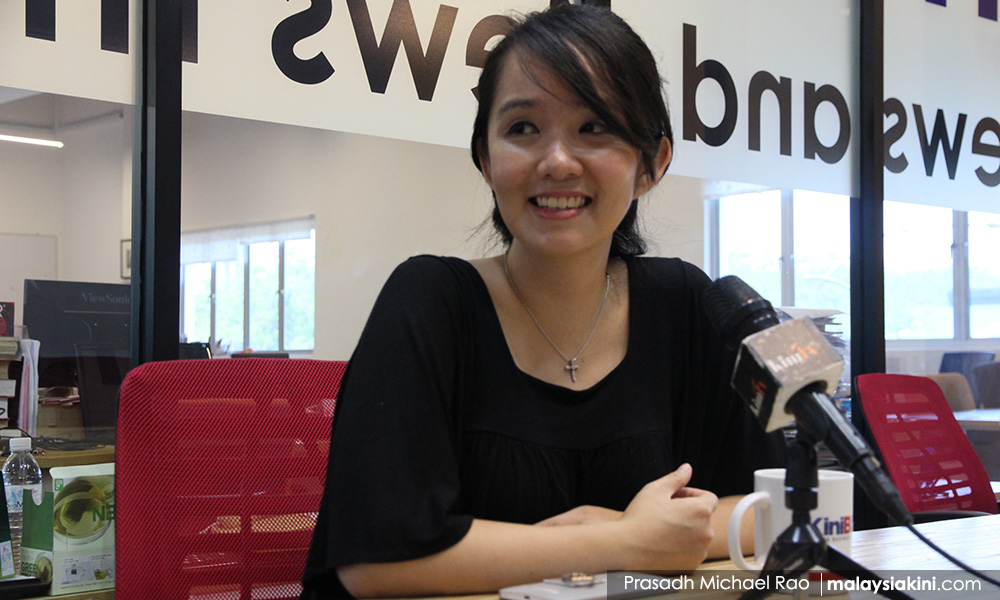

How M'sia's brain drain sparked DAP rising star's political awakening
CALONKINI | For many middle-class Malaysians, the first realisation that something is not right in the country may come relatively late in life.
However, for lawyer and DAP legal bureau secretary Michelle Ng, it came in the form of many unpleasant goodbyes with friends, and her own parent’s attempts to migrate to New Zealand when she was just 12.
Although her parents’ migration plans didn’t materialise, they later encouraged her to remain in the UK after she finished reading law at London School of Economics.
Instead, Ng decided to return to Malaysia following her bar examination in 2013. She became a lawyer in 2014, and joined DAP the following year.
She took on a more active role in the party when DAP found itself in need of more lawyers, so she was roped in to spend her after hours researching electoral discrepancies in Kuala Kubu Baru, and Petaling Jaya Utara MP Tony Pua’s malfeasance suit against Prime Minister Najib Abdul Razak.
In the middle of last year, Ng left her litigation job to join DAP legal bureau chief Gobind Singh Deo’s law firm, and was also involved in drafting and gathering feedback on parts of Pakatan Harapan’s manifesto pertaining to legal reform.
Now 28, she is being considered for candidacy in a Selangor state seat, but a decision on whether to field her has yet to be reached.
This is her story in her own words.
WHEN I WAS 12, I remember my parents taking us on a holiday to New Zealand. What was very curious about that holiday was that my dad started visiting banks to have...
CALONKINI | For many middle-class Malaysians, the first realisation that something is not right in the country may come relatively late in life.
However, for lawyer and DAP legal bureau secretary Michelle Ng, it came in the form of many unpleasant goodbyes with friends, and her own parent’s attempts to migrate to New Zealand when she was just 12.
Although her parents’ migration plans didn’t materialise, they later encouraged her to remain in the UK after she finished reading law at London School of Economics.
Instead, Ng decided to return to Malaysia following her bar examination in 2013. She became a lawyer in 2014, and joined DAP the following year.
She took on a more active role in the party when DAP found itself in need of more lawyers, so she was roped in to spend her after hours researching electoral discrepancies in Kuala Kubu Baru, and Petaling Jaya Utara MP Tony Pua’s malfeasance suit against Prime Minister Najib Abdul Razak.
In the middle of last year, Ng left her litigation job to join DAP legal bureau chief Gobind Singh Deo’s law firm, and was also involved in drafting and gathering feedback on parts of Pakatan Harapan’s manifesto pertaining to legal reform.
Now 28, she is being considered for candidacy in a Selangor state seat, but a decision on whether to field her has yet to be reached.
This is her story in her own words.
WHEN I WAS 12, I remember my parents taking us on a holiday to New Zealand. What was very curious about that holiday was that my dad started visiting banks to have serious discussions.
I found it very odd because we are supposed to be on holiday. I didn’t really understand it at the time, and then I began overhearing my parents talking about getting permanent residency in New Zealand.
My parents’ other friends were in the process of migrating to Australia, and since I was 12, I saw a lot of my friends leaving, one after another. We were always at goodbye parties and it wasn’t very nice.
That’s where I first got the idea that this country is not doing very well and there are greener pastures elsewhere, and that’s why a lot of people were moving out.
IT DIDN’T WORK OUT. I think my mum said: “Look, at the end of the day, your dad still feels that this is home. So, we’re not going anywhere, we are going to make the best of what we have here.”
Years later, when I was studying in the UK, I was encouraged quite a bit by my parents to stay in the UK. Aside from that, my contemporaries had the same idea to set up roots in the UK. So, with those influences, I did consider it. I can’t lie and say that I didn’t.
I applied for jobs there. But in applying for and in answering the interview questions, I began to realise that “This is not where my heart is.”
IT WAS THE MOST DIFFICULT FEELING I HAD TO BATTLE. Almost every single day when I was in the UK and when reading news about home, and with Bersih happening almost every single year at that time, it showed that our government is just not doing very well – I felt very helpless.
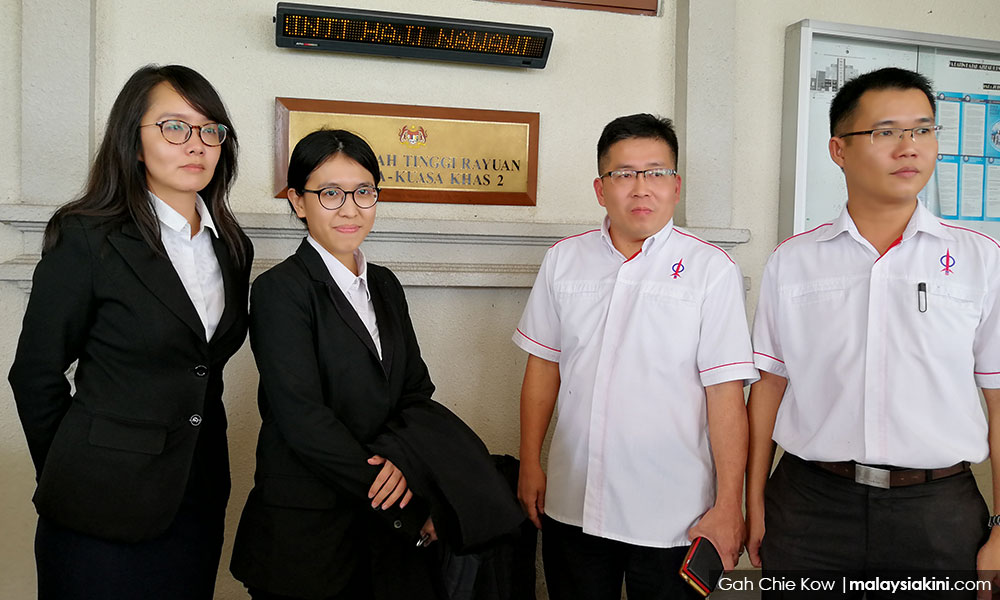
When I was young, I wanted to do law to help people, to help my fellow Malaysians. To then leave them on the back of how I felt and all that happening in the country, it felt like a betrayal, not only to them, but to myself as well.
So I thought, even though the UK felt good – everything there was nice, aside from the weather, which was quite horrible – I felt that I had to come back.
PEOPLE SAY I’M WEIRD BECAUSE OF THIS, BUT I knew that I wanted to do law when I was 12, and I’ve stayed on that course since.
You know when you go to school, you are always made to think about your ambition and what you want to be when you grow up? Mine was basically narrowed down to three things: I want to be a police officer, a judge, or a lawyer.
The common denominator was law. At 12 years old, I knew I wanted to do law, but as I grew older, it also had to do with a lot of other things. I began to see how law is quite necessary in almost everything that we do.
For example, I had a cup of coffee this morning. In drinking that cup of coffee, I’ve basically entered into a contract with the person who sold me that cup of coffee. That transaction is regulated. Driving here, there are road rules that tell me what I can and cannot do.
So having seen how law permeates everything that we do, I began to be quite interested to see how that applies in our everyday life and to be involved in that.
I’VE ALWAYS BELIEVED IN JUSTICE. As children, my parents made sure that we knew to do the right thing in life. So, as the eldest child, I was always told: You have to lead by example.
I was always told to be fair to my siblings. If there is a dispute, make sure you don’t cast the first stone; always be fair to them, always lead by example.
And I wanted to see that for everyone else.
WHEN I WENT TO UNIVERSITY, I still wasn’t sure what I wanted to do with my law degree, so in my first year I narrowed it to three things: being a policymaker, a lawyer, or part of the judiciary.
I told myself when I came back from my first year in university, I’m going to do an internship in all three sectors, and I did. I did an internship in a law firm; I did an internship with the then Federal Court Judge James Foong; I also did an internship with Pua and Ong Kian Ming, who are now MPs for Petaling Jaya Utara and Serdang.

Then I narrowed it down to two choices. I really liked law, I really wanted to practice as a lawyer. I’m very interested in policy making as well, but in terms of planning, that would probably be a long-term thing.
I wanted to develop myself as a lawyer first, and then, when things are more secure, consider policymaking or politics.
WHEN I JOINED, I WASN’T VERY ACTIVE. Not until later in 2015, when a few representatives – state assemblyperson Lee Kee Hiong, as well as Pua, Ong and Gobind – discovered that there were electoral problems in Kuala Kubu Bharu.
Basically the claim was that 5,000 voters who should belong in Batang Kali were moved to Kuala Kubu Bharu, so they thought of filing a suit against the Election Commission.
They needed some lawyers to bring that forward, and Pua got a bunch of lawyers together, which incidentally included me. That’s when I really got stuck in and started to understand the party’s mechanics.
Pua then said, “Look, 1MDB is happening and I’m thinking of filing a suit myself.” That’s how I spent time after work; working with him to understand 1MDB and draft his malfeasance suit, which is coming up for appeal this month, by the way.
I WAS ALREADY INVOLVED IN PARTY LEGAL MATTERS. I was then asked, “We are really short-handed and we need more lawyers. So, will you join us?”
It a difficult leap. Financially, I would be suffering a huge pay cut, about 50 percent. When I was in my previous firm, I was living quite comfortably.
But they said, "It would be good for you to start getting involved in more public interest suits to build your portfolio a little bit more.”
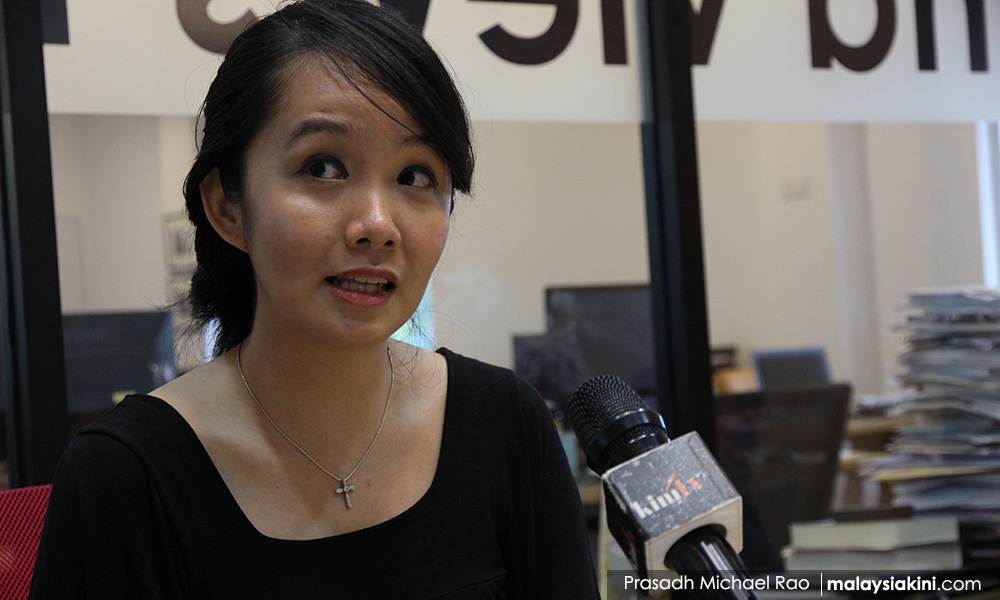
So I told them, “Give me a little time.” After a month I said, “I’ll do this.”
I told myself, I’m still young as a lawyer. I still have no real financial obligations – although I was thinking of getting a new car at the time because mine was nine years old. But I looked at the car and thought, this guy can still last a few more years.
With property and all that, I can still rent. And I’m still living with my parents and don’t really have to move out yet.
Career-wise, I thought to myself, if this ends up being a mistake, I still have time to pivot, I’ll give this a certain number of years, and if at the end of the day things don’t work out, it’s still not too late to rebuild my career.
I decided, can lah. Can take the plunge.
IT STEMS FROM TWO THINGS. I’m passionate about our Federal Constitution. And by that, I mean the basic principles of why and how a country comes into existence.
So when you talk about parliamentary sovereignty, separation of powers and rule of law, it all boils down to that. When you compromise those three things, the country collapses. So, preserving that – not just in the constitution, but in every piece of legislation that we draft and we pass – is very important to me.
I am also passionate about human rights. Because it speaks to the fabric of what makes us human in the eyes of the law. What is required of governance that allows you to be the human you need to be? That you should be allowed to be?
Very basic things like the right to water, the right to clothing, the right to food, etc., that’s what we call ESCR, or economic, social and cultural rights. And then you have your civil-political rights as well – your right to life, access to justice, etc. Fundamentally, these allow us to live as human beings.
So when you align all your policies, all your laws with all these principles, you should have a community that should prosper. When you satisfy all these, things should flow from that.
That informs everything that I do.
CALONKINI introduces new faces from all sides of the political divide who are potential candidates for the 14th general election.
The interviews are not an endorsement by Malaysiakini.
PREVIOUSLY FEATURED
SUPP-rising star from Sungai Apong fisher colony


