


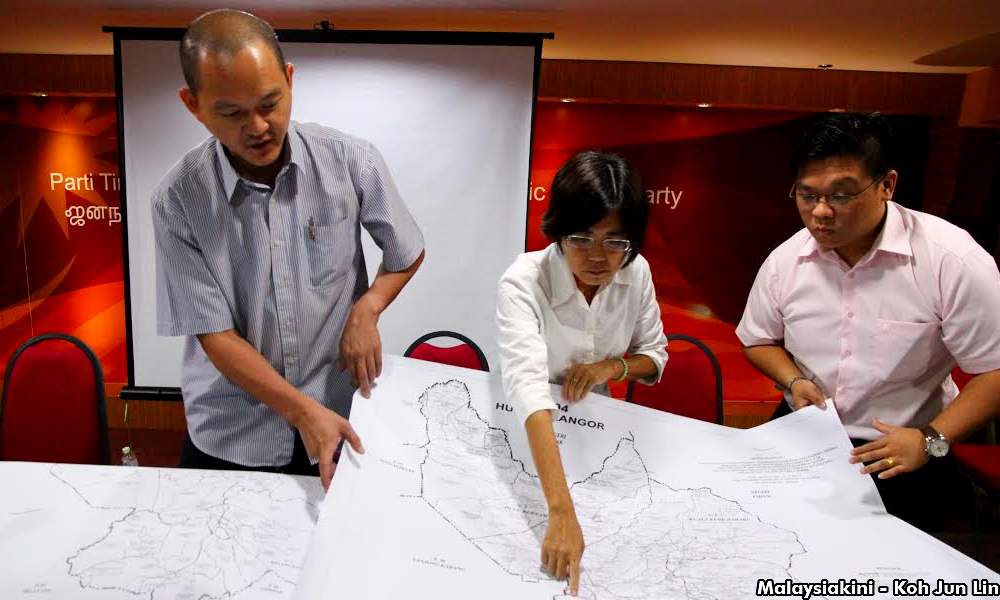

DAP mulls suing EC over 'illegal' redelineation exercise
DAP is mulling legal action against the Election Commission (EC) over what it alleges to be an illegal redelineation exercise.
"We are considering," said Serdang MP Ong Kian Ming when asked at a press conference in Kuala Lumpur today whether the party would take legal action against the EC.
DAP is mulling legal action against the Election Commission (EC) over what it alleges to be an illegal redelineation exercise.
"We are considering," said Serdang MP Ong Kian Ming when asked at a press conference in Kuala Lumpur today whether the party would take legal action against the EC.
When contacted for a response however, EC chairperson Mohd Hashim Abdullah replied with a statement dated two days ago that dismissed similar allegations as ‘unfounded’.
DAP's allegations were made in light of a notice gazetted on April 29, which listed changes to the polling districts and polling centres for federal and state constituencies in Peninsular Malaysia.
However, the changes also supposedly entailed the shifting of voters from one constituency to another, as well the alteration of constituency boundaries.
“What has happened is that instead of just creating new polling districts within the same constituency […] a lot of voters have been shifted from one seat to another and this is something that is illegal,” he said.
Ong claimed this cannot be done under Section 7(2) of the Elections Act 1958 invoked in the gazette, and should have followed the due processes of a redelineation exercise instead.
He urged the EC to restore the electoral boundaries in Peninsular Malaysia to those used in the 2013 general election.
The proper procedure for conducting a redelineation exercise is stipulated under Article 113 (2) the Federal Constitution, read together with Schedule 13 of the Constitution.
“You have to notify the speaker, you have to notify the prime minister, and you have to publish the notification for the start of the delimitation exercise in a newspaper.
”That has not been done because the EC does not want to admit that this is a delimitation exercise,” said Ong.
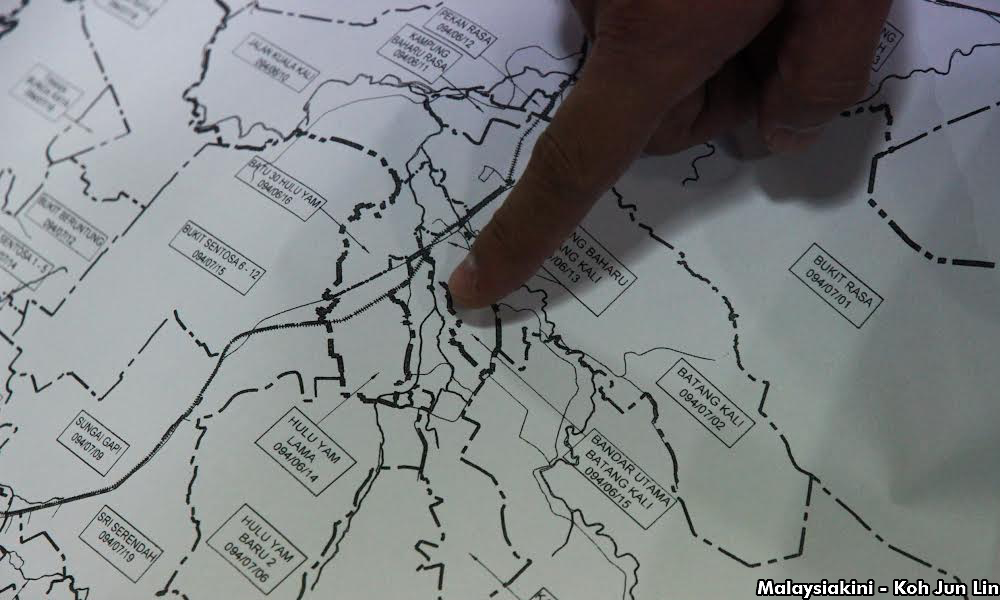 As an example, Ong said 5,590 voters from 40 localities in Batang Kali were moved to the Kuala Kubu Baru state seat in Selangor.
Meanwhile, 56 Kuala Kubu Baru voters were moved from the constituency to Batang Kali, yielding a net change of 5,534 voters.
Umno won the Batang Kali state constituency during the 2013 general election with a 5,398-vote majority, while DAP’s Lee Kee Hiong won the Kuala Kubu Baru seat with a 1,702-vote majority.
The two constituencies make up the Hulu Selangor parliamentary constituency.
“The chances for us to retain this seat is obviously affected,” Ong said.
Ong added that the voters were not informed they had been transferred to another constituency and now have a new elected representative.
“Obviously it will affect our ability to serve our constituents,” he added.
 Lee (photo), who was also at the press conference, expressed concern over the potential confusion that may occur among voters.
“Is it a must for the EC to do something like this which will confuse voters as to their constituency?” she asked.
“The gazetted maps for the 2009 and 2016 Hulu Selangor parliamentary constituencies also show that there has clearly been a change in border in the Batang Kali and Kuala Kubu Baru state constituencies,” Lee added.
Similar changes are believed to have been made throughout Peninsular Malaysia, but DAP is still studying the matter, he said.
EC responds
The electoral reform group Bersih had also raised similar allegations on July 1, and also used Kuala Kubu Baru as an example of the alleged wrongdoing.
In a statement dated July 18, however, the EC chairperson said such allegations are untrue and misleading.
He said the EC had merely updated information regarding polling districts, polling centres, and localities so that the information is up-to-date, in accordance to Section 7 of the Elections Act 1958.
“This is different from redelineation exercises under Article 113 for the Federal Constitution that concerns the boundary of state and parliamentary constituencies.
"In updating polling districts, no changes were made to state and parliamentary constituencies," he said.
He said the EC had found localities that needed to be corrected to its actual location, adding this was usual in any updates to polling districts.
"This happens when there is a discrepancy between the registered location code of the locality, and the actual location of the locality in the field," he said.
He said once the corrections were made, the voters registered to that locality will be reregistered automatically according to their actual location.
“No voters had been moved by the EC in the manner alleged. All voters were registered according to their respective locality, based in the information contained in their MyKad,” Hashim said.
The exercise was gazetted on Feb 12 for Sabah and April 29 for Peninsular Malaysia, he said
Contrary to claims that political parties and voters were not notified of this, Hashim said the EC had used several methods to raise awareness of it.
These include announcements through print and electronic media, letters to political parties, as well as the EC’s website.
Notices were also displayed at all polling districts, he added.


Report this comment
Are you sure you want to delete this comment?
This action cannot be undone.