




Malaysia: A nation with an identity crisis
Malaysia should use the richness of pluralism particularly its multi-racial and multi-religious composition to address discord in conflict areas elsewhere, said a human rights activist at a conference today.
Malaysia should use the richness of pluralism particularly its multi-racial and multi-religious composition to address discord in conflict areas elsewhere, said a human rights activist at a conference today.
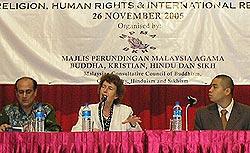
But first, said Netherlands-based Centre for Dignity and Rights programme director Dr Berma Klein Goldewijk, Malaysia must place top priority on the elimination of humiliation.
"This involves political parties, religious leaders, the legislature and the people themselves," she said at the conference on 'Religion, Human Rights and International Relations' in Kuala Lumpur.
She said many countries including Malaysia were faced with an identity crisis.
 "This seems to be the most critical fundamental issue relating to the government and society and when addressing new identity formation, it is impossible to avoid the sensitive issues.
"(This is) particularly the politicisation of identity and ethnicity which is associated with the tension between 'us and them'."
The day-long event was jointly-organised by the Malaysian Consultative Council of Buddhism, Christianity, Hinduism and Sikhism and the Global Human Rights Defense.
Goldewijk also noted that some Malaysians were concerned over whether Muslim men, Muslim women, non-Muslims and the minorities will all have different rights.
Some, she said, asked why those with equal status, rights and fundamental freedoms would want to support the creation of an Islamic state and whether this would serve a plural society.
Yet others questioned whether an Islamic state necessarily meant an authoritarian and theocratic political system.
"My point is this. Fundamental freedoms, human rights, democracy and religion can very well co-exist but only if difference and plurality does not collapse."
Any meaningful intercultural exchange, she said, must be firmly anchored in "a common and practical agreement on human dignity.
Equality before law
Speaking on 'Moving Beyond the Us-Them Divide', Goldewijk said human dignity, with humiliation or injury to self-respect as its downside, is founded on the principle of equality before the law.
 Drawing from extensive research, she found that racial and ethnic identities were increasingly linked with religious and cultural loyalties, becoming one of the most determining factors in present-day discrimination.
For Malaysia, she said that upholding the diversity and plurality of religions was the key to oppose discrimination, racism, xenophobia and intolerance.
"The problem is, a majority of the people don't know their rights and fail to see that human rights are a protective shield."
Several participants also noted the failure of the judiciary in upholding constitutional rights within the international framework because it lacked independence.
On the state of the Malaysian civil society, physician Dr Mahendran Markandoo firmly believed that only a strong civil society can provide the much-needed checks and balances.
"It is extremely important for the common (person) to be empowered and for this the civil society must be strengthened.
"The dignity of the people, slowly stripped off by the previous leader, must be restored and their self-esteem must be enhanced.
"Only then will Malaysians have the courage to speak out against injustices."
Mahendran argued that organised religion, like organised crime, was the source of social strife the world over because religion was widely used as a tool of control and to gain power.
"I remember the MCCBCHS pledging full support for the ruling party (Barisan Nasional). But what was the demanded exchange? We're still talking about the same problems today."
Various conflicts
Human rights lawyer K Shanmuga, a member of the council, illustrated the various conflicts sparked by civil and syariah court decisions in family matters.
"The syariah courts have usurped the powers of the civil courts that in turn affects the rights of non-Muslims."
He said in some cases, the plaintiffs had been told to seek help from Parliament or the Islamic authorities because the judiciary is unable to overturn orders by the syariah courts.
The council, he said, wants the government to create a formula which allows non-Muslims to live and practice their chosen faith and not to deprive them of their rights.
He quickly added that Muslims were also faced with similar problems as seen in a case in Negeri Sembilan where a father went to court after his young son was prohibited from wearing the serban to school.
"I personally think that these conflicts are about political power and to crush dissent. It appeals to populist sentiments to whip-up a religious fervour.
"Society and communities must stand up and tell the government to stop using religious sentiments for political mileage or to win elections," Shanmuga said.
On this point, Mahendran suggested that the civil courts be restored their place as the supreme decision making bodies, just as it was prior to the judiciary's darkest period in 1988 when a massive shake-up by the chief executive had resulted in a tame judiciary since.


