




Corruption: Don't just blame civil servants
Anti-corruption efforts should not solely be aimed at the civil service as it also entails an individual response from each and every Malaysian.
Anti-corruption efforts should not solely be aimed at the civil service as it also entails an individual response from each and every Malaysian.
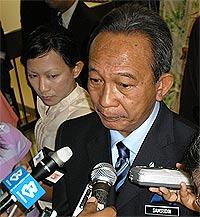 Chief secretary to the government Samsudin Osman said many "hard-working and obedient" civil servants are facing a lot of pressure just to earn an honest living.
"Naturally, the focus would fall on civil servants and public officials as they hold the power and authority that affect ordinary people's lives.
"But do we put the entire blame on the civil service? Aren't they too, as a sub-system, part of the same psyche?"
To illustrate the point, the country's top civil servant asked the 200-odd crowd at the Malaysian Integrity Institute (MII) how many had sought 'help' when caught for an offence.
He cited different scenarios to show that desperation almost always bred corruption.
Samsuddin who is also MII chairperson said many ex-civil servants who were now with the private sector also relate to him about problems in getting applications approved.
"They tell me about having to pay many 'tolls' to get things done but when I asked for details to do my own checks, they refused to say anything for fear of ruining their business.
"And this is despite repeated re-assurances of confidentiality. The point is that, just lamenting and complaining about it is not enough as long as no one is willing to provide information."
He was giving a luncheon talk in conjunction with an International Day Against Corruption celebration jointly-organised by Transparency International Malaysia, United Nations Development Programme and the MII.
First organisation winner
 To the music of
The X-Files
, he later launched the black-and-white ribbon signifying that corruption is a clear-cut issue that should be considered as a cancer and a sin.
To the music of
The X-Files
, he later launched the black-and-white ribbon signifying that corruption is a clear-cut issue that should be considered as a cancer and a sin.
In addition to the anti-corruption ribbon, TI Malaysia's monograph series was also launched at the event.
TI Malaysia president Param Cumaraswamy also announced Penang-based human rights group Aliran as the winner of the Integrity Award 2005, the first time for an organisation.
In his acceptance speech, Aliran president P Ramakrishnan gave a lengthy narration of alleged corruption and selective prosecution cases.
He also proposed for the ACA to be made answerable to Parliament, get political contributions and public officials' assets declared and appoint an ombudsman, among others.
Speaking to reporters later, Samsudin said the concern was over negative perceptions created by corrupt civil servants which promote "a culture of double standards".
The giving of gifts was cited as another practice which usually led to corruption although some, he said, argued that it was part of local culture.
"I think we shouldn't be giving or asking for gifts. As civil servants, we are all paid to do our job to serve the public. The danger is when the gesture turns into an expectation."
Referring to the National Integrity Plan, the government's anti-corruption blueprint, he said it was an attempt to reach out to the media, academia, private sector, politicians, entertainers and non-governmental organisations.
Black sheep everywhere
"The government cannot do it alone. There must be enough loud voices and courage in society to say 'no and if you say there are other givers or takers, think about this. If everyone says no, then who's left?"
 He said even the professionals with their strict code of ethics and professional conduct were not spared from the scourge because they also had their black sheep.
"It is my firm belief that the responsibility for turning Malaysia into a corruption-free society lies on each and every one of us. It is a long, arduous and daunting task which cannot be undertaken by the government alone.
The Higher Education, Education and Women, Community and Family Development ministries have been tasked with raising public awareness among the youths.
At the function, a group of Taylor's College students gave a 30-minute skit depicting three scenarios commonly associated with corrupt practices.
Also present were MII president Dr Sulaiman Mahbob, Policy, Advocacy and Research Task Force chairperson Anwar Fazal, UNDP resident representative for Malaysia, Singapore and Brunei Dr Richard Leete were also present.


