



'Clean government gets 0.65 pct interest bonds, kleptocrats 7 pct'
BUDGET 2019 | Finance Minister Lim Guan Eng has touted the favourable bond conditions offered by Japan as one of the benefits of choosing a “clean and democratic” government over a kleptocracy.
He said the coupon rate for the 10-year Samurai bonds being offered by the Japan Bank of International Cooperation and guaranteed by the Japanese government is 0.65 percent, and such low rates are more typical of five-year bonds.
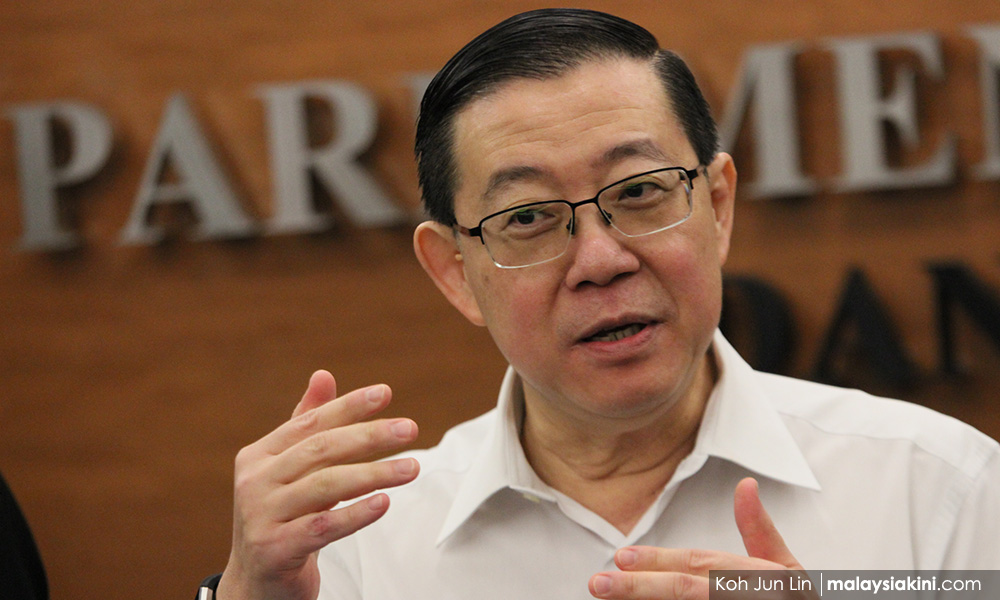
“The kleptocrats got six, seven percent; the clean one gets 0.65 percent. That is the difference between a kleptocracy, and a clean and democratic government,” he told a press conference at the Parliament building today.
Lim added that the low rates were offered out of the Japanese Prime Minister’s (Shinzo Abe) respect for his Malaysian counterpart Dr Mahathir Mohamad...
BUDGET 2019 | Finance Minister Lim Guan Eng has touted the favourable bond conditions offered by Japan as one of the benefits of choosing a “clean and democratic” government over a kleptocracy.
He said the coupon rate for the 10-year Samurai bonds being offered by the Japan Bank of International Cooperation and guaranteed by the Japanese government is 0.65 percent, and such low rates are more typical of five-year bonds.
“The kleptocrats got six, seven percent; the clean one gets 0.65 percent. That is the difference between a kleptocracy, and a clean and democratic government,” he told a press conference at the Parliament building today.
Lim added that the low rates were offered out of the Japanese Prime Minister’s (Shinzo Abe) respect for his Malaysian counterpart Dr Mahathir Mohamad.
He said this when asked to elaborate on the ¥200 billion (RM7.4 billion) Samurai bonds he mentioned in his budget speech yesterday.
Specifically, he was asked whether this would increase Malaysia’s exposure to changes in foreign exchange markets, and what Malaysia intends to do with the money.
Lim said the use of the funds is still being discussed, but one possible use is to use money raised through the Samurai bonds to repay foreign-denominated debts that have higher interest rates such as 1MDB’s debts.
“For instance, if you talk about substituting the other foreign-denominated loans, then that would overcome the problems that you raised (about foreign exchange exposure).
“Or, if you want to talk about the existing 1MDB loan which has a very high interest rate - six or seven percent compared with 0.65 percent - (then) you can see the difference,” he said.
Monitor movements
He added that a 10-year bond also allows the government to spend three years to monitor movements in the currency market and repay the bonds when the Yen exchange rate is in Malaysia’s favour.
In contrast, a five-year bond would not allow such room to manoeuvre, he said.
In his speech yesterday, Lim said the bonds would be issued by March next year, and the 0.65 percent coupon rate is an indicative rate.
On another matter, Lim said the increase in the government’s operating expenditure is only because of allocations to pay arrears in GST and income tax refunds.
“If you look at the budget, the operating expenditure did not increase. Instead, what has increased is development expenditure which was raised to RM54.7 billion,” he said.
He said the estimated funds required is RM37 billion. This is higher than the RM34.5 billion he had previously cited because there would be more income tax claims filed between May and the end of 2018, he said.
“It is not an unusual increase,” he said.
Under Budget 2019 proposal, the federal government’s operating expenditure is projected to reach RM259.85 billion – an increase of 10.93 percent.
If the RM37 billion is deducted, however, the expenditure comes to RM222.85 billion. In comparison, the estimated operating expenditure for 2018 is RM11.4 billion higher at RM234.25 billion.


Are you sure you want to delete this comment?
This action cannot be undone.